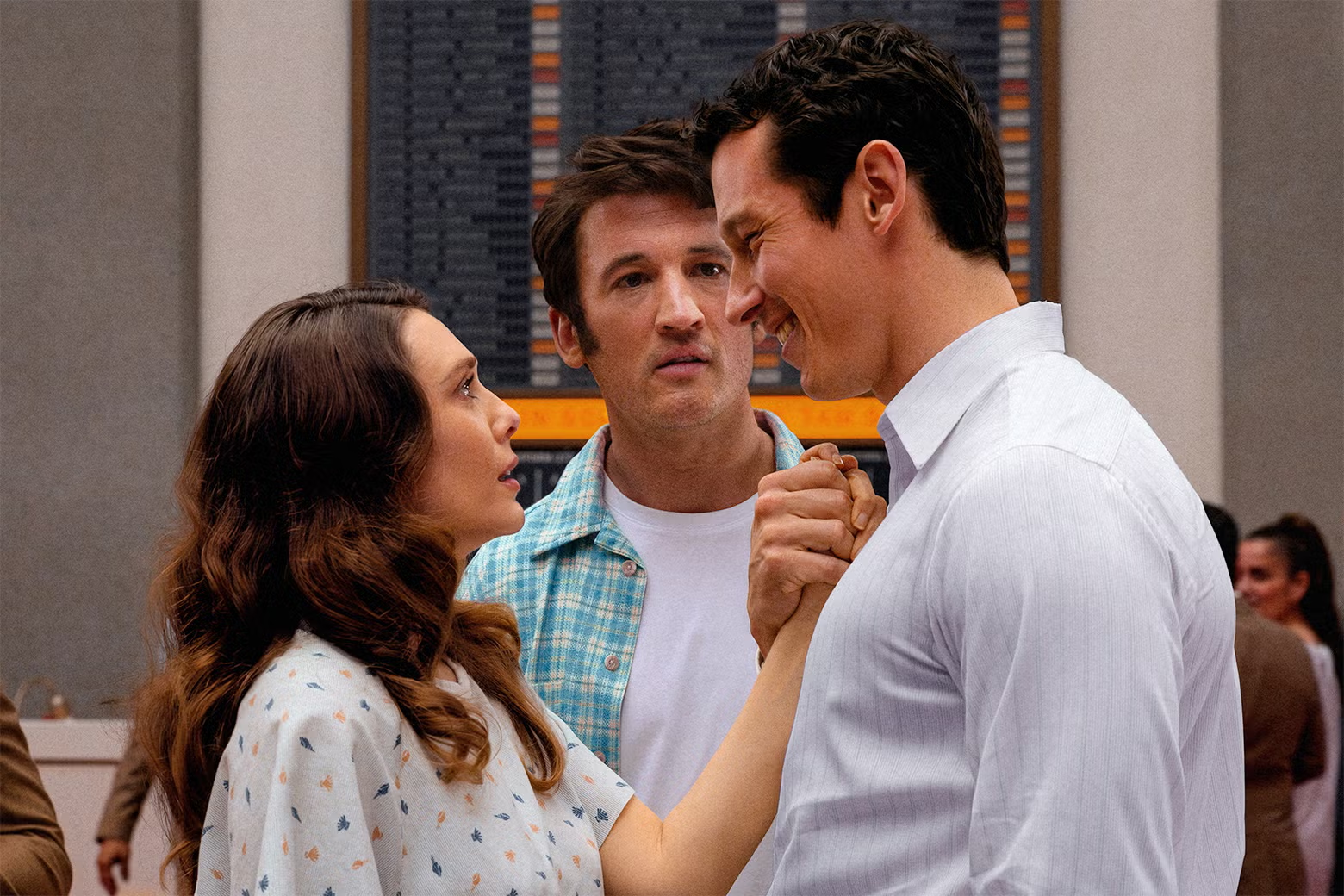
The Summer I Turned Pretty and Materialists made for strong indicators, but Eternity seals it: This has been the year of the unsatisfying love triangle. As my colleague Nadira Goffe has written, good love triangles in popular culture are increasingly a lost art. Eternity, the romantic comedy starring Miles Teller, Elizabeth Olsen, and Callum Turner that hit theaters last week, initially seemed to have the potential to overcome the pitfalls of the trope, thanks to a clever premise with real stakes: Upon dying in her 80s or thereabouts, Joan (transformed back into her younger self, as played by Olsen) must choose which of her also-dead husbands she wants to spend the afterlife with, the man with whom she shared six decades and a family (Teller, as Larry) or the one who died tragically young, before they could have any of that (Turner, as Luke).
The resulting film is pretty darn cute; when it comes to streaming, it will be a strong contender for the distinction of “movie I recommend to girlfriends looking for something to watch on planes,” and I don’t take that lightly. But as is often the case, what keeps it from being truly great has a lot to do with how the love triangle is resolved. Which is a shame, because it’s obvious how Eternity should have ended.
Eternity’s version of the afterworld is a pretty rigid place. After death, people arrive to something like a train station–meets–hotel–meets–convention center, where they learn about the various realms of the hereafter that could be their permanent destinations if they so choose, places like Space World, for astronomy enthusiasts, or Paris World, where it’s always Paris in the 1960s (only everyone speaks English with a French accent). Once someone makes their choice, they can’t change it or see anyone in any of the other worlds again, so Joan must decide: Mountain World with Luke or Beach World with Larry.
If you’ve seen the trailer, you pretty much know how things will shake out. Ditching her husband of 60-plus years, even if he can be a bit of a drip, was never a real option. Luke is suave and he has waited for Joan all these years, but he’s also practically a stranger. A few late reveals attempt to make him less wonderful than he appears at first, though they aren’t entirely convincing. It was always going to be Larry. And while the movie seems as if it’s over at about three different points, it gets there, eventually. Even independent of the logic of the plot, there’s the logic of Hollywood: Teller is higher on the food chain than Turner, i.e., more famous and therefore unlikely to play second fiddle to him, no matter how fast the handsome Brit seems to be shooting up in the internet-boyfriend rankings in the wake of his recent engagement to pop star Dua Lipa.
The movie waves away the notion that Joan, Larry, and Luke could all go to the same place for eternity. No, she has to pick, because … she just does? It’s not explained sufficiently why that wouldn’t work. Going to the same afterlife would let Joan put off making a decision until she knows Luke better, or never make a decision at all and be with both of them. It makes sense to me why “Just be married to two people” isn’t usually a realistic solution for us mortals, not least of all because the government tends to be a little fussy about that kind of thing. But must everyone continue to follow such strict conventions in the great beyond? “Till death” is right there in “Till death do us part”—once you’ve died, the nature of your relationship can and should change! I might submit that the best thing for the three would be to all live separately in paradise, enjoying their freedom and doing only what they want to do. Maybe this eventually won’t include being involved romantically at all, but at least this option would give them a structure to figure that out in their own time.
Heather Schwedel
I Never Expected the Most Controversial New Movie Ending to Be … in an A24 Rom-Com?
Read More
Would Larry and Luke be cool with all this? They might, actually. For members of the Silent Generation, they’re surprisingly un-possessive. When they first meet, before Larry knows that Luke is Joan’s first husband, they get along well. The reveal throws them for a loop, but eventually they get back to being buddies. At one point, when it looks as if Joan isn’t going to choose either of them, it even seems possible that they might pick each other, so strong is their bond. When Luke mentions later that he has had dalliances with men in the 65 years he’s been waiting for Joan, it adds fuel to this reading. Polyamory may genuinely be a path worth considering here!
Here on Earth, poly people have a reputation for talking about being poly a little too much, but this movie makes the crucial error of not talking about it enough. I don’t know why Eternity’s vision of everlasting life has such a scarcity mindset, but I wish its characters had pushed back on it: The more the merrier, especially when you have all the time in the world.