Good morning. There’s less than two weeks left to stake your claim in the bread price-fixing settlement. Today, we’ll look at who qualifies, how much you might get and how to apply before the clock runs out.
Up first
In the news
Mining: Barrick Mining Corp. is exploring an initial public offering of its North American mines, bowing to pressure from shareholders to take action after years of stock market underperformance.
Culture: A joint bid by the Thomson and Weston families is set to prevail in their $18-billion bid to buy the 1670 Hudson’s Bay charter, and will donate it to four cultural institutions to keep it in Canada and accessible to the public.
M&A: Fairstone Bank of Canada will buy peer Laurentian Bank in an all-cash deal valued at $1.9-billion, the lender announced this morning.
Airlines: Pierre Karl Péladeau has launched a battle for control of Transat AT Inc., calling for the ouster of the company’s chair and a top-to-bottom review of its operations and direction.
Manufacturing: Algoma Steel is laying off more than a third of its work force as the U.S. trade war effectively blocks the company from exporting south of the border.
Open this photo in gallery:
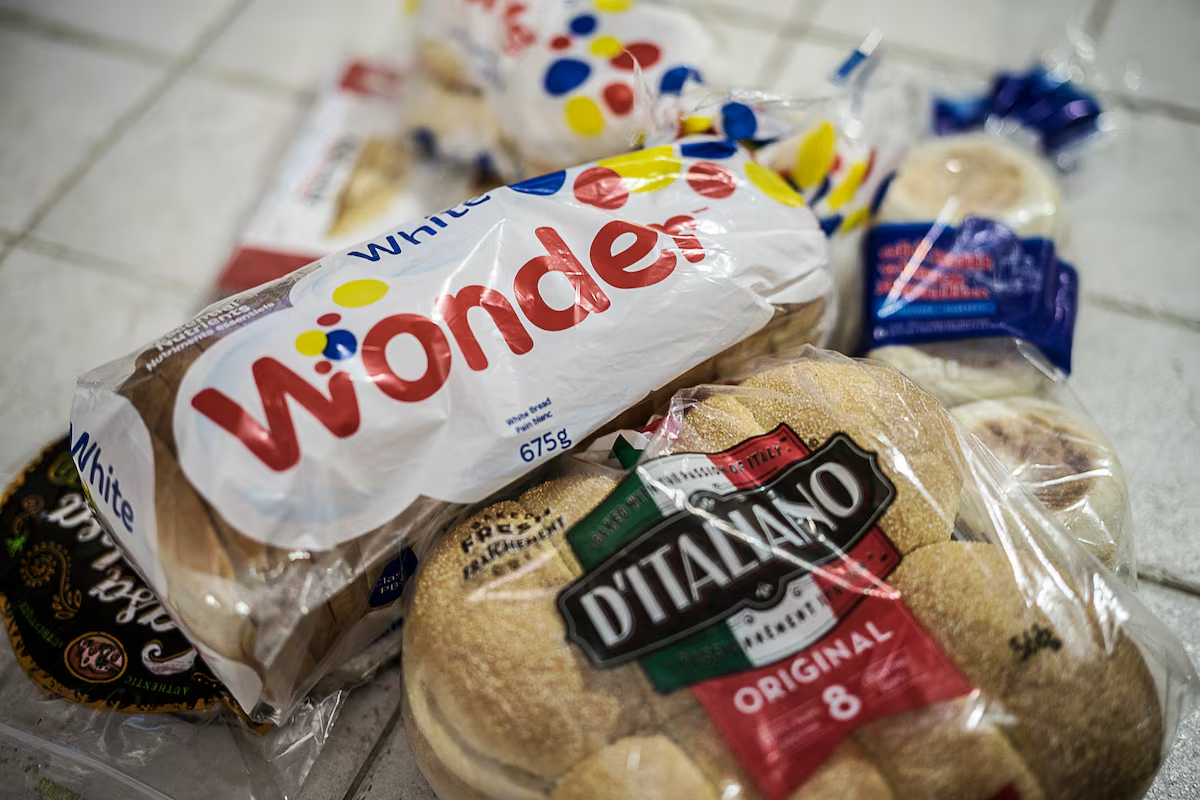
Sliced bread: The baseline for best things since 1928.J.P. Moczulski/The Globe and Mail
In focus
Get that dough: What to expect and how to apply
The deadline (breadline?) is just around the corner for Canadians seeking a piece of the $500-million settlement over an alleged bread price-fixing scheme. More than a million people have already filed claims ahead of the Dec. 12 cutoff.
Loblaw and its parent company, George Weston Ltd., agreed to the settlement to resolve two class-action lawsuits – one in Quebec and one representing the rest of Canada – that together addressed bread price-fixing across the country.
The two companies received immunity from criminal prosecution after reporting the conduct to the Competition Bureau in 2015. The bureau’s investigation into other businesses continues.
So what does this all mean for shoppers – and how much money could you actually get? Retail reporter Susan Krashinsky Robertson walks us through the basics.
First of all, where do I apply?
How much money is on the table?
About $268-million remains available for consumer compensation after accounting for the 2018 gift cards, legal fees and administrative costs. That said, it’s tough to do the math until we know how many people file before the Dec. 12 deadline, how many of them already received gift cards and how that all breaks down by geography.
The short answer: You’re unlikely to fund your next vacation with this money. Still, it’s not nothing.
To give you an idea of how it will work, here’s a hypothetical example: Let’s say three million eligible Canadians participate and half already got gift cards. (For our purposes, we’re going to assume the proportion of people in the settlement who applied for the gift cards in 2018 is the same in Quebec as in the rest of Canada. Remember, those are two pools of money that will each get their own calculation, so it almost certainly won’t be this cleanly divisible. But just to keep things simple.)
That would mean:
- about $102 each for those who never received a gift card
- about $77 each for those who previously received a gift card
But these estimates are far from precise. If fewer people register, the per-person payment would be higher – or lower if lots of eligible Canadians fill out the form. With over a million submissions in the first week alone after registration opened in September, expect the final figure to be more modest than some might hope.
Who is eligible to claim?
Any Canadian resident who bought packaged bread – at any grocery store in Canada, not just Loblaw banners – between Jan. 1, 2001, and Dec. 31, 2021, can apply. (For Quebec residents, the period ends Dec. 19, 2019.)
You do not need receipts.
If you redeemed one of those $25 gift cards in 2018, you can still apply – you’ll just receive a bit less than people who didn’t. Priority is given to shoppers who didn’t receive that initial compensation. Once they’ve been allocated up to $25 each, the rest will be divided among the entire group.
It’s unlikely those first in line would consume the whole settlement; more than 10 million eligible shoppers without gift cards would need to file claims for the money to run out.
How will the rest be paid out?
After everyone in that first tier is allocated up to $25, they will calculate how much of the funds remain to be distributed among all approved claimants.
There are a couple of details to keep in mind: The leftover pool of money has to equal at least $5 per person; otherwise, due to the cost of processing payments, it doesn’t make sense to send such small amounts to everyone individually. In that case, the leftover amount could be redirected to something like national food bank support, subject to court approval.
How are the funds allocated across Canada?
The money is divided into two groups: 78 per cent is allocated to the Ontario action, which represents all provinces and territories except Quebec. The remaining twenty-two per cent goes to the Quebec case. Because the number of claims and the share of earlier gift-card recipients will vary by region, the final payout might not be the same everywhere.
Is this case fully resolved?
Not yet. The settlement only covers Loblaw and George Weston. Other grocery retailers – who have denied any wrongdoing – and Canada Bread are still facing litigation. Canada Bread (under new ownership) admitted involvement in 2023 and paid a $50-million fine, while former owner Maple Leaf Foods maintains it had no role in the scheme.
You can read more here.
Mapped
Don’t call it the World Cup
Sandwich-board writers: You’re on notice. As part of their host-city deal, Toronto and Vancouver have to help FIFA guard its trademarks, which means carving out a two-kilometre “clean zone” around each stadium where only official sponsors can show their logos. Expect bylaw officers and FIFA-approved brand enforcers to be out on patrol, hunting down rogue blimps and any other unsanctioned efforts to cash in on the World Cup.
Quoted
Tesla’s market capitalization is ridiculously overvalued today and has been for a good long time.
— Michael Burry
Days after criticizing about the AI boom, “The Big Short” investor took aim at electric automaker Tesla. We are curious to see how noted calm person Elon Musk will respond.
Up next
More files we’re following
Overseas: Canada has reached a deal to join the EU’s military procurement fund, but the Carney government is refusing to reveal the entrance fee. As taxpaying citizens, we would like some clarity.
At the bell: The Big Six earnings week begins with Scotiabank, which reported earnings this morning. Royal Bank of Canada, National Bank and EQB are up tomorrow. You can find our full earnings and economic calendar here.
Morning update
Global stocks climbed as hopes for a U.S. interest-rate cut next week helped keep markets afloat.
Wall Street futures were in positive territory and TSX futures pointed higher after major North American markets closed lower yesterday.
Overseas, the pan-European STOXX 600 was up 0.37 per cent in morning trading. Britain’s FTSE 100 gained 0.35 per cent, Germany’s DAX rose 0.67 per cent and France’s CAC 40 climbed 0.36 per cent.
In Asia, Japan’s Nikkei closed flat, while Hong Kong’s Hang Seng advanced 0.24 per cent.
The Canadian dollar traded at 71.36 U.S. cents.