‘Hamnet’s Chloé Zhao, Jessie Buckley And Paul Mescal Reveal The Kismet That Led To An “Acting Olympic Moment”

Chloé Zhao had no plans to read Hamnet, Maggie O’Farrell’s bestselling novel about Shakespeare, his wife Agnes and the tragic death of their son. Back then in fact, the director felt no particular affinity for Shakespeare, and one of Zhao’s favorite anecdotes from doing Hamnet press is when she and lead actress Jessie Buckley were asked about their prior experience with The Bard. Buckley told an “epic story” says Zhao, “about her first job at the Globe Theatre, Judi Dench and all of that. And then it was my turn. I had done a Lady Macbeth speech at LA High,” she laughs. “I absolutely loved it, but that was about it.”
So Hamnet might have passed Zhao by entirely. She had been offered it and had turned it down. But just as Shakespeare so often nods toward fate and destiny, it was, for Zhao, those same mysterious forces that brought her back to the project.
Zhao is, as she says, a person who looks for signs and serendipities that seem to nudge her. “I’m always waiting, looking for patterns of synchronicities, someone bigger than me saying, ‘This is the path,’ by sending me out these little hints,” she says. “Things where you go, ‘Wow, this is too good to be true.’ When you think, ‘Oh, this is so lucky,’ that’s usually a sign. And then I will keep moving forward when those things are coming in.”
One of these signs was meeting Buckley and Paul Mescal at Telluride.
Director Chloé Zhao with Mescal and Buckley with on the set of ‘Hamnet.’
Agata Grzybowska/Focus Features
“Do you know the river that runs through Telluride?” Mescal asks when we meet on Zoom. He’s in the back of a car, headed home from shooting Sam Mendes’ Beatles biopic, in which he’ll play Paul McCartney. “We went for a walk around there. I’d caught wind that she was maybe going to do it.” Mescal did not know then that Zhao had just passed on the project. “We met, and Jessie was also in Telluride at the time, so it was the perfect point for us all to bump into each other.”
Despite the stars seemingly aligning for this meeting, Mescal confesses, “I had a total agenda. I wanted to meet the great Chloé Zhao, and I thought she was doing Hamnet, so I was like, ‘Please cast me in it.’ I was a massive fan of the book, so I was like, ‘I really think you should treat yourself and sit down with this wonderful book and spend time with it.’”
For Mescal, O’Farrell’s book was “trying to disarm the audience from any kind of preconceived ideas about Shakespeare, his family, or anything. It just immediately made him very, very real to me. It was like I was reading a piece of fiction not associated with Shakespeare, which is a fascinating story about love and grief, and my initial hook was I kept looking at it and thinking about how remarkable it is for any married couple to survive the death of a child.”
So Zhao finally did read the book. And then everything changed.
“He said, ‘Please read the book, please. It’s not what you think.’ And then I read the book and it was like ‘boom.’ And there’s so many things in the book that are exactly what I have been trying to explore myself in this stage of my life. So, the timeliness was amazing. And then I knew it was going to be Jessie right away. It was then about Jessie saying yes. And I knew I needed Maggie to co-write, and she also said yes. Then I thought, Maybe this is OK.”
Zhao expands on the aspects of the novel that she had herself been trying to explore personally: “One is, I have lived a life of… Well, like Shakespeare’s, meaning I have been expressing myself through creativity, and that’s where the safe space is for me. And this inner Agnes, this feminine consciousness that exists without shame, exists with such knowing of her lineage and expresses a spectrum of emotions and does not suppress anything. That part of me, that character, does not exist in my films until this one. And particularly this mother figure. I knew I was working on bringing her through myself for about four years, and then I was ready to do this film.”
Buckley, Mescal and Zhao on the set.
Agata Grzybowska/Focus Features
Secondly, says Zhao, there is “this fear of death that is quite strong. And I think when you’re afraid of death, you really are afraid of living. And if you’re afraid of loss, then you’re afraid of love at the same time, because how can you love with your heart open if your nervous system can’t stand loss? How can you live to the fullest if you’re so afraid to die? So, the paradox of this — the brighter the summer, the deeper the winter — is that’s the paradox of the human experience. It was really important for me to explore that as well.”
And then, finally, she says, there was, “My own purpose as a storyteller. I was questioning why I’m doing this. At the end of Eternals, I knew what I was trying to bring through is the importance of one-ness because at the end of Eternals, that’s what it took. You have to become one. And then there’s something about one-ness that I’m looking for where the illusion of separation dissolves. And there’s something about everybody going into a circle, a structure of the Globe Theatre, and experiencing a catharsis together.”
Buckley says: “I think Chloé did a very brave act of putting her heart in the river of the story, not objectifying it, not looking at it objectively, but actually she needed this story as much as any of us needed it in a way, to unravel something in herself and let it be seen.”
Buckley herself also references fate. She didn’t read the book until after meeting Zhao, and once she started, she could not stop. “I stayed up all night, and I read the whole book back-to-back and I was like, ‘Let’s start now.’ It was extraordinary. These books, these stories, these women, this moment of my life, Chloé, what I was looking to explore, motherhood, it was such an incredible collision. I don’t know if it will ever happen to me ever again, what this was. I hope it does, but it was just so fateful and I’m so grateful for it.”
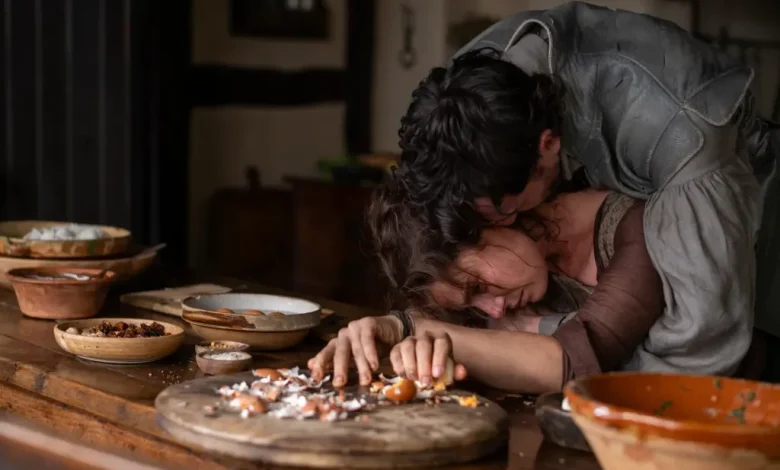
Jessie Buckley and Paul Mescal in ‘Hamnet’.
Agata Grzybowska /© Focus Features /Courtesy Everett Collection
When Zhao first met O’Farrell, it was, somewhat bizarrely, inside Shakespeare’s house at Stratford-Upon-Avon. Zhao had gone there for “a very brief touristy visit,” and O’Farrell was doing an interview at the historic site. The meeting in that pertinent location was “very helpful” Zhao says, “in the sense that she pointed out, in the house, the fireplace. She said, ‘There’s a good chance that Hamnet died right here.’ And I remember the size of that fireplace. And I remember the void inside the fireplace. And then the ground, because it’s been stepped on for so long, it kind of dips under a little bit. That became so vivid in my mind, I took a picture, I sent it to Fiona [Crombie, production designer], just this idea of the fireplace almost like a threshold. And that helped a lot.”
The production design involved recreating the houses and the Globe Theatre. “We were building the homes and rooms around those big fireplaces,” Zhao says. “Łukasz [Żal, cinematographer] and Fiona, they basically built everything, talking to each other about how he wants to shoot it. So, she built it with the right size and the right space. I think when you have a good balance of chaos and order, that’s a sweet spot. I feel like I have HODs [heads of department] who are so incredible, and they are able to just externalize everything I’m feeling. And then they’re able to build such great structures.”
During the shooting of two pivotal moments in the story — Hamnet’s birth and his death — Mescal was not needed on set. But despite his physical distance, he seemed to be so emotionally connected to what Buckley was experiencing, it became almost a spiritual bond.
Says Zhao, “He just stayed in his little hotel room in Shoreditch, losing his mind. He didn’t go out to see anybody. He didn’t go have dinner. He just sat in his room freaking out the entire time. He said it was the worst two weeks of the whole shoot for him, knowing what we were all going through, but holding the container anyways and staying very much in character and not allowing himself to break the tension. We felt him. We would send him messages. We felt him there. And that was hard to explain to people that, really, does that really matter? Yes, it does. It really does. It does for Jessie massively, knowing he’s there holding space, knowing she’s going through this.”
Mescal says of this time, “It felt like a functioning family… then I felt like I was ripped away from them, which also is exactly what happens to the characters. I hadn’t moved into my own place in London, so I was bouncing around these random accommodations that didn’t feel like home. And I knew that Jessie was going through the wringer in terms of what was being asked of her at work.”
Buckley as Agnes in the reconstructed Globe theatre.
Agata Grzybowska/Focus Features
Something that’s much talked-about is Hamnet’s ending. Zhao keeps us on Buckley’s face in close-up for much longer than one might expect. She has discovered her apparently cold-hearted husband has written a play named for their dead son. Enraged, she pushes her way to the front of the Globe Theatre and watches from the very edge of the stage. The emotions that pass over her face are of a depth and capacity that’s hard to even name, but that seem to encompass everything that is human and sad and beautiful all at once.
“We knew, even from the book, it is going to be Agnes’ experience,” Zhao says, “so we had been filming her face for about six days leading up to that. But also on her face, that is where the audience are going to be.” But once they finished the scene, it didn’t feel like the right ending. “I could tell that she looked at me, I looked at her, at the end of that day and we were like, ‘We don’t have a film. There’s no catharsis.’ Then we both went home, and for Jessie, she felt so lost and she was fighting that lostness.”
Then, driving home from set, Buckley listened to composer Max Richter’s “On the Nature of Daylight”. She says, “There was something about the music which made me realize that I was amongst other humans [extras in the theater] who probably had their own grief… all of these people around me had the most incredible faces that had lines and scars — old women and babies and men. And listening to this music, I just had that image of all these faces around me.”
She sent the song to Zhao, who recalls, “I was going through the end of a very important relationship. I knew it was coming to an end, and I was holding on for dear life. So, I was very much on the same path as Agnes is, holding on to her loved one. And then I couldn’t sleep and the film isn’t working. And then in the morning when I got that song in the car, I listened to the song, I started crying and my whole body was vibrating.”
Read the digital edition of Deadline’s Oscar Preview magazine here.
That scene in the theater would ultimately include two things that had not been in the script: the character of Hamlet was on the stage and Agnes reaches out for him. And Buckley brought something else, too. She says, “I just realized exactly what I had to do was surrender to the humanity that was around me. And that in some way, when we go to the cinema, we go to the theater, we listen to a story, we’re holding our unspoken feelings beside each other, and then the play is holding them in a whole other way. And that’s the great mystery of why stories are important and needed in culture.”
Says Mescal of watching Buckley work: “Oh my god. It’s one of those acting olympic moments where I was just like, ‘What’s happening? How are you doing it? Jesus Christ. You’re a god.’ It’s an incredible thing to watch. When I saw that, I was like, ‘That’s a crazy feat of artistic achievement.’ Not even just that shot, it’s just the film for her in general. That’s a seminal performance for me as a viewer. To be a part of it, opposite to her, I was just like, ‘This is an amazing experience.’”