This article contains major character or plot details.
“What do you say to people who say you only play yourself?” a fellow train passenger asks Jay Kelly in the middle of his impromptu European vacation.
“You know how difficult it is to be yourself?” Jay (George Clooney) responds. “You try it.”
It’s an exchange that lies at the heart of Jay Kelly, writer-director Noah Baumbach’s new film, co-written with Emily Mortimer. As played by Clooney, Jay is a titanic movie star, recognized everywhere from the streets of Los Angeles to the quiet car on an Italian train. He’s on top of the world — but even so, something is missing.
“We come to points in our lives where we’ve settled on an idea of ourselves,” Baumbach tells Netflix. “But I think, for all of us, there’s a gap between who we are deep down and who we present ourselves to be, and this varies in terms of all the different roles we play in our lives. As we get older and gain more experience, and maybe wisdom — how do we re-meet and redefine the person that we are?”
That’s the challenge facing Jay, as a confluence of circumstances sends the man with the million-watt smile spiraling. “He has been really good at being a movie star,” Clooney tells Netflix. “This is a story of him having to come to terms with other parts of his life besides the part that he’s been very successful at.”
First, Jay grapples with the death of a beloved mentor (Jim Broadbent). Then, an old friend (Billy Crudup) resurfaces, dredging up old resentments and regrets. Finally, his youngest daughter (Grace Edwards) decides to spend her final summer at home on a trip to Europe with friends. Jay, already struggling to reevaluate his life, decides to follow her, setting off a journey that will be an odyssey and an ordeal in equal doses.
Along for the ride is Jay’s entourage, composed of a star-studded ensemble cast made up of more than 75 speaking roles. Leading the pack is Jay’s manager Ron Sukenick, played by Adam Sandler, who has his own parallel life decisions to make. “We both identified with the subject matter, as we both know what it’s like to go away and make a movie,” Sandler tells Netflix. “Life shuts down around you, and it’s all about the movie.”
Whether Jay likes it or not, that’s the truth: It’s all about Jay Kelly. Read on to dive into the lives and choices at the heart of Baumbach’s latest film.
Who is Peter Schneider?
Jay Kelly opens with a lavish single-take set piece that sees Jay and his team working on a film within the film. Even opposite a dog as his only scene partner, this is Jay in his element, a movie star without compare. “One of [Noah Baumbach’s and my] great pet peeves in movies is how movies that are about making movies can be so inaccurate,” Clooney says. “The way they shoot is never how you really shoot. So we really worked to make sure that we were depicting what we do accurately.”
That attention to detail ranges from Clooney’s performance within a performance to Ron and Jay’s publicist, Liz (Laura Dern), scurrying around the set making sure everything is in order. We even see hair and makeup artist Candy (co-writer Emily Mortimer) enhancing Jay’s eyebrows with a Sharpie. “It was important that everyone we meet on Jay’s journey suggests a whole life outside the film,” Baumbach says. The opening shot lays those other lives out as a mosaic, before zeroing back in on Jay, who’s ready for a break.
Before that break can come, Jay gets some bad news: His mentor Peter Schneider (Broadbent) has died. “To some extent, he discovered Jay Kelly,” Broadbent tells Netflix. “He set him on the road to stardom.” When the man who made him a star is gone from the world, Jay is left wondering: “What makes me a star now?”
On top of that, Jay is dealing with a world of regret. “We meet him later on when Peter’s fallen on slightly hard times,” Broadbent says. “He’s coming around to Jay’s to beg him to get behind some work of his so they can work together again. But Jay is reluctant to make that commitment.”
In the first of the film’s flashbacks, we see Jay tiptoeing around his mentor, unable to admit that he can’t quite justify doing this favor for an old friend. “He’s in some cases a casualty of the industry of life: somebody who once had everything at his beck and call who’s now hustling for work,” Baumbach says of Peter. “And he is calling upon a relationship he has with Jay based on their history together. Jay loves this man and would love to give him anything, but he can’t give him this.”
Peter’s death is the first domino in a row that will send Jay to Europe and beyond. “It’s the inciting incident that puts Jay in the place that ultimately begins his transformation,” Baumbach says. The next step in that transformation follows quickly: As he’s leaving Peter’s memorial, Jay runs into another old friend: Timothy (Billy Crudup). They make plans to meet for drinks later that evening.
Why does Timothy hate Jay?
Jay and Timothy’s sit-down (at Los Angeles’s fittingly titled Chez Jay) begins in friendly enough fashion. Reminiscing about their acting past, Jay challenges Timothy to demonstrate his mastery of method acting by … reading their menu.
Crudup, not a method actor himself, found the experience more challenging than Timothy does. “Jay asks Timothy to do an acting trick, like cry on cue,” he says. “That sort of thing, which I think people typically think actors can do — I don’t know how to do that. That’s not really my thing.”
For the scene in question, Crudup made it his thing. “What it’s asking you to do is find an internal resource that is traumatic enough that the memory of it brings an authentic emotional response,” he says. “It was such a blessing actually to get to learn something new about something I’ve been working so hard at for 30 years.”
Jay and Timothy’s conversation goes downhill from there. As we see in a later flashback, Timothy (played as a younger man by Louis Partridge) was the one who first landed Jay’s career-making audition with Peter. When Jay (Charlie Rowe, in flashbacks) accompanied him for moral support, Jay nabbed the part instead, even borrowing Timothy’s script edits during the audition. Timothy has resented him ever since and says as much.
“The experience of Jay Kelly is not an experience that everybody [in Hollywood] has,” Crudup says. “It’s like .01% of people. They are the lotto winners. Most of the people I know have the experience that Timothy does, which is that they had an aspiration to be part of it, they had a passion for it, they had a gift for it. The stars just never aligned right for them to get the opportunity at the right time.”
In the parking lot outside Chez Jay, Timothy reveals that he’s in touch with Jay’s estranged daughter — and even recommended her therapist. Then things get physical, although we don’t see exactly what happens; the film cuts away from Jay throwing a punch, and the next time we see him, he has a black eye.
“There’s a moment where basically the rubber meets the road,” Crudup says. “We don’t often get that chance to confront somebody that we’ve looked up to to say, ‘Sometimes this makes me sad,’ or ‘I wish we could have been better friends,’ or whatever it is. And Timothy gets that chance.”
Timothy also has a few things Jay doesn’t have: a relationship with his family, free time, a life that exists independently of his star image. Jay’s about to head off in search of those things.
Why does Jay go to Europe?
The biggest blow to Jay comes when his younger daughter, Daisy (Edwards), tells him she’ll be spending her summer in Europe, before leaving home for college. “Even the most present parents go through something like what Jay’s going through with Daisy,” Baumbach says. “She’s growing up, she’s going to college, she wants to be with her friends. She doesn’t want to hang out with her parents anymore. It’s just coming at a time when Jay actually is like, ‘Wait, I should probably spend some more time with you.’ And she’s not interested in that.”
Daisy leaving sends Jay into a tailspin. He’d signed on to shoot a new film and turned down a tribute at a Tuscany film festival. But soon enough, he calls up Ron and Liz and tells them plans have changed. “As Jay starts to behave in a more spontaneous and erratic manner and decides to take off for Europe, we see how Ron and Liz and everyone who surrounds Jay in his orbit has to drop what they’re doing and go with him,” Baumbach says.
Ron has to leave behind his wife, Lois (Greta Gerwig), and daughter, Vivian (Sadie Sandler) — in the middle of a crucial tennis game for the young Sukenick. “Like everybody, you have a family vacation planned, and the boss says, ‘Ay, that’s done. We’re working that week,’ ” Adam Sandler says. “Even though it’s a very good life, and he feels like he’s accomplishing a lot and dedicated to Jay and feeling all the rewards that Jay gets, he’s also feeling the pain of his kids and wife saying, ‘Where are you going this time?’ ”
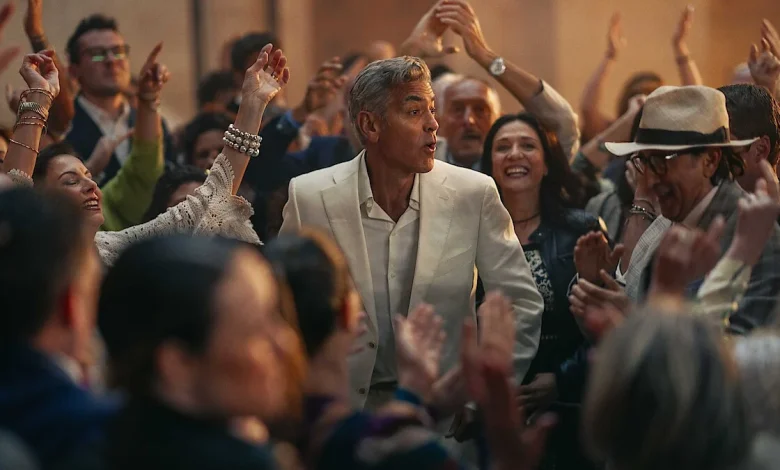
Upon arriving in Europe, Jay tracks Daisy’s friend’s credit card transactions to a train, where he’s set upon by a crowd of fans. Meanwhile, Ron and Liz have a heart-to-heart about their relationship with each other — and with Jay. “They’ve dedicated their life, somewhat codependently, to protecting and preserving the career, reputation, and joy of Jay Kelly,” Dern tells Netflix. “Your life has to take a back seat when your client is your priority.”
Ron and Liz have been in that back seat for a long time. They reminisce about another trip to Europe, when Liz was forced to abandon a date with Ron because Jay needed her. Ron reveals that he had hidden a ring in the ganache, but never had the chance to propose because she never came back.
They’re now both married to other people, and Liz has a child of her own. When the pair finds out about Jay’s fight with Timothy, they realize this trip is about more than Daisy or a film festival. “They’ve suddenly discovered the reason they’re on this trip, which they’ve all gone on under certain pretenses, and now suddenly they’ve found out why he has a black eye,” Baumbach says.
As Liz gets off the train to head back to her family, she leaves Ron with a kiss that’s more of a plea. “That moment is so pure that it isn’t a betrayal,” Dern says. “We’ve seen Ron’s wife and we know he’s married, but it’s not about that. The kiss is, ‘Promise me you’ll take care of yourself. Don’t do this again.’ ”
“They’re all somehow tied to him whether they like it or not,” Baumbach says. “Laura is so beautiful in talking about how they could never be because of Jay, how Jay was always going to come [first] — how they both, in essence, by choosing Jay professionally, were choosing not to be together.”
Escaping from Liz and Ron, Jay finds himself locked in a train bathroom, repeating his name in the mirror. “We’d written it in the script as a kind of incantation,” Baumbach says. “You have this movie star who essentially has lost his name or he’s donated his name to this other Jay Kelly who was the movie star. But there was a kid in Kentucky growing up named Jay Kelly, and it’s the same guy, but somehow this name means something entirely different now.”
The setting changes to another flashback, where we see Jay struggling to make things right with his elder daughter, Jessica (Riley Keough). She tricks him into coming to a therapy session with Dr. Carter (Josh Hamilton), who ambushes him with a letter Jessica wrote from her 10-year-old self, struggling to verbalize her father’s abandonment. “You know how I know you didn’t want to spend time with me?” she tells him. “Because you didn’t spend time with me!”
In the dining car, Jay finds his other daughter, but manages to screw things up again. She learns he’s been tracking her via her credit card, and storms out, leaving him alone on the train with only Ron to comfort him. “The challenge in those scenes was casting somebody who could do that and make it feel ordinary, not like, ‘Oh, she’s being mean,’ ” Baumbach says. “You need to understand why. Because we all understand why. We’ve all been those teenagers and, for those of us with kids, have all had those teenagers. Essentially, we’re lucky they want to get away from us.” Jay doesn’t feel very lucky.
What happens at the film festival?
Jay’s public image is whipsawing back and forth as he makes his way to Tuscany. First, a video of his altercation with Timothy spreads online, and his lawyers receive word that Timothy is planning on pressing charges for assault. Then, Jay chases down a purse thief and goes viral for his real-life heroism.
Meanwhile, Jay dwells on his own lovelorn regrets. In one of the film’s elegantly integrated flashbacks, we see Jay walking through a door on an airplane or train and entering the past. “When you see these transitions from a plane to an acting class, there’s actually a plane built and an acting class built on top of it,” Clooney notes.
In the flashback, Jay is falling in love with Daphne (Eve Hewson), a universal experience but cloaked in the glamour of Hollywood myth-making. “Not everybody has memories that involve falling in love with someone on a movie set when you’re pretending to have sex with them,” Mortimer tells Netflix. “[But] everybody has the love that got away, a memory of an intense feeling. You’re falling for them, and they’re falling for you, and there’s no going back.”
“He’s talking about this love that, again, couldn’t happen because of Jay Kelly and Jay Kelly’s ambition,” Baumbach says. “It’s another choice that he made that had these consequences. And what Eve does so beautifully is you just totally, you feel it all. How could you leave her?”
For the first time, the older Jay speaks to his younger self. “He’s now interacting with [his past] in a way,” Baumbach says. “He’s more ready to face himself.”
The film festival is an opportunity for Jay to face himself for good. The people who matter to him, including Daisy and Jessica, have turned down the invitation. Only Jay’s disapproving father (Stacy Keach) has arrived, which is a backhanded compliment that turns more sour as the event wears on. Jay is tired, glum, and sick of the cheesecake that appears at every turn, thanks to his rider. When his father has a dizzy spell and decides to leave early, it’s another missed chance at reconnection.
Jay spends the night in the woods, searching for something he can’t put a name on. When he runs into the other actor being celebrated at the film festival, Ben Alcock (Patrick Wilson), and his family, it’s a brutal reminder of what Jay doesn’t have. He even hands over a set of his own tribute tickets to Ben. What is he going to use them for?
As he meanders through the forest, Jay calls his daughter Jessica. If Jay’s relationship with Daisy is complicated, his relationship with Jessica is tortured. As he walks through the woods, Jay imagines her here with him and struggles to communicate with her. He apologizes for giving up the opportunity to be a good dad in favor of chasing a career as a great movie star, but Jessica has no time for her father on the other side of the world. He’s trying, but it’s too little too late.
Jessica has her own history as an aspiring actor trailing in her father’s footsteps, and all the disappointment and pain that entails. She can’t be there for Jay, because he hasn’t been there for her. But she’ll do her best regardless. “When she says ‘I’m going to be OK,’ you really believe it,” Baumbach says. “She really has put her life together under real strain and difficulty and the lack of having a parent.”
Having lost touch with his real family, Jay turns back to the only friend he has left: Ron. But Ron is coping with his own abandonment issues.
What happens to Jay and Ron?
Jay isn’t the only one of Ron’s clients being honored in Tuscany. After Jay initially turned the festival down, Ron gave the spot to Ben Alcock. Now that Jay is back on board, the festival is doing a dual tribute. When Ron sits down with Ben in Tuscany, Ben gets an earful over this snub — and is soon fired. “He finds himself at a crossroad,” Wilson tells Netflix of his character. “His wife, Melanie (Isla Fisher), is really giving him the courage to end this relationship with Ron, to move on to greener pastures.”
In other words, Ron’s commitment to Jay has cost him another relationship. And Jay doesn’t even seem to notice he’s been missing. “There are scenes about what Ron thinks the relationship is [compared] to what it actually is, and it’s painful for him,” Sandler says.
“You’re Jay Kelly,” Ron tells his boss. “But I’m Jay Kelly, too.” He’s met with nothing. Everything Ron has done for Jay — helping to build him into the star he is, giving up life and love and family for him —seems to fall on deaf ears.
“I’m at an age where I definitely have to look at what the most important thing is that year, what I’m taking on, who will be affected,” Sandler says about his own work/life philosophy. “It’s about doing the right thing, making sure that I’m focused for everybody if I can be.” That’s a lesson Jay hasn’t learned.
After phoning home and finding little comfort, Ron decides to hit the road, only for Jay to chase after his taxi. After so many years with Ron, Jay can’t bear to go through with the tribute without him. “He’s, in a sense, a shadow of Jay,” Baumbach says. “If Jay does something, Ron has to do it, too. If Jay has a nervous breakdown, Ron’s got to, on some level, have a nervous breakdown as well. But he really believes in Jay. I think there’s something very moving about someone who’s so committed to an artist and what an artist is doing in the world. He also shows that same level of commitment to his family.”
When Jay asks Ron to stay with him as a friend, saying, “You’re the one I want there most of all,” Ron responds with a little bit of a bite: “I’m the only one who’s here.”
So Ron tries to split the difference. He’ll stay with Jay for the tribute, but that’s it. Their professional relationship is over. As the pair sit down in the theater, Jay is surrounded largely by strangers: people invited from the train, festival employees, and Ron — by his side one last time.
The Jay Kelly tribute rolls, and we see a filmography strikingly similar to George Clooney’s (clips from Ocean’s Eleven, Out of Sight, and The Midnight Sky feature prominently). In the theater, Jay sees familiar faces — Timothy, Peter, his younger self, Daphne. In a fit of emotion, he takes Ron’s hand.
Shooting the scene was Clooney’s first time seeing the montage. “I felt like maybe there’d be something to George not watching the reel and us not really talking about it,” Baumbach says. “So the scene at the end of the movie when Jay’s watching the reel, that is the first take of George watching his own tribute reel. And it was kind of amazing.”
Clooney was genuinely taken aback by the reel. “It threw me off a little bit because you’re literally with an audience sharing 40 years of aging,” he tells Krista Smith on Skip Intro. “It’s like the frog in the water and turning up the heat — you don’t really feel it until you see yourself with a mullet on The Facts of Life, slowly [becoming] a guy with a long gray beard. I was watching it with everybody else for the first time, and it was tricky. But it was good.”
The montage evolves into another memory: Jay watching his daughters perform a homemade variety show in their backyard, as he gets ready to leave for a job. But here, Jay puts his briefcase down and watches the girls instead. Is it flashback or fantasy? The tinge of regret in Jay’s eyes suggests the latter.
Jay Kelly’s final moment is something Baumbach always had in mind — a subtly dark punchline that sees Jay reckoning with the life he’s built for himself. The reel closes, the audience applauds, and a teary Jay responds, “Can I go again? I’d like another one.”
“I had the line for the ending, and I knew how I wanted it delivered,” Baumbach says. “I didn’t know where it was going to be or how I was going to do it or who exactly was going to say it. One way of looking at Jay Kelly is that I reverse engineered an entire movie just to get to this last line.”
Jay isn’t going to get the chance to go through his life again. But if he wants to, really wants to, he can change how he lives the next day. “It’s a movie about pain: living with pain, blocking pain, coming to grips with what you’ve done wrong, and saying, ‘Now that I am openly admitting I’ve been wrong, let’s try to move forward,’ ” Sandler says. “You can’t correct the past, but you can at least say, ‘Let’s move forward in the right direction and do the best we can.’ ”
Jay Kelly is now streaming on Netflix.