With “Task,” creator Brad Ingelsby returns to Delaware County (Delco), Pennsylvania, where his previous hit HBO mini series, “Mare of Easttown,” was set.
“We used to joke in prep — there is a version where Mare (Kate Winslet) could roll through the back of the frame in any scene,” said “Task” production designer Keith P. Cunningham. “She’s right down the street, in one of the local police departments, and at some point the FBI task force could ultimately work with her.”
According to Cunningham, one of the many Ingelsby collaborators who worked on both series, despite the similarities in location, crime genre, and the creator’s distinctive voice, “Task” was a different mode of visual storytelling. Gone were the claustrophobic, overcast gray and blue vibes of “Mare;” “Task” moved outside of the domestic drama into the natural world, with a summer color palette and its own approach to cinematic storytelling led by executive producer and director Jeremiah Zagar (“We the Animals,” “Hustle”).
What didn’t change was how Ingelsby’s scripts and the production were rooted in regional specificity. That task (it’s impossible to avoid the unintentional pun) was more demanding, as the sprawling series didn’t focus on one tight-knit community like “Mare,” but incorporated a wider swarth of the population, to include a local drug-dealing biker gang (the Dark Hearts), the Brandis family’s suburban Philadelphia neighborhood, the Prendergast family’s more rural existence on the outskirts, and an ecclectic group of characters that made up the FBI task force.
Makeup department head Adrienne Bearden, a Delco native, told IndieWire, something we heard from everyone who worked on “Task,” “I wanted to honor [the region] so that locals would come up to me and say, “Oh yeah, that’s totally relatable.”
That anthropological study of Delco served as the raw material from which Ingelsby’s scripts and his craft team molded the story of characters and families as specific, layered, and nuanced as the region itself. In the three videos below, watch how Cunningham, costume designer Meghan Kasperlik, and the makeup and hair team — including Bearden, makeup department co-head Anna Stachow, and hair department head Diane Dixon – brought to life the world of one of the year’s best TV series.
The Production Design of ‘Task’
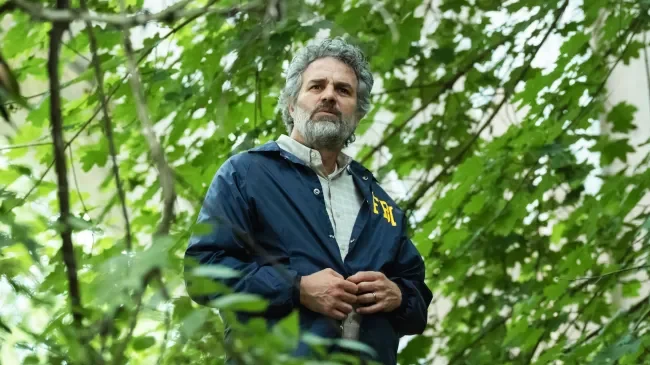
The heart of “Task” lies in the parallel stories of FBI agent Tom Brandis (Mark Ruffalo) and the trash-collector-turned-masked-bandit Robbie Prendergrast (Tom Pelphrey). In the first episode, Ingelsby’s script lays out the two men’s similar station in life — both are single fathers, approaching the one-year anniversary of losing their wives — and the contrasting ways they’ve handled their grief. Here, the delicate visual storytelling depends on the production design.
“Tom has had a loss of faith, so we tried to reflect that in his home,” said Cunningham. “He’s a more structured guy, really having trouble dealing with life after this traumatic issue, so it motivated grays, desaturated colors. There’s a symmetry and a bit of a balance [to the house].”
In the miniseries’ opening four-minute montage, cutting back and forth between Tom and Robbie’s daily routines, Ruffalo is often in static shots, framed within the weight of these rigid symmetrical structures. It lends a sense of emptiness, a void in his life, that is felt when juxtaposed with the fluid, steadicam images of Robbie.
“Tom’s spaces have a density to them, contrasted with Robbie’s world, which is definitely looser — there’s a lightness, it’s more colorful, there’s more physical affection being shown within that family,” said Cunningham. “We wanted to juxtapose those two different lives, but even though Robbie’s world was more colorful, it was somewhat transparent — materials like draperies and other fabrics — there’s a loss in that house [as well].’’
For all the amazing character work, the story of the families serves as the production designer’s guiding principle. Cunningham’s houses have backstories, leaning into how Delco homes are often handed down generation to generation. In the video above, he breaks down how his starting point with the Prendergrast home was Robbie’s niece, Maeve (Emilia Jones), and her family’s backstory.
The Makeup and Hair of ‘Task’
In the role of Robbie, Tom Pelphrey delivers a star-making breakout performance, rooted in his transformation from a traditionally handsome, well-groomed Hollywood actor into the free-spirited Delco native.
“We had a few [phone] conversations regarding his character, and Tom had let me know he has very thick hair, and then when I met him, I thought, ‘I think he should have long hair,’” said hair department head Diane Dixon, who found Pelphrey enthusiastic to give it a try. “We did a test with two looks, one down, and then one back in the ponytail, and Brad [Ingelsby] said, ‘This is it. This is Robbie.’”
The “Task” team conceived of the character as someone who threw on whatever clothes he found on the floor and never looked in the mirror on his way out the door. The ponytail was an important step in establishing this low-maintenance look, but it was the beard that pushed it over the top.
“The character of Robbie reminded me of my brother’s friends growing up in the [Delco] area,” said co-makeup department head Adrienne Bearden. “And with his beard, I think Robbie’s character completely came to life.”
Bearden said Pelphrey was willing to do whatever it took to look like a Delco native, but at first, his facial hair didn’t cooperate with the Delco big bushy beard aesthetic: “He has this beard that if you let it dry naturally, it just curls right up. He could dread his beard, I’ve never seen anything like it, so we’d actually smoothed it out every day with a heated device just to get the hair to [look] longer.”
True to the region, Pelphrey’s beard was one of dozens that Bearden had to closely monitor the growth with an elaborate “beard chart,” as the production’s checkboard schedule was constantly jumping across episodes, moving forward and backwards in narrative time.
“Because both of our leading men ended up with these big, fabulous beards, we also really wanted to find a way to create some distinction between the two, and with Robbie we leaned really heavily into the artwork,” said co-makeup department head Anna Stachow, who was brought on to handle the extensive tattoo work on “Task.”
Stachow worked closely with Pelphrey, who felt each tattoo was important to his character’s backstory, especially those connected to his late brother Billy (Jack Kesy), whose death gives Robbie his vengeful purpose to take down the Dark Hearts’ drug houses. But it would be the Dark Hearts’ ink that would become Stachow’s biggest task. In the video above, she breaks down the color, backstory, and generational divide of the biker gangs’ tattoos, as well as the technical challenges of having to first cover up an actor like Sam Keeley’s real-life ink, before adding his character Jason’s Dark Hearts tats.
As for the biggest technical challenge complicating all three artisans’ jobs: It was the extensive action scenes, especially those involving water or swimming. From wigs to tattoos, their teams had to prep both the actor and the stunt double, while somehow ensuring their work held up under the stress of physical, often violent, and sometimes underwater scenes.
The Costumes of ‘Task’
Tom Brandis has had a rough year, having lost his wife and his son in prison for her death, resulting in his having lost his way and daily routine as he tries to drink away his pain. How Ruffalo physically carried this backstory would be key to his remarkable performance.
“I had in the back of my head that this character should have a little bit more weight than Mark [Ruffalo] did,” said costume designer Meghan Kasperlik. But with the actor on another gig, and limited access to him in the months leading up to production, the costumer abandoned the idea. “I thought, no, we’ve never talked about it. It is a long show, and that’s a long idea.”
But when Ruffalo showed up for his first fitting, it turned out he’d been thinking along the same lines. Kasperlik, using silicone pregnancy pads she had with her, quickly created a makeshift solution to test out what an additional 40 pounds would look like on the actor. After Ingelsby’s jaw hit the floor, they landed on the happy medium of adding 20 pounds. Kasperlik reached out to a body-sculpting expert to quickly turn around padding for the upcoming shoot, but she had already been thinking about how to bring this to life with the wardrobe.
“In order to make Mark look like he had gained weight, I wanted to make sure that he had plaids and that the pleated trousers, something that will add a little bit to the hips,” said Kasperlik.
In pre-production, Kasperlik also studied Ruffalo, not only his performances, but also his on-camera interviews, to learn his body language and how he used it to express both himself and his characters. “Task” is an example of how a great costume designer can collaborate with an actor to aid a performance. Meanwhile, she tailored Ruffalo’s pants so the belt fell below his beer belly, accentuating his slouch, while creating a “work uniform” of patterned dress shirts and khakis that would feel restrictive to the actor when combined with the padding. This aided the normally casually dressed (in real life) Ruffalo in capturing how his character carries his character’s psychological burden into his physical performance.
Subtle touches like these signal to the audience how Tom has started to turn the corner in the “Task” finale, which story-wise comes months after the dramatic events of episodes 5 and 6.
“For Episode 7, [Tom] pulled himself together,” said Kasperlik. “So we did minimize the belly. We did pull his pants up. We did tighten the waist a little bit, and we adjusted the fit of the costume to show that his character was transitioning into getting it together.”
Kasperlik marvels at Ruffalo’s performance and how he subtly shifted his body language in the last two episodes. She pointed to the difference in how Ruffalo played off Sam (Ben Lewis Doherty), the kidnapped boy from his case, compared to his teenage daughter Emily (Silvia Dionicio)
“It’s always really telling when you work with an actor who has children of their own, and then they have to be the father figure,” said Kasperlik. “There’s a transition of Mark Ruffalo’s body when he’s with the Dark Hearts or even with the Task team, but then when he’s with Sam, he has a different posture than he does with his own daughter who he’s feeling very lost with, and I feel like that really comes out in the character and then we try to exemplify and showcase that within the costumes.” — Chris O’Falt
This article is presented in partnership with HBO.