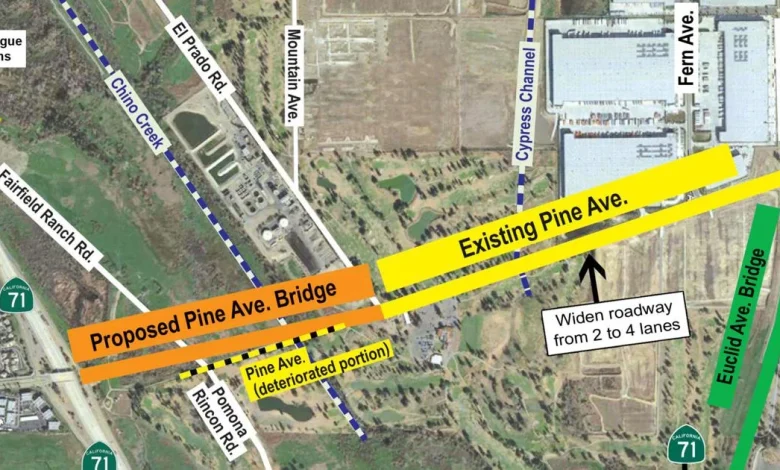
The Chino City Council on Tuesday approved a $7 million design contract for a $140 million project that will extend Pine Avenue from Euclid Avenue to the 71 Freeway but the City of Chino Hills is no longer keeping its commitment to contribute $4.2 million toward the project.
Chino Hills began to reconsider when learning from Chino representatives in September that the project had ballooned from $50 million to $140 million.
On Nov. 23, the council made the decision to use the $4.2 million to lessen traffic impact on city streets from the new Pine and pay for the Soquel Canyon Parkway extension to Peyton Drive.
“I’d much rather retain this money for projects that would benefit our residents than throw it into a big hole that will lose its identity,” said Councilman Art Bennett. “I mean $4.2 million is a drop in the bucket on a $140 million project.”
City Manager Benjamin Montgomery pointed out that the project changed from a graded project with a substantial amount of earth movement to a bridge project which increased the cost to well over $140 million.
“Maybe Jurupa and Eastvale can pony up $4.2 million to make up the loss,” said Councilman Brian Johsz, adding that residents of those cities will benefit more from the new Pine than Chino Hills residents.
When the city made the commitment to Pine in 2017, residents began a petition and social media campaign to oppose the extension, stating it would push more traffic onto the already congested 71 Freeway and Butterfield Ranch Road.
They were also concerned that Riverside County residents would circumvent the 91 Freeway and take side streets to the 71 Freeway, dumping that traffic into Chino Hills and onto Carbon Canyon Road.
Councilman Ray Marquez said when the project is “construction-ready” it will be eligible for state and federal funding.
“We can’t request funds because the project is not ready to go,” he said. “It’s up to the City of Chino to get it construction-ready so we can start hitting our state and federal legislators for funding.”
He said the San Bernardino County Transportation Authority (SBCTA), of which he is a board member, is discussing a potential $200 million bond measure related to Measure I in which funding for Pine could be made available.
The $4.2 million commitment was coming from Measure I funds and the city’s traffic facilities fees funds.
Mr. Montgomery said he would bring a report back to the city council on reallocating the Pine funding and having a further discussion on the Soquel Canyon Parkway extension.
It was unknown if the Chino City Council was aware of the decision made by Chino Hills when the design contract for Pine was approved on Tuesday.
Mayor Eunice Ulloa said she heard that Chino Hills was considering pulling the funding.
“I would encourage our councilmembers and staff to remind Chino Hills that the majority of this is in their community and that we need more than just their verbal and written support,” she said. “They need to put up some money as well.”
Councilman Curt Burton said, “I think that Chino Hills may believe that it doesn’t benefit them to connect, but it certainly does. I hope they are taking a very deep look at what’s going on.”
Chino’s Public Works Director Hye Jim Lee said Chino will apply for federal grants that will hopefully cover 80 percent of construction and engineering costs and the remaining 20 percent could be split with Chino Hills.
The Pine Avenue project consists of three sections: The $140 million extension connecting Euclid Avenue to the 71 Freeway (of which one-third is in Chino Hills), the $150 million Euclid Avenue Bridge Project, and the $15 million Pine Avenue/71 interchange improvement project.
Ms. Lee said the Pine extension will provide an excellent evacuation route for Chino Hills in the event of a wildfire in the Chino Hills State Park and adjacent areas.