Nottingham Forest’s plans to redevelop the City Ground have taken a big step forward, with the club today launching a public consultation period over their proposals.
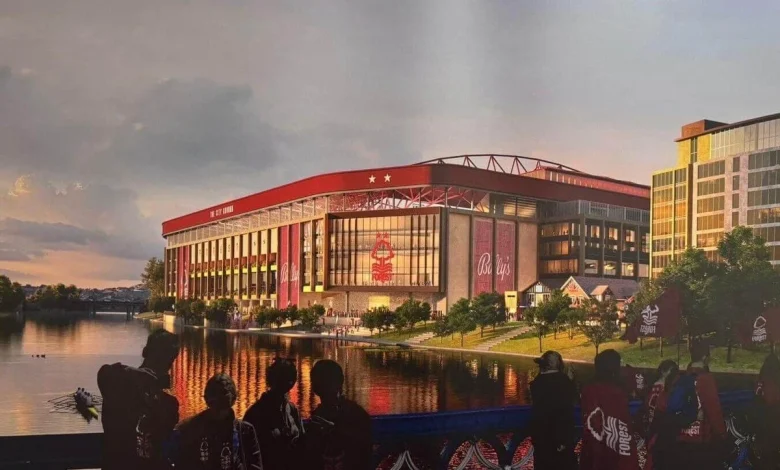
The first images of the plans have been unveiled as part of that, prompting fresh excitement over the project, which could eventually see the stadium’s capacity increased to 52,000, putting it among the 10 biggest in the country.
As Sean Dyche’s side head to Everton to play at their newly built Hill Dickinson Stadium this weekend, we take a look at what the plans could mean for the club and beyond.
What is planned?
On Thursday, Forest outlined plans for extensive work on three of the four stands at their riverside home during a launch event that included a speech from East Midlands mayor Claire Ward.
The first phase of work would increase capacity from 31,000 to 45,000, before a subsequent redevelopment of the Brian Clough stand would grow the ground’s capacity by up to 7,000 more, for a potential future capacity of 52,000.
The club had previously intended to demolish the Peter Taylor stand — the oldest and smallest of their four stands — and replace it with an entirely new structure, increasing the stadium’s capacity to around 35,000. The latest set of proposals are considerably more ambitious.
The City Ground as it looks now (Paul Ellis/AFP via Getty Images)
Among significant changes to the package first put together six years ago, the club have been exploring alternative plans to build over the existing structure to turn it into one of the biggest stands in English football. The new stand would be 58 metres tall — only slightly shorter than the famous dome on the Council House in the Market Square, where Forest celebrated their promotion in 2022. The previous proposals were for a structure standing 38 metres tall.
The latest designs would triple the size of the current stand from 5,000 to 15,000 seats. Forest also want to fill in the corners on either side of the Trent End, joining it up with the adjacent stands to create up to 5,000 more seats as part of that first phase of work.
There are currently no plans to extend the Bridgford Stand, but the new additions to the ground will be built in such a way that this could change in the future, if the club ever decides that it is required.
It is estimated that this project could ultimately require up to a billion pounds of investment, much of which will be bankrolled by Evangelos Marinakis himself.
How Forest envisage the updated stadium would look (Paul Taylor/The Athletic)
When will work start?
The hope is that work could begin next summer. Forest plan to submit their latest planning proposals to Rushcliffe Borough Council later this month. The expectation is that it will happen on or around December 15, but that is fluid.
It would require a swift turnaround for work to begin this summer — six and a half years after plans were first submitted — but that is the idea.
It is hard to predict when the work will be finished, while the club wait for confirmation of when it can begin. But the rough estimates are that phase one of the project, involving the Peter Taylor Stand and the Trent End, could be completed by 2031. The redevelopment of the Brian Clough Stand would be completed beyond that.
The construction process will be designed in a way that limits any reduction in capacity as much as possible while work is going on.
The first phase would involve the Peter Taylor Stand (Paul Taylor/The Athletic)
Who is involved?
Marinakis, the Forest owner, has long held ambitious plans to redevelop the City Ground, and he remains the driving force behind the latest proposals and the increase in scale.
Work has already been done to take the capacity towards the 31,000 mark, with the construction of the hospitality suites, built out of shipping containers, positioned between the Trent End and the Brian Clough Stand, and the addition of new rows of seating at the front of the Peter Taylor Stand. But the Greek shipping and media magnate has always had loftier intentions.
Tom Cartledge — the chief executive of Handley House Group, the parent company for four international businesses specialising in design and architecture — was appointed as chairman to help aid the process in 2023, with one of those companies, Benoy, having designed the initial stadium plans.
Cartledge stepped down from his role last year and his replacement — Nicholas Randall KC, who returned for a second spell as chairman — is now one of the people driving the proposals forward once more.
Konstantinos Chatzimanolis, an architect formerly with Foster + Partners, is a prominent figure in the new plans, having been appointed earlier this year as an executive within the Marinakis multi-club model. Forest have brought in KSS Group, the London-based architectural firm that previously worked on the expansion of Liverpool’s home stadium, to oversee the latest proposals. The architects have managed to turn around these designs in less than a year.
What would it mean for the club?
The City Ground currently has the 15th biggest capacity in the Premier League, ahead of Crystal Palace’s Selhurst Park (25,194) and just behind Wolverhampton Wanderers’ Molineux Stadium (31,750). If their capacity is ultimately increased to 52,000, that would put them among the Premier League’s big hitters.
Newcastle United’s St James’ Park (52,258), Manchester City’s Etihad Stadium (52,900) and Everton’s newly built Hill Dickinson Stadium (52,769) — where Forest head this weekend — all have similar capacities, although Old Trafford remains the biggest stadium, with 74,197 seats.
The new Peter Taylor Stand alone, with a capacity of 15,000, would hold more fans than Bournemouth’s entire Vitality Stadium (11,307).
Increasing City Ground attendances would immediately boost revenue, but so too would the addition of bigger and better corporate facilities. The plans for redevelopment include a vast addition of executive and corporate seating, which would further enhance the matchday revenues at the club. These are currently limited by the size and age of the Peter Taylor Stand in particular.
The club also believe that if they have more season tickets to sell, that could allow them more flexibility on pricing in the future. This was something chairman Randall spoke about during Forest’s presentation on Thursday.
There are 17,500 people on the waiting list to buy season tickets at Forest, so the demand is there. More than that, the club also hope it will provide more opportunities for the next generation of fans to watch games. Currently, the demand for tickets means it is difficult for young fans to watch their first game on the banks of the Trent, and the club want the redevelopment will change that.
Steve Battlemuch, a Nottingham City councillor who represents the Wollaton West area, has welcomed the proposals.
“It’s great to see the exciting plans for the increased capacity at the City Ground. It’s long overdue. It will be an improvement for the fans and the area as a whole. Obviously there will be hiccups along the way, but there seems to be some urgency & detailed planning now in these plans,” he said.
What about beyond football?
The club are hopeful that the City Ground will be more than just a weekend destination for fans.
They have seen clubs such as Aston Villa and Liverpool hosting regular music events and Forest hope to establish themselves similarly. The City Ground has already hosted a Take That concert and the club would like such events to become more regular. They also want the stadium to become a destination for people throughout the week and somewhere that can host community events.
Outside of the stadium, the Trentside tow path will be significantly revamped to help cope with the extra footfall before and after games. The area will be landscaped to ensure fans can get in and out safely without the risk of an unwanted dip.
The interior plan for the renovated stadium (Paul Taylor/The Athletic)
Why has there been no official launch?
The public consultation is an important part of the planning process, but it is not the end of it.
Details can change along the way, so while the club plans to stage a grand unveiling — in a similar fashion to the fanfare with which Birmingham City announced their plans to build their new Powerhouse Stadium recently — they will wait until more of the details are finalised before they do.
In September, it was confirmed that Manchester United had drawn up a fresh set of plans for the redevelopment of Old Trafford, with a canopy that had caused a stir when the blueprints were first made public subsequently removed. The club are looking at alternatives to the bold design first presented in March by co-owner Sir Jim Ratcliffe and architect Sir Norman Foster due to issues over purchasing the required land. Since they first announced their plans, they have changed significantly in Manchester.
Forest want to avoid a similar scenario. The club announced their own plans to redevelop the City Ground in March 2019 and are cautious about making a big fanfare over the latest proposals before the process has progressed further.