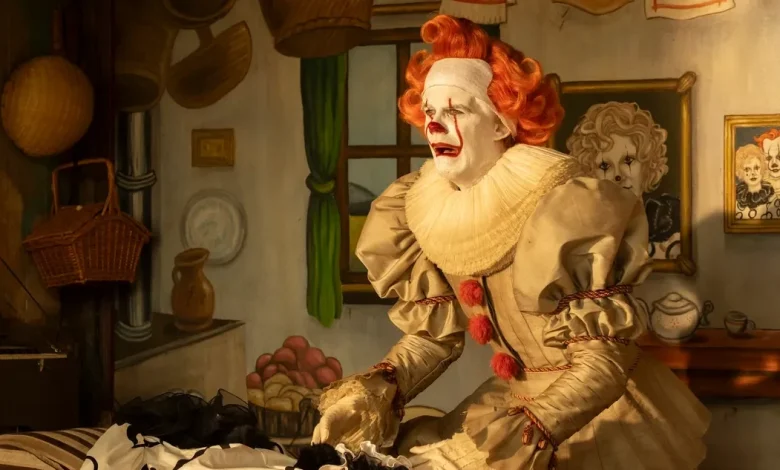
Ingrid’s long-awaited reunion with Pennywise isn’t what she thought it would be.
Photo: Brooke Palmer/HBO
This close to the end of the season, I’ve come to accept that It: Welcome to Derry is a show I’m going to struggle with. But as frustrating as the storytelling can be, I can’t deny there are individual elements that really work. That’s certainly the case in “The Black Spot,” an obvious improvement over last week’s installment but an episode that left me with some burning questions. Why, for example, do we get an 11-minute cold open detailing the origin of Pennywise? For one thing, this is material that the show would presumably want to save for a future 1908-set season. For another, it’s not telling us anything we don’t already know. We see Bob Gray performing as Pennywise and young Ingrid following in her mother’s footsteps by adopting her clown moniker of Periwinkle. One night, a little boy with glowing eyes (never a good sign!) approaches Bob and remarks, “The children seem drawn to you.” He lures the clown into the forest, and the real Bob Gray is never seen again. All Ingrid is left with is her father’s bloody handkerchief.
There’s no real benefit to showing more of the human Pennywise, which, if anything, undermines the horror of the shape-shifter’s most infamous form. Who Bob Gray was doesn’t actually matter — he’s simply an appearance that the creature took on, and Welcome to Derry’s insistence on overexplaining this drags the episode down. That’s especially unfortunate when the prior episode ended on a cliffhanger with a gang of armed and angry townspeople arriving at the Black Spot for Hank. Thankfully, after the opening diversion into the past, we pick up right where we left off. Hank tries to surrender to the mob to stave off bloodshed, but the service members draw their own weapons and order the intruders to leave. It’s a Pyrrhic victory: As soon as the mob steps outside, they all barricade the doors and throw Molotov cocktails through the windows, setting the Black Spot ablaze with dozens of patrons trapped inside. For those who have read It or seen the 2017 movie, this turn of events is not surprising, but it’s still horrifying to watch the scene play out. While the chaos of the fire and the panicked rush to escape sometimes make it hard to tell exactly what’s going on, it’s an undeniably harrowing sequence. The fire features the show’s most memorable imagery yet as Pennywise emerges from the flames. Equally arresting: the shot of the clown devouring Jax’s date, Noreen. (I did laugh at his ghoulish joke to Ronnie: “Do I have face on my face?”)
Ultimately, there’s only so much Welcome to Derry can do to capture the terror and carnage of the Black Spot fire, described in the novel by a dying Will in gruesome detail. I do give the series credit for its additions, like Dick breaking his no-contact rule and communicating with the spirit of an Indigenous warrior to find a path to safety. In retaliation, Pennywise confronts Dick while flanked by a legion of less friendly ghosts — another stellar shot. For his efforts, Dick is able to get Will, Ronnie, and Hank out of the Black Spot through a tunnel under the floor, and all four manage to escape unscathed — at least physically. Rich and Marge, however, are trapped behind burning debris. Rich finds a cooler and urges Marge to hide inside, noting that it’s their only hope of surviving the smoke and flames. Then, in a stunning move that’s pure Jack Dawson, he closes the lid behind her, using his body to hold it down. As with the door in the freezing Atlantic Ocean, there’s really only room for one of them. Rich’s sacrifice is moving, even if the “I love you”s he and Marge exchange in his final moments feel a bit rushed. Strange as it may sound, I commend the show’s choice to kill off one of its young characters. Aside from the massacre that ended the series premiere, Welcome to Derry has felt oddly safe with Pennywise spending far more time scaring kids than eating them. This is a smart way to raise the stakes ahead of the season finale. (I do have to note that it’s bizarre how much Rich’s death pulls focus from the deaths of the many Black patrons of the club, given that the fire is specifically an act of anti-Black violence.)
Outside the Black Spot, the mob flees the scene — except for Stan Kersh, who finds that his car won’t start. That’s when he sees a very odd sight: his wife in full Periwinkle attire. “This is me, Stanley,” Ingrid tells him. “This is who I really am.” He threatens to beat her if she doesn’t go home and wipe the clown makeup off, but he’s thankfully interrupted by Pennywise, who slices off the top of Stan’s head with a cleaver and starts munching on the meat inside. Ingrid is overcome with emotion at seeing her “father” again. She knew he wouldn’t be able to resist the explosion of violence at the Black Spot, she tearfully tells him. “Come to Papa,” Pennywise says, embracing this weepy woman he clearly wants nothing to do with. He’s even gracious enough to tell Ingrid she did well. But their reunion ends abruptly when Pennywise announces, “I’m going to sleep now” (and who among us, after a big meal?!). Ingrid begs him not to abandon her, but when he turns back, drooling, she suddenly comes to her senses. “You’re not him,” she says. “Who are you?”
Permit me a moment here to return to some of the questions that flooded my mind during this scene, starting with, How is it only in this moment that it suddenly occurs to her that the creature is not her father? Are we supposed to understand this as the first time Ingrid has seen Pennywise up close since she inadvertently fed him a little girl? If that’s the case, then what exactly has she been doing to aid him over the years? When Pennywise tells Ingrid that she “did good,” what is he referring to? And while I’m asking questions, does Ingrid care that a racist mob just burned down the club where her lover was hiding out? Is she the one who tipped them off? And if her affair with Hank was always a means to an end, how could she possibly have gamed out the kind of mass-casualty event that would bring her father back? I’ll stop there, but suffice it to say, we don’t get any answers. Instead, Pennywise taunts Ingrid before showing her the deadlights and leaving her (mostly) catatonic. (When she’s being carted off by the paramedics, her eyes flash toward the young survivors of the fire.)
Yes, Ronnie, Will, and Marge have all made it out, but they’re traumatized by Rich’s death as they jointly hug his corpse the next morning. (It’s perhaps a small mercy that he appears to have died from smoke inhalation and not from being burned alive, though I realize there’s no great way to die in this scenario.) When Charlotte arrives, the kids direct her to Hank, hiding out in the forest — he has been reported dead by the local news, which is blaming the 23 deaths at the “illegal colored speakeasy” on an electrical fire, but she’ll still need to get him out of town. The military is also on the scene, and Leroy does his best to calm Dick, who is not faring well in the aftermath of the fire. Because he talked to the Indigenous warrior, he has broken the boundary between himself and the dead. They’re all speaking to him simultaneously, and he can’t make the voices stop. Dick does have some good news, though: He now knows where to find a pillar, and they don’t have to worry about the creature, which he can sense has gone into hibernation. Why Dick is suddenly eager to help with Shaw’s mission is beyond me, but Leroy remains frustratingly single-minded himself. After Charlotte says that someone has to pay for the mass murder at the Black Spot, Leroy tells her, “That’s not our job.” Worse, he assures her that the creature under Derry can no longer harm her or Will. They’ll all leave town together once Leroy’s mission is over. “The worst of all this shit is behind us, I promise you,” he says, which is, again, the dumbest possible thing to say on a show like this.
It really feels as though Charlotte is the only one reacting to the Black Spot fire properly, and given that she’s the only sensible person in Derry, I suppose that tracks. When Will says he wants to go to Lilly’s with Ronnie and Marge so they can tell her about Rich, Charlotte forbids it. Will reasons that the creature being asleep means the danger is behind them. “It wasn’t that thing that lit the fire last night,” Charlotte snaps back. “This town is the monster. You’re not going anywhere.” I honestly don’t know what I would do without her, the sole Welcome to Derry character who doesn’t make me feel insane. She still has a mission of her own, though. Charlotte decides to bring Hank to Rose, believing that Rose will be able to get him and Ronnie safely across the border. To do so, Charlotte disguises him as Leroy. Hank worries the neighbors might notice, seeing as the two men look nothing alike. “In this town?” Charlotte answers. Rose, meanwhile, is meeting with the members of her tribe tasked with monitoring the Galloo. They’ve determined that the Black Spot fire was the Augury, or the end of the latest feeding cycle, which means 27 years of relative peace. Yes, many people died to get to this point, but infinitely more would die if the pillars weren’t in place. “We do as much as we can for as many as we can,” Rose says. “Focus on the lives saved, the ones protected because we keep this thing in its cage.”
About that cage: True to his word, Dick is able to locate one of the pillars. Once it’s dug up, Leroy is horrified to discover that they won’t be moving the pillar inward toward the center of Derry to box the creature in but will instead be bringing it to base for testing. “What you’re suggesting,” Leroy tells Fuller, “it’s like leaving the cage door open.” Well, yes, exactly that, and it’s even worse than he knows. When we next see the pillar, it’s not being analyzed by military scientists — it’s being loaded into an incinerator. Leroy tries to stop this at gunpoint, only for Fuller to tell him that orders are orders. Shaw intervenes at this point to share his true plans with Leroy: This was never about Russia or ending the Cold War; the general has always intended to destroy the pillars and deliberately set Pennywise free. “The greatest threat to this nation is not from without, Major, it’s from within,” Shaw tells Leroy. To prevent what he sees as an otherwise inevitable civil war, he’s going to spread fear throughout the country. The Black Spot fire was “horrific,” Shaw acknowledges, but “the streets are calm today.” He continues, “The fear, it settles on every living person it touches like a fog, like a goddamned anesthetic.”
In other words, Shaw is “fucking insane.” (Hey, Leroy said it, not me.) The general admits that, yes, countless American children will die, but it’s all for the greater good, and as soldiers, they’ve been trained to accept collateral damage. There doesn’t seem to be anything Leroy can do to stop Shaw. Fuller arrives and holds the major at gunpoint while the pillar is loaded back into the incinerator and destroyed. Down in his lair, Pennywise is sleeping, but apparently not too soundly — as soon as the meteor piece melts, his eyes pop open. (That hibernation was really more of a catnap.) Back at the Hanlon home, Will learns this the hard way when he gets a call from Ronnie. She can’t stop thinking about Rich, she tells him. “The way he looked, the way he must have suffocated, lungs bursting like popcorn, making my mouth water,” says her voice, merging with Pennywise’s. “I can smell the little stinky, broken boy body, can’t you?” When Will turns, the clown is waiting for him on top of the fridge. Pennywise doesn’t eat him, though, instead opening wide and showing Will the deadlights.
• At the risk of making this overly complicated, the deadlights aren’t something inside Pennywise — they’re actually the creature’s true form. Seeing them can instantly kill a person or make them go insane. (In the novel, Henry Bowers is institutionalized after seeing the deadlights, which turn his hair white.) The Muschietti adaptations have mostly focused on the deadlights’ ability to put their victims into a state of floating catatonia, as we see with Will and Ingrid in this episode.
• We know Will survives because (spoiler alert!) he goes on to father Mike Hanlon. In It, Beverly sees the deadlights and is revived with a kiss from Ben, so I’m willing to bet Ronnie kisses Will awake in the finale. (It might be a hint that the episode is titled “Winter Fire,” a reference to the haiku Ben writes for Beverly, which she recites back to him after he rescues her from the deadlights.)
• As I said above, the Pennywise origin story we get in this episode doesn’t reveal anything new. The book suggests that It saw the real Pennywise perform at some point in the 1800s and decided to take on the clown’s form because clowns both attract and frighten children, which is pretty key to his whole deal. That Welcome to Derry shows this happening in 1908 marks a timeline shift, but that’s true of the show as a whole.
• Although the angry mob that burns down the Black Spot certainly intends to find and lynch Hank, there’s something oddly sanitized about how the series depicts these events. In the book, the perpetrators are the Maine Legion of White Decency, an iteration of the Ku Klux Klan. I don’t mean to suggest that Bowers and the townspeople aren’t just as motivated by their racism, but the series holds back on making that as explicit as the novel.
• The pillar, no surprise, is held in place by turtle shells, another reference to Maturin. This also touches on what I said about the pillars mirroring the beams that hold up the Dark Tower — the shells mark the turtle as protector of the pillar, and Maturin is one of the 12 guardians of the beams.
VULTURE NEWSLETTER
Keep up with all the drama of your favorite shows!
Vox Media, LLC Terms and Privacy Notice
See All