Also: Atlanta plays South Carolina in a true-crime tale and Stranger Things returns.
::
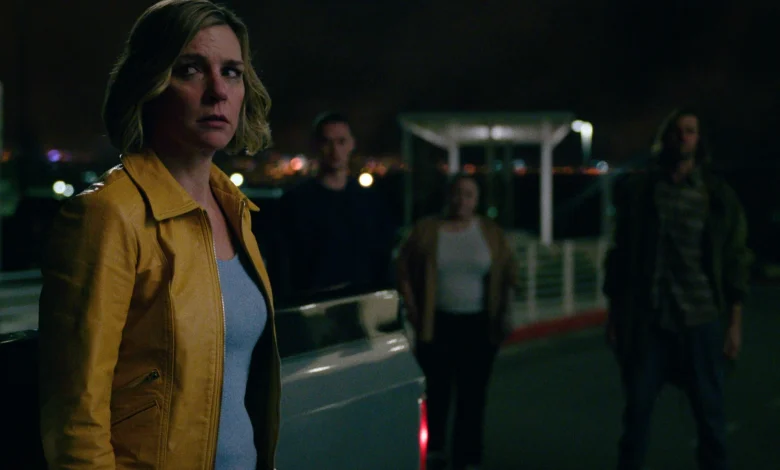
Halfway through the first season of Apple TV’s Pluribus, I’m torn between identifying with its heroically sour protagonist Carol (Rhea Seehorn) and wanting to shake some sense into her … or at least persuade her to be less miserable and more curious about her new reality. If the character sometimes frustrates me, I completely love the way creator Vince Gilligan continues to baffle, amuse and surprise me with his storytelling approach in each episode.
Since the show has already aired half of its 10 episodes, I don’t think it’s a spoiler to spill its premise. We first meet Carol, bestselling author of a series of bodice-ripping sci-fi novels, grinning through gritted teeth as she signs copies of her latest for kvelling fans. Only one of them is a man. Soon, she feels as much of an outlier as him when all but 13 humans on Earth are transformed via an extraterrestrial code into benevolent, smiling automatons.
The show is a variant on both Invasion of the Body Snatchers and I Am Legend, sci-fi yarns about human survivors in a world suddenly overwhelmed by a conquering, hive-mind culture that lacks any of the idiosyncrasies that make us human. Things like anger, selfishness, stubbornness, fear and bad habits like boozing it up. Carol has all those traits, and she argues with the other unaltered humans that our very flaws make us as heroic as anybody in her stupid novels. However impassioned her argument is, it’s met with indifference by her fellow survivors. They prefer either to cling to a sense of status quo, or they get off on having every whim fulfilled by the pod people. (Wouldn’t you want to be whisked around the globe in Air Force One?)
Gilligan’s fable or warning or whatever sort of tale it turns out to be is impressive in scaling up and down, from epic to intimate. Some episodes are virtual one-woman shows, resting on Seehorn’s clenched shoulders. It’s also, often, funny as hell as Carol stomps and scowls her way through a personal purgatory that others might see as heaven. I don’t know where the story will wind up, but Apple has greenlit a second season.
PEACOCK
The last hour of All Her Fault had my husband and me howling with laughter. The kidnap thriller is not a comedy, but its conclusion contains humdingers so implausible they verge on plot turns you’d expect from the wildest telenovela. Still, the eight-episode show is so well-acted and paced, it rewards watching — especially if you’re the sort of aspirational career woman who knows it’s always wine o’clock somewhere.
That demographic is embodied here by Succession’s Sarah Snook and Georgia’s own Dakota Fanning as Marissa and Jenny. They’re two rich Chicago mothers whose boys go to school together. Another similarity: They’re juggling challenging careers, marriages to problematic men and the demands of maintaining just the right relationship with the hired nannies who tend to their sons. In the first two episodes, we see how their husbands call them “amazing,” less as a word of praise than of expectation. And, man oh man, those husbands …
Based on Irish writer Andrea Mara’s novel, Fault is definitely on the side of its women characters. Except for the keen-eyed detective on the case (a terrifically sympathetic Michael Peña), Fault holds most of its male characters in high contempt. Yes, they earn that scorn through their actions, but the gender bias is sometimes as accidentally amusing as the what-the-hell final revelations.
Oh, I forgot the plot. And the show is all plot. In the very first scene, Marissa discovers her 5-year-old son Milo is missing, and so is Jenny’s nanny Carrie (Sophia Lillis). The crisis draws together then splinters Marissa’s family: husband Peter (Jake Lacy, working hard in a tough role), his recovering alcoholic sister Lia (The Bear’s Abby Elliott) and brother Brian (Daniel Monks). The extended clan includes Marissa’s business partner Colin (Jay Ellis). Every one of these people has a secret or two.
A page-to-screen potboiler, All Her Fault has a super glossiness that can be a little distracting, like a dime store mystery played out on the slick pages of Architectural Digest. Olive, sage and taupe are the colors of the enormous homes’ interiors and characters’ wardrobes. Locations are chosen not for their logic but for their scenic value. When the desperate parents organize a door-to-door operation for volunteers to get residents’ info about their boy, there are no doors or residents anywhere nearby: They set up their HQ on a knoll at the edge of Lake Michigan, commanding a stunning view. Oh well, great scenery and some unintentional laughs — what’s not to like?
Matthew Rhys as Nile Jarvis, left, and Claire Danes as Aggie Wiggs in The Beast in Me.(Photo by Chris Saunders/Netflix)
NETFLIX
Imagine you’re a famous writer whose new arrival to your wealthy enclave is a developer less famous for his big properties than for the mysterious disappearance of his wife a few years ago. Is he unlucky — or a murderer? And wouldn’t that make a hell of a comeback book you could pen all these years after your big memoir made the bestseller lists? It’s a great premise, and the eight-part The Beast in Me keeps it spinning. Well, at least for its first half.
Claire Danes is Aggie Wiggs, the writer, and Matthew Rhys is Nile Jarvis (wow, these names!). He’s the arrogant newcomer to Oyster Bay, who’s canvassing his new neighbors for permission to pave a running path through their shared park. Aggie’s not feeling it. She’s recovering from the death of her young son and subsequent divorce from wife Shelley (Natalie Morales). She’s got no time for Nile or his scary dogs or his hulking bodyguards, including his uncle Rick (Tim Guinee). For the record, Brittany Snow plays Nile’s new wife; along with Netflix’s Hunting Wives and Hulu’s Murdaugh: Death in the Family (see below), she’s everywhere now.
Both a strength and a weakness of the show is the diametric acting styles of its two leads. Rhys is all cold-blooded self-possession; you can’t figure him out until Episode 4 gives the game away. By contrast, Danes has zero poker face; her character’s every (exaggerated) emotion is always front and center. You kind of wish Danes could give Aggie a little more restraint and depth, but it’s too late now. If nothing else, Beast (like All Her Fault) could be a good palate cleanser if you’re overdosing on sticky-sweet holiday programming.
Left to right: Tessa Thompson as Hedda Gabler, Nina Hoss as Eileen Lovborg and Imogen Poots as Thea Clifton in Hedda. (Courtesy of Amazon MGM Studios)
PRIME VIDEO
I love the saturated period look of writer-director Nia DaCosta’s Hedda, a version of Henrik Ibsen’s play relocated from 1891 Oslo to a British estate in the 1950s. The movie loses more than Hedda’s maiden name in the title. In the end, when two characters who famously don’t survive past the final curtain are still breathing, you have to question how much there is of Ibsen, as opposed to DaCosta.
That’s not the worst thing. As Hedda, now mixed-race and bisexual, Tessa Thompson looks fantastic in the ’50s dresses as she sweeps through a grand party in the house her husband Tesman (Tom Bateman) can’t afford — unless he gets a promotion at his university. He expects Hedda to schmooze with his department chair and secure his success … which suggests he’s a really bad judge of his wife’s reliability.
As mentioned, Thompson looks great, and she tries hard. But there’s the air of playacting in her preening, brattish Hedda. That grows glaring when German actor Nina Hoss enters the scene. She plays Eileen Lovborg, Tesman’s gender-switched academic rival, Hedda’s former lover and an alcoholic barely clinging to sobriety. Hoss is fantastic — both powerful and nuanced in ways that create a character deeper and more tragic than anything Thompson summons. I found myself wanting to see her take on Hedda Gabler instead.
Chloë Grace Moretz, Denis Leary, Michelle Pfeiffer and Jason Schwartzman are among the cast of the Atlanta-shot Oh.What.Fun. (Photo by Alisha Wetherill)
LOCAL INTEREST
I listened to the 2021 podcast that inspired it, so I was happy to watch Hulu’s take on the true-crime tale Murdaugh: Death in the Family. The eight-episode series, available in full on Hulu, stars Jason Clarke as attorney Alex Murdaugh and Patricia Arquette as his ill-starred wife Maggie. The Atlanta area plays the Lowcountry. (You know you’re not in South Carolina when Stone Mountain looms over a scene set at an outdoor fair.)
The murders, suspicious deaths and financial shenanigans surrounding the Murdaugh clan have become overfamiliar in the last four years. The miniseries is well-made but feels a little anticlimactic. Hamstrung between the facts (as they were argued by the prosecution and believed by a jury in the summer of 2024) and the urge to make the show dramatically compelling, the writers never manage to create interesting interior lives for the characters — Maggie in particular. When in doubt, they just seem to have the khaki-clad good ol’ boys just call each other “Bo” a lot and talk about hunting.
If you didn’t know, the locally shot Stranger Things is back for its fifth and final season: where’ve you been? The first four episodes are already streaming on Netflix. The final four will drop on December 25 and December 31. The “kid” actors are way too old for their characters now. (Season 4 came out more than three years ago!) Each episode is too long, too convoluted, too loud and too violent. And I’m enjoying the whole messy, derivative thing all over again. I’ll be as sorry to see it go as all the people who’ve worked on it since 2016.
Another Atlanta-shot project, just in time for the holidays, dropped this week on Prime. I didn’t get a chance to look at the awkwardly titled movie Oh. What. Fun., but it has two things going for it: It stars the great Michelle Pfeiffer, and it’s directed and co-written by Michael Showalter, the mind behind Wet Hot American Summer and Search Party. His take on a Christmas movie ought to be interesting.
::
Steve Murray is an award-winning journalist and playwright who has covered the arts as a reporter and critic for many years. Catch up to Steve’s previous column here.