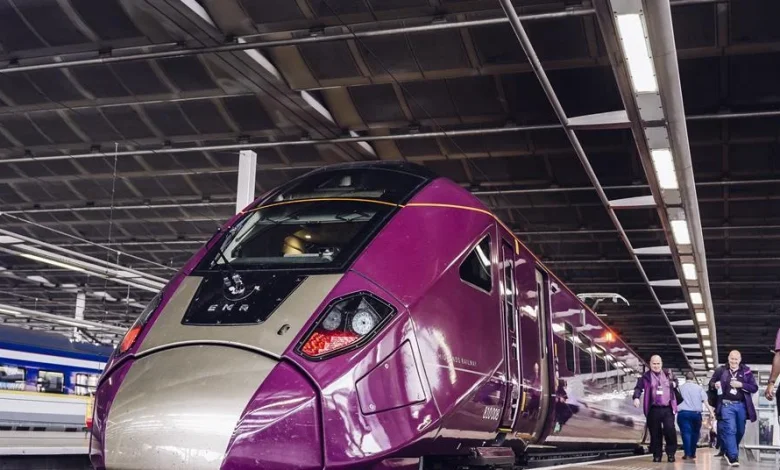
The first of 33 Class 810 bi-mode trains finally entered service with East Midlands Railway on December 3.
The 200 km/h electro-diesel fleet had been formally unveiled at an event at Derby Etches Park depot on November 20, with EMR finally able to confirm that the programme to replace its Class 222 fleet was about to get underway.
In a contract signed in July 2019 and valued at around £400m, the five-car trainsets will provide a 24% increase in seat capacity and 19% more legroom. The fleet overall will deliver a 46% increase in the total number of seats available for passengers as well as an increase of up to 136% in luggage capacity, the operator says.
While electrification of the Midland Main Line beyond Wigston to Sheffield has been paused indefinitely, the Class 810s will now operate in electric mode for around 60% of their journeys, resulting in a reduction in carbon emissions of 66% on journeys between Sheffield and Nottingham and London. As well as AWS and TPWS equipment, the trains are described as ‘ETCS-ready’ by the operator.
Delay and blame
Delivery and commissioning of the trains by Hitachi has been significantly delayed, with the original target date for entry into service by December 2022 having been missed by more than three years. While Hitachi has placed much of the blame for this on the macroeconomic effects of the pandemic, EMR has been rather more open in citing various perceived failings by the supplier in public presentations.
Whilst Hitachi now insists that the 24 m long vehicle design is simply a development of the existing 26 m long cars that make up the Class 80x fleets already in traffic with several operators, EMR has stated that there are many detail differences, and insiders believe that some design elements have their roots in the AnsaldoBreda business that Hitachi acquired in 2015. This was perceived as having a poor reputation for rolling stock quality, not helped by the infamous problems of the Fyra fleet originally ordered from AnsaldoBreda in 2004 to operate high speed services between the Netherlands and Belgium. The trains were formally rejected by NS and SNCB in early 2013 following a series of high profile failures
In the case of the Class 810s, one major delay was caused by the need to rewire the first 12 trains following a ‘thermal event’ in the first half of 2025. The aluminium carbodies are the first to be welded on site at Hitachi’s Newton Aycliffe plant.
Speaking at the event in Derby, David Harris, Senior Projects Director at Hitachi Rail, said ‘it’s a complex platform, it’s a new design for the UK. I’m not going to comment on any of the speculation or information which you’ve been fed by individuals or whoever it is. There’s been some challenges in testing, but any issues we’ve had 100% resolved.’
Invited by Rail Business UK to apologise to EMR and its customers for the delay of over three years in delivering the new trains, he reiterated that the supplier was ‘focused here today on passenger service trains. That’s what I’m going to say. We’ve worked really closely with EMR and Rock Rail to get to this point.’
Delivery schedule
According to Hitachi, the trains will now be delivered progressively over the next year with the aim of completing supply of all 33 electro-diesel sets by December 2026. Currently approximately half of the fleet has been completed at Newton Aycliffe, eight of which are on test, with the remainder in various stages of production. Acceptance into the EMR fleet will require 1 600 km of fault-free running on the East Coast Main Line.
With the trains expected to deliver performance on diesel that matches the speed profile of EMR’s current Class 222 fleet, the Class 810s are equipped with four MTU diesel engines that each provide 735 kW in output. Drivers report that on testing they are ‘on a par’ with the Class 222s while on electric power they are described as ‘rapid’.
Power changeover between power modes is carried out manually, as indicated by lineside signage. ‘It’s a one-button press and it seamlessly transitions over; so the pantograph will raise for electric and the diesel engines go through a cool-down cycle and eventually they’ll shut off’, said one driver. Balises will ensure pantographs are dropped automatically in the event of a driver failing to initiate the process.
Fleet plan
Talking to Rail Business UK, EMR Managing Director Will Rogers explained that while much of the company’s legacy rolling stock has been or is to be extensively refurbished, the 810s ‘are the icing on the cake, it’s a true transformation’. He explained that the first step will be to replace the 24 Class 222 diagrams from 27 trainsets with Class 810s, before using the additional trains to create a number of 10-car formations. These will be targeted at services where demand for capacity is highest.
Asked about a target for availability in the longer term, Rogers said he would ‘love to get to 31 trains in service every day if we can. That would match other fleets’, although EMR’s fleet specialists are more cautious in their aspirations for availability at this stage.
Rogers pointed out that having a homogenous sub-fleet of five-car trains for its London services in the future, rather than the current mix of five- and seven-car sets, will also make planning and diagramming easier.
EMR reports that it still has a significant amount of driver training to be undertaken before the Class 810s can enter service en masse.
Better facilities
As well as enabling electric operation, the Class 810s will also bring enhanced amenities to the MML route. A five-car formation will have 301 seats, of which 47 are in first class. Two wheelchair spaces are located in the First Class area, but passengers will be able to use them with standard class tickets.
The onboard wi-fi is expected to have better functionality than that of the current fleet, thanks to the glass supplied by Flachglas being designed to mitigate the so-called ‘Faraday cage’ effect which can block mobile phone signals from reaching the saloon. Catering for First Class passengers will be provided from a galley located at the end of the DPTF driving vehicle, while a trolley for Standard Class passengers can be housed in a dedicated area in one vehicle where a power supply and water top-up facilities are available.