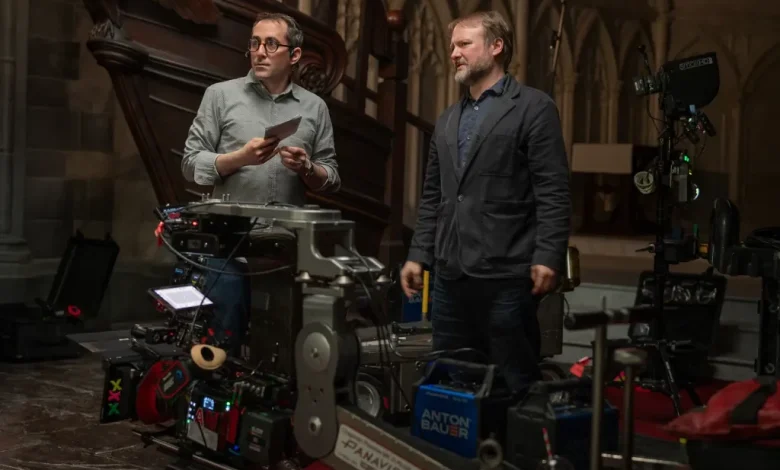
For Wake Up Dead Man, the third film in Rian Johnson’s Knives Out series, the tone and palette shift created a major change in how the cinematography was done. “The movie has a different tone and palette,” says Johnson. “It’s a little more gothic and moodier in its tone, so that defined a lot.”
One of the major ways Johnson sought to achieve the new tone was through lighting, which cinematographer Steve Yedlin was thrilled to help with. “Early on, you had this idea of the light changing a lot,” says Yedlin, “where we feel the clouds coming in front of the sun and all these different changes within scenes.”
Josh O’Connor and Daniel Craig in ‘Wake Up Dead Man: A Knives Out Mystery’
John Wilson/Netflix
Johnson also says Wake Up Dead Man is “more of a lighting movie than a camera movie” compared to the other two films. “I feel like this is the most lighting movie of the three.”
A lot of the lighting changes are used to highlight characters within conversation but, in keeping with the Catholic church setting, light was mostly used to backlight characters in moments of clarity or darken scenes in moments of despair.
“I grew up in Colorado where the clouds moved very fast and lots of times you’d be having a conversation in the living room with your family, and suddenly it would be like God turned the lights out and just things go from very sunny to very dark,” says Johnson. “And the notion of getting very theatrical with natural light shifts that you don’t see very often in movies.”
One of the scenes that shows their use of light the best is early on in the film when Detective Blanc (Daniel Craig) and Father Jud (Josh O’Connor) have a conversation about faith. “The first time Blanc and Jud talk to each other about their view on faith and the sun coming out behind Jud during his speech… That one came out so pointed,” says Yedlin.
Josh O’Connor, left, and Daniel Craig in “Wake Up, Dead Man: A Knives Out Mystery”
Netflix / Courtesy Everett Collection
Another scene with an interesting use of light happened at night, with a strobe light effect. “There’s a bit of a freak out sequence where I wanted to do this sort of dream effect with a bunch of different strobe lights going off in different sequences to create a nightmare vibe,” says Johnson. “It was so fun because Steve rigged it and gave me essentially a video game controller, so I could sit at the monitor and trigger all these lights… I’d start mashing buttons and then realize certain combos could do certain things. ”
Johnson has often used the term “theatrical realism” when describing how he makes his films, but Yedlin says it’s a fine line between overly theatrical and not big enough. “What we’re trying to do is have it feel really big and theatrical,” he says. “It’s not some tiny, subtle thing. You’re seeing the light shifts where it’s really big, but it’s not theatrical in a sort of fake, movie-light way. We’re trying to be evocative of the actual time of day and weather. We have so many different things in that church, not just the sun coming over the clouds, but we have day, night, dusk, dawn… we even have the different versions where first it’s dawn, but then it’s after dawn when the orange sun is streaming in.”