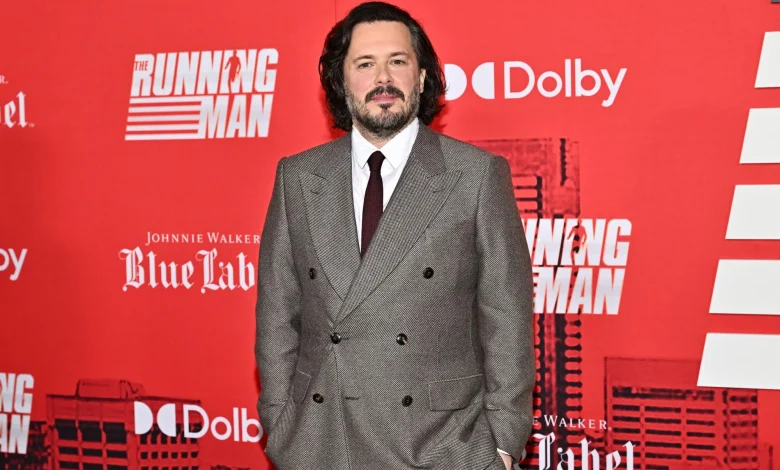
Attempting to reboot the 1987 cult classic, Edgar Wright’s “The Running Man” is ever topical. The story revolves around blue-collar worker Ben Richards (Glen Powell), who, needing money for his sick child, signs up for a death game in the form of a television show called “The Running Man” where contestants are hunted down by the rest of society while promised a cash prize the longer they can survive.
The anticapitalistic premise of the film is pretty clear-cut, similarly so in the first make from the 80s in which Arnold Schwarzenegger starred. Both films dwell somewhat in the absurdity of their premises. There is, however, something characteristically different about Edgar Wright’s interpretation of the narrative; the film is much more explicitly anti-establishment and by extension more explicitly punk as Richards takes the role of a political hero for the lower class within the ultra-capitalist dystopia he lives in, lead of course by the conniving producer, Dan Killian (Josh Brolin). The irony of a film about the destruction of an all-controlling media corporation made by multi-billion dollar media conglomerate, Paramount Pictures, is stark. The film suffers significantly in the interaction it has between its blunt thematic message and its absurd and self-contradictory narrative.
In the 1980s version of “The Running Man,” Richards is much less complex, punching his way through the film spouting one-liners and fighting costumed hunters to punish the unfair system that put him there. Schwarzenegger’s Richards is ultimately simplistic as a down-to-earth moralist, yet it works in the context of a person who is pitted against the world itself. The rebooted Richards, played by Powell, has more of a complex edge, refusing the original call, but ultimately embracing his role as the rebel to the corporate regime that controls him. Rather than simply showing Richards’ actions, however, the script gives him a sick daughter and overworked partner that he needs to provide for giving him a motivation besides taking down the despotic CEO running the show as well as the city.
It is here where the mistake in characterization appears: Richards’ character is outlandish and destructive, yet also perfectly guided by morals with a deep devotion to his family. These two things are not mutually exclusive for a person, yet with these traits is a main character who constantly flips between them. Richards is at one moment a destructive punk and the next a humble moralist. The result is a confused characterization of Richards, or merely a lack thereof. The problem with the overcomplicated characterization of Richards is indicative of the theme at large as well – the script uses such aggressive and flamboyant diction in the dialogue of its main cast. This dialogue seems strange in the context of their war against such a comically evil organization that seemingly no one has decided to side against until Richards shows up. The absurdity of the plot culminates in the final scene where the formally docile and enthusiastic live audience of The Running Man game show somehow riot and revolt against the network so aggressively that it could be the cover of a “Black Flag” album.
Besides thematically, Wright’s visual style has also seen somewhat of a castration; the innovative trucking shots and energetic montages he’s known for are either streamlined or removed entirely, embracing a more homogenous identity. It could be argued that the proceeding film from the 80s has more visual creativity despite a shorter runtime. It would seem like Edgar Wright’s previous style has been streamlined to be more American, once again contradicting his less serious, more avant-garde style that he is known for.
The film has been placed in a self-contradictory position where nearly all its aspects attempt to be punk and anti-establishment while being holistically compromising. Perhaps the problem lies within the idea of punk itself. Any form of rebellion taken to a great length runs into compromises and circular nature when the notion of only being against something inevitably becomes the notion for. It really does seem foolish to rage against the very machine that you are yourself attached to. Admittedly, it is sad to see a director who has so shrewdly and tactfully tackled social phenomena so well in the past fumble now.