Open this photo in gallery:
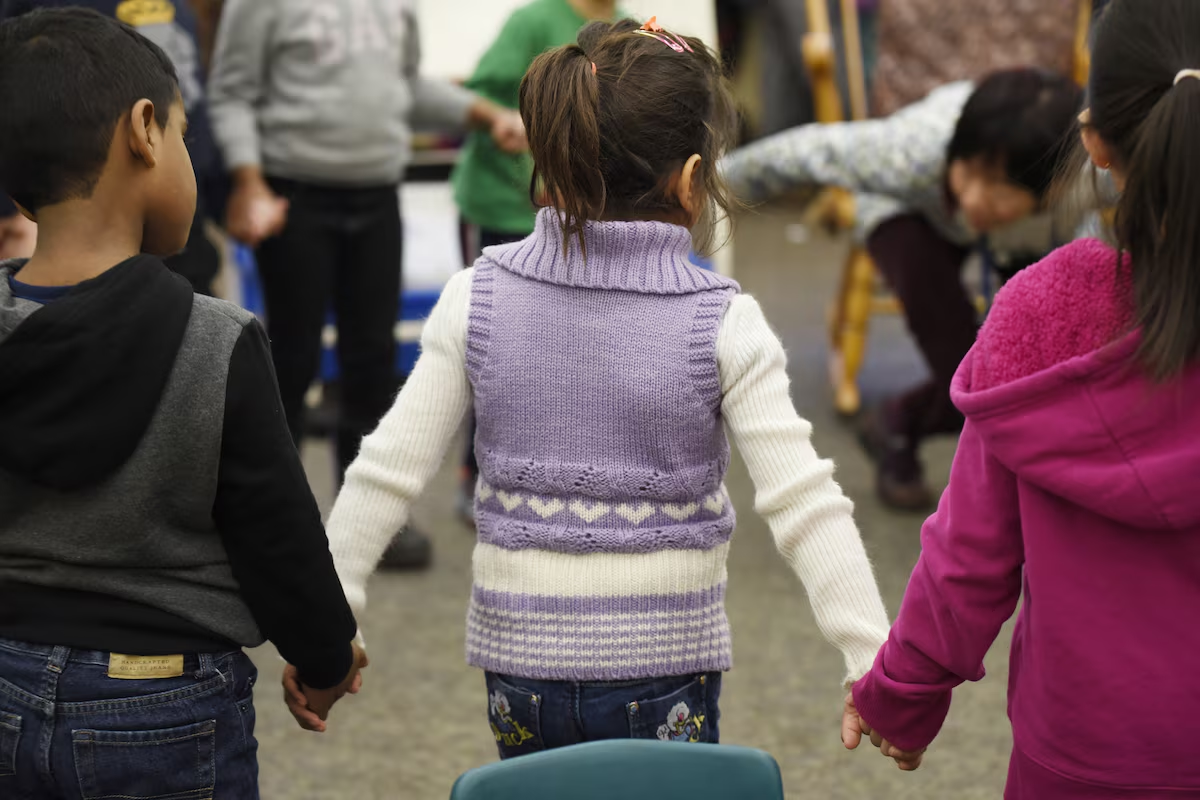
Five-year-old Mariah Al Rassoul holds hands with classmates Aarush, left, and Kaili, right, during her first day in kindergarten on Jan. 4, 2016. Ten years after arriving in Canada as Syrian refugees, Mariah and her family are thriving.Fred Lum/The Globe and Mail
The last time I saw Mariah Al Rassoul, she was throwing a shoe at her school principal.
Mariah was five years old. She and her family, refugees from Syria’s civil war, had arrived in Canada just a couple of weeks earlier. There were 12 of them in all: Mahmoud Al Rassoul, his wife, Isaaf Al Omar, their eight children and Mahmoud’s two sisters. Their Canadian sponsors found them a house in Scarborough to stay in and schools for the kids to go to.
So on the first day of the winter term, the kids pulled on their new snowboots and trooped off to class. None of them spoke more than a few words of English. But after decades of taking in kids from every corner of the globe, Toronto schools knew how to welcome them.
More about Mariah: How one family is learning to adapt on the first day of school in Canada
Mariah’s teachers guided her gently to the kindergarten room, where she took her place sitting cross-legged on the carpet with the others. “Good morning, Mariah,” her classmates sang out.
At first, things went well. A bubbly kid who liked to clown around with her brothers and sisters, she played in the toy kitchen with another girl, all smiles.
But midway through the morning, Mariah seemed to wake up to the fact that she was in a strange place in a foreign country. She dashed out the school door into the cold. When the principal, Marcia Pate, brought her back inside, she lost it, chucking a running shoe at Ms. Pate and pummelling her with her little fists.
That was 10 years ago. How is Mariah and her family doing now? I decided to find out.
This is not a good time to be a migrant. After years of taking in floods of refugees and immigrants from other places, many rich countries are closing their doors with a resounding bang.
Since an Afghan national was accused of shooting two National Guard members in Washington last month, the United States has intensified its immigration crackdown, pausing applications from 19 non-European countries, including Afghanistan and Somalia. This week, U.S. President Donald Trump called Somali immigrants “garbage” who “contribute nothing.”
In Britain, an anti-immigrant party is leading the polls. To win back support, Labour Prime Minister Keir Starmer plans to bring in new restrictions on refugee claimants. Germany and France both have surging anti-immigrant parties and both are bringing in tougher policies on citizenship and immigration.
Doug Saunders: Keir Starmer risks losing Britain in his awkward dance with intolerance
Even in Canada, attitudes have changed. The Liberal government of Justin Trudeau bungled the immigration file. Hundreds of thousands of young people on student visas flooded into the country, many hoping to find a back door to full-time residency. Temporary foreign workers arrived in large numbers, too.
Though Ottawa has since throttled back on the number of newcomers we accept, many Canadians still think the figure is too high. A new study by University of Toronto researchers found that the young in particular have been souring on immigration, partly because of the high cost of housing.
No one wants an immigration free-for-all. Canadians are right to demand rules, limits and good management. As my Globe and Mail colleague Tony Keller puts it in a new book, Borderline Chaos: How Canada Got Immigration Right, and then Wrong, Canada’s motto should be: “Welcome immigrants. Many, but not too many. Mostly educated and skilled. Always legal.”
But while we strive to get it right again, let’s not forget that, in the scheme of things, immigration has been an overwhelming boon for Canada, bringing new blood and new energy to a country that needs both.
When Syrians fled their country en masse a decade ago, Canada stepped up, as it had with the Vietnamese boat people and as it would with Ukrainians after Russia invaded.
With the help of generous Canadian sponsors, 25,000 Syrians arrived within 100 days in 2015-16.
The Globe in Syria: Syrian MPs hold cautious hope for a democratic future
Among them were Mariah and her family. They had spent a miserable few years as refugees in Lebanon, living in a tent after fleeing the fighting in the city of Homs, where they lived. Then, they got permission to come to Canada.
After Mariah’s little blow-up, she settled down and followed the path of countless kids dropped into the deep end at Toronto schools, those miraculous integration machines.
It was hard at first. “Nobody wanted to be friends with a girl who didn’t even speak English,” she said when I talked to her this week. But it got better. She learned English. She earned friends. She became as Canadian as anyone else.
Her family thrived. Her father, Mahmoud, got a good job in construction. In time, he was able to buy a five-bedroom house on a quiet street in Brampton, the sprawling Toronto exurb that is a landing pad for so many newcomers.
Three of his six sons now work construction, too. The other three are in school, like Mariah and a younger sister. One son has a kid of his own, a first grandchild for Mahmoud and Isaaf.
A decade after I first met her, Mariah is a shy teenager with the same big, dark eyes she had as a little kid. She likes connecting with her friends on Snapchat, watching YouTubers and shopping at the mall.
That day when she threw a shoe at the principal seems a long time ago. At 15, she is thinking about the future.
When she was younger, an infection on the brain that came out of nowhere put her in Toronto’s Hospital for Sick Children for months.
She saw how skillful and kind the nurses were. She wants to be a nurse herself now.
I think she will be a great one.