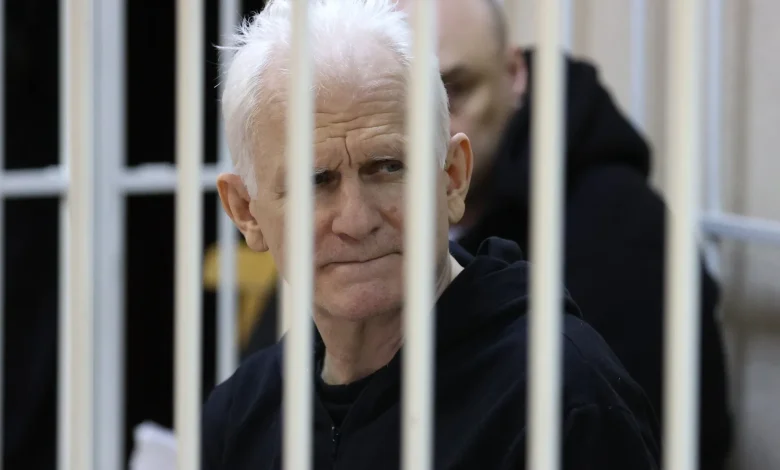
Belarus has freed 123 prisoners, including Nobel Peace Prize winner Ales Bialiatski and leading opposition figure Maria Kolesnikova, in exchange for sanctions relief from the United States.
John Coale, the US special envoy for Belarus, announced the lifting of sanctions on potash on Saturday after two days of talks with Belarusian President Alexander Lukashenko in Minsk.
Belarus is a leading global producer of potash, a key component in fertilisers, the former Soviet state is a leading global producer.
The prisoner release was by far the biggest by Lukashenko since the Trump administration opened talks this year with the close ally of Russian President Vladimir Putin. Western governments had previously shunned him because of his crushing of dissent and backing for Russia’s war in Ukraine.
Separately, Ukraine’s prisoner of war coordination centre said it had received 114 prisoners released by Belarus, including Ukrainian citizens accused of working for Ukrainian intelligence and Belarusian political prisoners.
The centre’s statement said the released captives would receive medical attention, adding that the Belarusian citizens who so wished would subsequently be transported to Poland or Lithuania.
Ukrainian President Volodymyr Zelenskyy said five Ukrainian citizens were among those freed.
The US, the European Union and the United Kingdom did not recognise Lukashenko as a legitimate president after the country’s 2020 elections, which were rigged according to the opposition and rights groups. They also imposed sanctions that hobbled the economy and isolated longtime ruler Lukashenko, whose main international supporter remains Putin.
Speaking from Warsaw, Pavel Slunkin, a former Belarus diplomat, told Al Jazeera that today’s release of prisoners signifies a major improvement in relations between the US and Belarus that was “turning the table on sanctions”.
“For Lukashenko, it means he starts to renew his international legitimacy … His relations with the West are going to improve,” he said.
“I expect the US to lift more sanctions … I think Washington will also pressure the European Union to do the same,” he added.
Exiled Belarusian opposition leader Sviatlana Tsikhanouskaya expressed gratitude to Trump and said the fact that Lukashenko had agreed to release prisoners in return for the concessions on potash was proof of the effectiveness of sanctions.
The opposition has consistently said it sees Trump’s outreach to Lukashenko as a humanitarian effort, but that EU sanctions should stay in place.
“US sanctions are about people. EU sanctions are about systemic change — stopping the war, enabling democratic transition, and ensuring accountability. These approaches do not contradict each other; they complement each other,” Tsikhanouskaya said in a statement.
US officials told the Reuters news agency that engaging with Lukashenko is part of an effort to peel him away from Putin’s influence, at least to a degree – an effort that the Belarus opposition, until now, has viewed with extreme scepticism.
“The United States stands ready for additional engagement with Belarus that advances US interests and will continue to pursue diplomatic efforts to free remaining political prisoners in Belarus,” the US embassy in Lithuania added.
‘It is a very emotional moment’
It was not immediately clear where many of the group of 123 freed prisoners were heading after their release.
Officials told the Reuters news agency that nine of the released prisoners left Belarus for Lithuania and 114 were taken to Ukraine.
Speaking from Vilnius, Lithuania, Anais Marin, former UN special rapporteur on the situation of human rights in Belarus, told Al Jazeera that “it is a very emotional moment”.
She said that relatives of the political prisoners, journalists and rights groups had not even received any news on many of the prisoners in five years.
“They had been held incommunicado, which is a very serious human rights violation, where they have no access to their lawyers, no chance to get phone calls from their relatives and even the post was not delivered. So we were just not aware if they were alive still,” she said.
She added that at least seven political prisoners had died due to the lack of sufficient food and access to healthcare in the prisons.
Bialiatski, co-winner of the 2022 Nobel Peace Prize and a human rights campaigner who fought for years on behalf of political prisoners before becoming one himself, is among the prisoners being taken to Lithuania, according to his wife.
“I spoke with him, he is travelling to Lithuania, and he is feeling well,” his wife Natalia Pinchuk told the AFP news agency.
The Norwegian Nobel Committee has expressed its “profound relief and heartfelt joy” after Bialiatski’s release and called on Belarus to release all political prisoners.
Also freed were Kolesnikova, a leader of mass protests against Lukashenko in 2020, and Viktar Babaryka, who was arrested that year while preparing to run against the president in an election.
Kolesnikova was among the large group taken by bus to Ukraine.
“Of course, it’s a feeling of incredible happiness first of all: to see with your eyes the people who are dear to you, to hug them, and understand that now we are all free people. It’s a great joy to see my first free sunset,” she said in a video published by the Ukrainian Telegram channel Khochu Zhit.
It showed her embracing Viktar Babaryka, an opposition politician arrested in 2020 while preparing to run against Lukashenko in an election. Babaryka said his son Eduard was still in prison in Belarus.
Tatsiana Khomich, Kolesnikova’s sister, told the Reuters news agency she had spoken to her by phone.
“She told me she is very happy to be freed, that she is thankful to the USA and Trump for their efforts in leading the process, and to all countries involved.”