The Vancouver Canucks may be on the verge of making another in a long line of unforced errors.
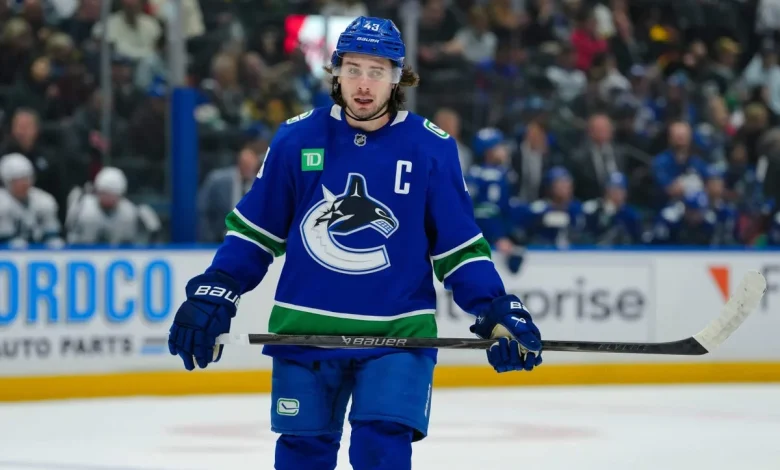
As the rumour mill has churned over the past week, driven initially by reports from Sportsnet’s Elliotte Friedman on “Hockey Night in Canada,” the notion that the Canucks will trade captain Quinn Hughes has taken on a certain sense of inevitability.
This is one of those situations that the club could easily pour cold water on. That Canucks management has opted instead for radio silence on a matter of tectonic importance to the franchise would appear to speak volumes.
As for Hughes, he was asked directly by CTV News this week at a food bank if he intended to remain in Vancouver long-term or had a message about his status for Canucks fans. He demurred, quite reasonably citing the singular focus of being a professional athlete in the midst of the season.
“Right now I’m just focused on what I can control,” Hughes said. “We’re in the middle of a season, and I can’t even sign if I wanted to; I can’t sign until July 1. So right now there’s nothing I can do. So I’m focused on what I can control and what I can do, and that’s what I’m trying to do.”
At this juncture, whether a deal happens in short order or not, it’s apparent that the topic of Hughes’ future will dominate the conversation around this team for the foreseeable future.
Meanwhile, hardcore Canucks fans, well aware that owner and chairman Francesco Aquilini is characteristically reluctant to communicate directly with the Vancouver market even on matters as critical as charting a new direction for this 32nd-place franchise, have grown accustomed to reading between the lines of columns written by Gary Mason in “The Globe and Mail.”
Mason’s columns are the closest we’ve come over the years to getting any sort of window into the often tortured logic guiding what we might far too politely call “decision making” at the ownership level for this dismal franchise.
On Wednesday afternoon, Mason published a new column that should send a chill down the spine of any Canucks fan that somehow, against all odds, retains any semblance of hope for the future of this hockey team.
“It now seems just a matter of time before Hughes, one of the greatest talents to ever pull a Canucks’ jersey over his head, is traded,” Mason wrote.
If the contents of Mason’s column are in fact an accurate reflection of the underlying assumptions of ownership on the matter of Hughes’ Canucks future, then the capricious reasoning on display is nothing short of breathtaking.
Let’s begin by summarizing the key points in Mason’s latest column, before zooming out to discuss the various problems in the underlying organizational assumptions revealed therein:
- Mason writes about the club’s successes during the 2023-24 campaign at length, referring to it as “unfathomable” that a club that looked to be an ascending contender has been brought so low, so quickly.
- Mason writes that “literally one intractable problem changed everything: Veteran J.T. Miller seemingly could not exist in the same dressing room as the team’s talented young centre, Elias Pettersson because of personality differences,” with the implication being that if not for the Miller trade, the Canucks might still be an ascending team.
- Mason writes that the club has recognized the need to rebuild, but only sort of, and that current Canucks management remains in the driver’s seat from a decision-making autonomy standpoint, “that seems to be where the Canucks are at — if not a complete teardown, in a state of rebuild for certain. I believe (Canucks president of hockey operations Jim) Rutherford has the complete support of ownership on whatever moves he ends up making.”
It’s vital that we unpack these three points, and untwist the faulty assumptions they betray. It’s even more important that the organization strongly reconsider the internal mythos about what’s happened to this team and how it arrived at this juncture.
If they fail to, the Canucks will surely bungle one of the biggest and most important transactions in franchise history.
1. The ascending team fallacy
This is the key assumption that the club needs to disabuse itself of.
It makes sense, after all, that the Canucks organization doesn’t believe that a rebuild is necessary, in part because of the belief that this really was a contending team in the 2023-24 season and might still be if not for personality conflicts outside of anyone’s control.
It’s a line of thought that permits the club to pass the buck on taking any sort of accountability for what occurred following the club’s elimination in a lopsided Game 7 against the Edmonton Oilers, and also short-circuits the need for a lengthy rebuild.
If Rutherford built a contender in just 18 months on the job, surely this club can reset it all and do it again, right?
This logic betrays a complete misunderstanding of the 2023-24 season and what this team’s true level was during that stretch. And what’s key to remember here is that Vancouver’s short-lived run of success during that dream Pacific Division-winning campaign wasn’t exactly a one-off for this Canucks core, nor was its quick decomposition unfathomable to anyone paying close attention.
Throughout what we’ll call the Hughes era of recent Canucks history, we’ve watched a team capable of hitting highs in fits and spurts, largely as a result of a collection of elite talent that the organization accumulated over six years from 2014-19, during which Vancouver selected in the top 10 at the NHL Draft in five of six seasons.
The 2023-24 campaign doesn’t exist in isolation, it exists as part of a wider picture that should also include the club’s playoff run in the 2020 playoff bubble and its incredible showing during the latter half of the 2021-22 campaign, when the Canucks played to a 104-point pace and captured the imagination of fans during the short-lived mirage that was the “Bruce There It Is!” run.
The Canucks weren’t a durably ascending team in the 2020 playoff bubble, or during the spring of 2022, or during the magic that was the 2023-24 campaign. Instead, what we’ve witnessed is a high-end core group that was never able to escape the morass that is the NHL’s mushy middle, largely because they’ve been persistently under-supported by an impatient, unserious organization intent on bleeding future value for the benefit of their short-term outlook for a decade.
In the middle of the NHL standings, we see real parity. If you’re the 12th through 20th best NHL team, you can seem like a fringe top-five team for a playoff run, or a half-season, or even for a full year based solely on variance.
Shoot an elevated percentage for a stretch, receive elite goaltending, get some good luck health-wise, hire the right head coach, and a middling team can fool you for a spell.
Of course, the opposite is true, too. Struggle to finish chances, get porous goaltending, get bit hard by the injury bug, hire the wrong head coach, and a middling team can dip down to the bottom of the NHL standings for a stretch as well.
This is what we’ve seen from Vancouver over the past five years. A shallow team with some high-end players that was never as good as it looked when things were rolling downhill, and never as doomed as it seemed during significant drops in form (often leading to the dismissal or scapegoating of perfectly competent head coaches like Travis Green or Boudreau).
The Canucks have never been a contender in this era. They’ve been an average team subject to the slings and arrows of fortune (or misfortune), the product of an organization that has never been willing to commit to doing the disciplined work required to amass the sort of talent that the true contenders — Colorado, Vegas, Tampa Bay, Florida, Carolina, Dallas — possess.
Contending teams, after all, don’t rise and fall arbitrarily year over year. They open a durable competitive window, during which they are evidently among the NHL’s best teams over a multiyear stretch. They also tend to outshoot and outchance their opponents consistently, and aren’t quite as reliant on ephemeral factors like shooting efficiency and unsustainable runs of dominant goaltending. Even at their 2023-24 best, the Canucks never met the durability or the outshoot and out-chance opponents consistently standard for more than a month or two at a time.
If Canucks ownership can’t see through the volatility of short-term results and grasp the big picture truth about their recent history, then it won’t really matter whether or not Rutherford hits a home run in auctioning off Hughes. It won’t matter if Pettersson becomes a 95-point, play-driving first-line centre again. It won’t matter if Thatcher Demko can stay healthy, and it won’t matter if Adam Foote can morph into the second coming of Rod Brind’Amour.
Unless Canucks ownership can grapple with what’s led the franchise to this point, and their role in it, the body of this organization will continue to rot from the head down.
2. The Miller trade didn’t change everything
Miller and Pettersson were teammates for parts of six seasons, and the Canucks won two playoff rounds and won the division once. The team accomplished little else during their shared Canucks tenure.
Miller, meanwhile, is 32 and has five years remaining on his $8 million contract. He’s on pace for 50 points, isn’t even playing centre full-time in New York and partly because he seems to be playing hurt (as he was at the start of last season as well), he hasn’t moved the needle for the Rangers, who are currently 12th in the East.
Does that seem like the profile of a player that an ascending team couldn’t possibly live without? The sort of piece whose departure would necessitate a rebuild, or explain why an ascending team finds itself, less than a year following Miller’s departure, in 32nd place in the NHL?
The irony is that it seems like the dubious belief that the Miller trade changed everything is borne more of self-preservation than any proper accounting for this franchise’s reality. To accept that the club misjudged Miller’s risk profile, quality as a player and volatility as a person and a leader in signing him to a seven-year contract instead of committing to Bo Horvat — who has outperformed Miller by a wide margin this season — is to accept that the organization made a severe miscalculation. That the Canucks kept the wrong centre, if they were intent on keeping one at the time (and they were).
If the organization insists on viewing the Miller trade as a massive setback, as opposed to being an obvious bullet dodged, it specifically prevents the club from acknowledging the scale of the mess they’re in, and the very real misjudgements that led them to this point.
3. Rutherford remains in charge of not a complete teardown
The one benefit of trading a player like Hughes is that all of the other 31 NHL teams would love to have a player of his calibre on their roster.
If the Canucks hold an open auction for Hughes’ services, the bidding will be fierce, and the acquisition cost will be steep.
While local confidence in Rutherford and general manager Patrik Allvin is understandably at a low ebb given this club’s performance this season, they’ve largely been competent, reliable operators across their four years at the helm of Canucks hockey operations. Their failures don’t lie in the realm of execution, but in the realm of lacking the big-picture vision to rebuild a team that required it.
In any event, I don’t have any grave concerns about their ability to optimize an auction for Hughes’ services, if that’s what this ultimately comes to.
What does concern me, however, is what comes after Hughes is dealt if that’s what occurs in the weeks and months to come.
What concerns me is the oft-demonstrated habit in the Rutherford era of Vancouver making an initial trade in which the club collects meaningful future assets, only to set up a deal in which those future-forward assets are used to buy NHL players, in a fruitless attempt to short-circuit the club’s much-needed rebuilding effort.
In Pittsburgh, Rutherford (and Allvin, as a lieutenant) proved themselves adept team builders. They’ve similarly shown themselves capable of identifying useful depth pieces capable of providing surplus value in Vancouver.
That’s a valuable skill for hockey operations leadership to have. The problem is that the Canucks don’t need to build a team right now. They need to stop the drip-by-drip bleeding of constantly sacrificing marginal future value for win-now pieces and amass future value with the long-term goal of building a great team front of mind.
What’s required in Vancouver is something less conventional, something focused more on accumulating value for the purpose of building a real contending team down the road. Not maximizing a middling team with clever depth additions for the purpose of making the playoffs “if everything goes right,” and then confusing what’s broken your way for some false arrival as a contender-level team.
I leave you with this key lesson from Canucks history. In June 1986, the Canucks permitted lame duck general manager Jack Gordon (in concert with the club’s head coach Tom Watt) to sign Barry Pederson to a deal that required the club to pay the Boston Bruins compensation. That compensation took the form of Cam Neely and a first-round pick, and is more widely remembered today as the Cam Neely trade.
It was a major decision made by a general manager whose time had come, and it set the Canucks back a decade. By December of that year — just six months later — the club had reached an agreement with Pat Quinn to replace Gordon.
Contrast that with the Pavel Bure trade, which was made by Brian Burke at the start of his tenure. Burke was named Canucks general manager in June 1998, and was firmly in place with his hand on the tiller by the time Bure declined to report to training camp that fall. Burke engaged in a lengthy staring contest with Bure’s representatives, and his head coach Mike Keenan (who complained endlessly about the lack of offensive pop in his lineup, heaping pressure onto Burke throughout the process), and found a deal with the Florida Panthers for Bure in January 1999.
That deal was a loss for Vancouver, as any Bure deal was always going to be, but the Canucks were able to get defenceman Ed Jovanovski in the trade. Jovanovski’s addition gave Burke a surplus of young left-handed defenders that also included Mattias Ohlund and Bryan McCabe.
Even if the Bure deal was a painful one for the organization, adding Jovanovski helped build an asset surplus on the blue line that Burke used on the draft floor in Boston in 1999 — sending McCabe as the key part of the package to the Chicago Blackhawks for the second top-five draft pick that was required to set up Vancouver selecting Henrik and Daniel Sedin. What was a tough, painful trade was turned indirectly into a franchise-altering win.
I bring up these anecdotes because a successful Hughes trade can’t represent the end of an era for the Canucks, but the beginning of a new one. Whether Rutherford is permitted to make that trade or not, the Canucks — from ownership on down — have to know what they hope to build, as Burke did 27 years ago, if they hope to make one of the most painful decisions in franchise history count.