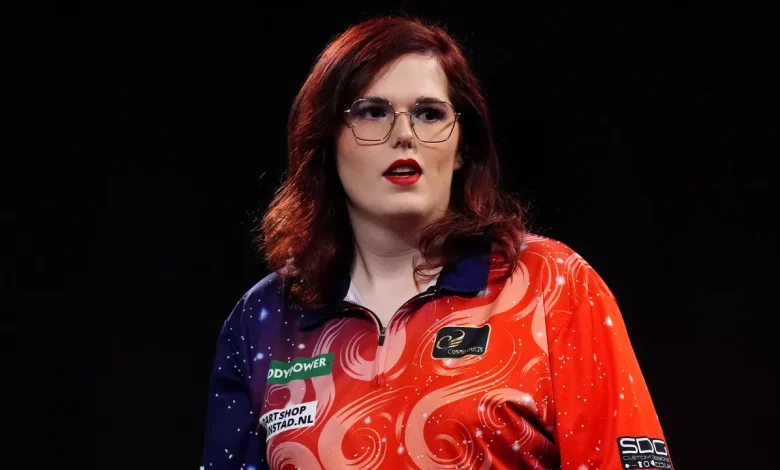
Professional darts champion Noa-Lynn van Leuven says that dealing with anti-transgender backlash took a severe toll on her mental health and forced her to step away from the game. Now she’s back, and vying for a championship win.
Van Leuven, 29, holds three titles from the World Darts Federation (WDF) and became the first trans woman to compete in the Grand Slam of Darts invitational tournament last year. But with her visibility came backlash. Some of her cisgender opponents withdrew from their matches together in protest; two of her former teammates on the Dutch national women’s team resigned rather than play alongside her; and anti-trans protesters allegedly threw objects at her during a Professional Darts Corporation (PDC) event this July, shortly after the WDF announced it was banning trans women from women’s competitions entirely. In October, competitor Deta Hedman forfeited a PDC tournament for the second time rather than face van Leuven.
In a new interview with darts publication Oche 180 this weekend, van Leuven said she didn’t feel the weight of the backlash until after last year’s World Darts Championship (WDC), in which she was knocked out in the round of 64. “Last year I had so many darts tournaments that I didn’t have time to dwell on how I was really doing,” van Leuven said. “First this tournament, then that Worlds. But when all that is over, the crash comes. It felt like I ran into a massive concrete wall.”
Van Leuven’s mental health deteriorated so much she struggled to get out of bed some days, she shared. The misgendering comments her former teammates Anca Zijlstra and Aileen de Graaf had made about her in particular were “incredibly painful,” she said. “At a certain point I was convinced that all people were scary and s****y. I just had nothing left to fall back on.”
Eventually, van Leuven’s health started to make a comeback with the help of 14 weeks of in-home behavioral therapy. Her treatment team “literally showed up at my door three times a week,” she recalled. “They helped me with small things: what can I do today? Shall we go for a walk? Sometimes they just took me outside. Then I had to get out of bed. It didn’t go up in a straight line. But there were more and more moments when it felt a little better.”