Avatar 3 doesn’t feel engineered — it feels handcrafted by James Cameron, down to the last tear

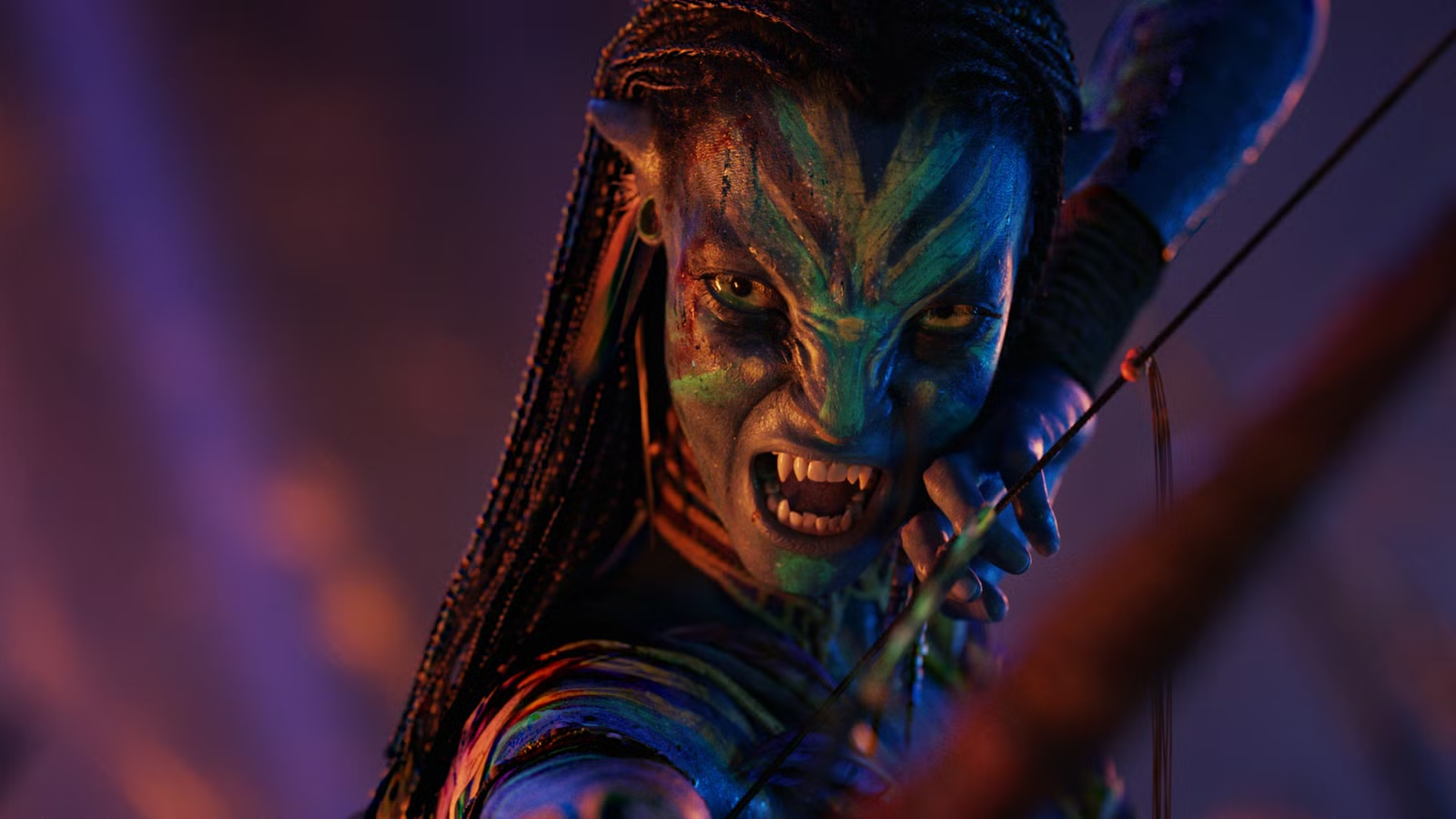
A funny thing happened on the way to Avatar 3’s release date: the proliferation of generative AI tools convinced a class of sub-amateurs they could poop out hyperrealistic animated blockbusters with the tap of a few buttons. Yeah, James Cameron spent decades finessing motion-capture technology that brought the human soul into entirely CG-rendered characters, but a bunch of blank-face Midjourney videos strung together to make a gritty Naruto remake is basically the same thing, duh.
Clearly, in the years since 2022’s Avatar: The Way of Water, the “art” movement initiated by Sora, DomoAI, and countless other video generators got under Cameron’s skin — he said as much in the opening of his recent Disney Plus making-of documentary series. His moving pictures cut even deeper than words. The greatest rebuke to the corner-cutting AI hucksters and slopmakers is Avatar: Fire and Ash, a captivating spectacle built as much around intimate performances as fleets of war whales smashing Terran invaders to smithereens. Three movies in, sculpting the Na’vi out of pixels is the easy part. Now, the unfathomable lengths Cameron and his team of visual effects artists have gone to bring physicality and nuance to digital creations have paid off with edge-of-your-seat family drama. No text-to-video prompt could accomplish what Fire and Ash does in a single minute, let alone 197 of them.
Image: 20th Century Studios
A year after hammering the tulkun-hunting RDA faction on the seas of Pandora, Terran soldier turned Na’vi Jake Sully (Sam Worthington), his partner Neytiri (Zoe Saldaña), and their surviving kids are at peace at their oceanfront property in the Metkayina clan village. We and they both knew the endless war between Pandorans and Terrans was always going to catch up with them. Avatar-bodied Terran Colonel Quaritch (Stephen Lang) survived his encounter with Jake in Way of Water thanks to some quick thinking from his estranged, dreadlocked son Spider (Jack Champion), and of course, he’s back in pursuit of his former subordinate Jake in the opening bow of Fire and Ash.
There’s a sense of Way of Water déjà vu to the film’s first act — and eventually, its armored-boat-heavy conclusion as well. Cameron overinvests in the cool factor of watching Na’vi plunge into crystal-clear waters on the back of the plesiosaur-like ilu. When the Sully family flees their Metkayina home yet again in Fire and Ash, it starts to seem like the mad genius has run out of story ideas this time around.
Image: 20th Century Studios
But just when you think Fire and Ash might play out in photocopy, Cameron and screenwriters Rick Jaffa and Amanda Silver (from the recent Planet of the Apes films) narrow the focus in exhilarating ways. Neytiri, mourning the loss of her son Neteyam, who was killed in battle during The Way of Water, is not cool with the human Spider acting like one of their pack. Jake, forever caught between two worlds, is pitted against his partner’s wishes and his responsibilities as a foster father. Their son Lo’ak (Britain Dalton, who narrates the film) can’t impress either of them, wearing the stain of his brother’s death. And their adopted teen daughter Kiri (Sigourney Weaver) struggles with her own connection to a greater mother: Eywa, the spirit of Pandora. Aiming for a tale that’s more Greek tragedy than Greek epic, Cameron pushes his camera closer than ever before into the hyper-detailed motion-capture-driven drama. The tears feel as real as anything in Chloé Zhao’s Hamnet.
The psychological screw keeps turning when Varang (Game of Thrones’ Oona Chaplin), a fellow Na’vi and leader of Pandora’s cultish volcano-dwelling raiders, ambushes the Sully family as they travel with a group of peaceful Wind Traders. Between flying beasts setting airships aflame and bursts of hand-to-hand combat aboard, the sequence, as I witnessed it in glorious 3D with a shifting frame rate, stands as one of the most harrowing setpieces in Cameron’s action-heavy history. The filmmaker goes bigger before the credits roll, with an explosive prison-break sequence set in an RDA compound and a sea-creature-filled final battle that feels more like Cameron’s take on the ending of Beauty and the Beast than it feels like any previous live-action epic.
The idea of Na’vi crossing fellow Na’vi adds to the shock of that early fight, even if it’s thematically obvious — Pandora is a planet-sized moon where, like on Earth, everyone has their own priorities, regardless of who is at war. Varang wants her cut, and will scalp the kurus off her fellow Na’vi to get it. Chaplin, under Varang’s digital skin, avoids pure villainy thanks to a jaded glimmer; she feels crossed by Eywa, and intends to hurt the goddess’ followers. Eventually, the anarchical warrior chases our heroes down to the Pandoran jungle surface, where, for a good 20 minutes, Cameron delivers the version of Rambo II he actually did direct.
Image: 20th Century Studios
An Avatar movie with lots of moving parts, fueled by overt technical prowess, could sound like “just more Avatar.” But Cameron, Jaffa, and Silver seem determined to make the script really count this time around. Neytiri and Jake each spend a good chunk of the movie debating whether to kill Spider to keep their family and other Na’vi safe, with Saldaña always on the verge of tears, and Worthington honestly giving a performance that would be Oscar-worthy in a year where Leonardo DiCaprio wasn’t also playing a sad dad. Hallucinogenic sequences in which Kiri walks the alien version of Garden of Gethsemane lead into an entire subplot with the tulkun that culminates in a mini courtroom drama with our boy Payakan on trial for insubordination. You know Fire and Ash was produced by a human brain, because half of Champion’s lines as Spider sound like cut scenes from Tommy Wiseau in The Room — you can’t manufacture that.
Fire and Ash bursts with genre details and imaginative flourishes, in a way that has me worried Cameron might be cramming in every idea as he goes out in a blaze of glory (despite promises of Avatar 4 and 5). If it is the director’s final visit to Alpha Centauri, he made sure to gift 73-year-old Stephen Lang the ideal Quaritch incarnation before they parted ways. In Avatar, the colonel was the xenophobic leader hellbent on laying waste to the Na’vi people. In The Way of Water, he was a Na’vi “stranger” on a path of vengeance.
But, entranced by Varang’s Manson-esque hold over her followers and his own ambition for control, Quaritch blossoms into his knottiest persona in Fire and Ash, as a faithful soldier, failed father, engineer of chaos, and possibly, a convert to the Na’vi way of life. When Varang hands his ass to him, Quaritch knows he can intertwine with the cunning leader to become a power couple. (And yes, the two bring the fire and ash behind closed hut doors, too.) Quaritch started this saga as a Javert to Jake Sully’s Valjean, but he’s turned into more of a Joker, with Harley Quinn by his side. There is no act of violence either won’t commit — against the Na’vi or the RDA — in order to come out on top.
Image: 20th Century Studios
Fire and Ash has big finale energy, whether it’s all over or just the closing of a trilogy. There’s healing, permadeath, closure, and even a portal/beam setpiece that puts Marvel’s 800 other portal/beam setpieces to shame. Nothing in this movie is entirely novel (The Last of the Mohicans still feels like a major touchpoint) and, yet for the first time in this series, I cared deeply about where the actual story of Avatar was going, and felt satisfied over how Cameron landed his personal leonopteryx.
The filmmaker tugs at a few threads that could lead to more movies in the future (including news broadcasts beamed from back home that finally give us a familiar-but-bleak glimpse of a brainwormed, propaganda-pilled Earth), but I’m hard-pressed to think of anyone who could take over for Cameron if he stepped down. It’s hard to imagine anyone else being this dedicated to the craft of realizing the gravity of Pandora, funneling the tech into this amalgamation of creative influences, or beating executives into submission over escalating budgets and R&D demands. Fire and Ash, and the Avatar trilogy as a whole, are a complete vision, unreplicable.
Earlier this month, Disney made a $1 billion equity investment in OpenAI, opening the door for Sora to generate videos featuring its IP and characters. To whoever thinks they can “improve” Avatar from the comfort of their own home, good luck: Its creator built it all from the ground up, then went out on top.
Avatar: Fire and Ash opens in theaters on Dec. 19.