The NGV’s current summer exhibition Westwood | Kawakubo brings together two of fashion’s most influential rule-breakers for the first time. Born a year apart and shaped by different cultural contexts, Vivienne Westwood and Rei Kawakubo each transformed fashion through radical experimentation, challenging conventions of taste, gender and beauty while redefining what clothing could be. Featuring nearly 150 groundbreaking designs from international museums, private collections and the NGV, the exhibition traces their practices from the mid-1970s to today through thematic pairings that reveal both shared provocations and stark contrasts.
Designed by Studio Peter King, the exhibition design is built on the principle of symmetry, presenting Westwood and Kawakubo as parallel yet fundamentally distinct forces – like left and right hands. This carefully calibrated spatial dialogue heightens moments of convergence and tension, creating a dynamic framework through which their work can be experienced. In this conversation, Peter King reflects on the ideas, challenges and design thinking behind this ambitious exhibition.
View gallery
1. Where do you as a designer begin with designing an exhibition like this? What’s your starting point?
I joined the project team at NGV around twelve months ago, and the work began in close dialogue with the curators to understand the narrative framework of the exhibition. An early focus was how this dual presentation might sit alongside NGV’s previous exhibitions that paired two artists, such as Andy Warhol | Ai Weiwei and Haring | Basquiat.
These precedents helped guide conversations about the possible structures for presenting Vivienne Westwood and Rei Kawakubo together, and the merits of different spatial approaches. From there, the process deepened into research – into each designer’s history, their approach to practice and design. My starting point is always to consider how these qualities can be translated into space, atmosphere and movement, so that the exhibition design becomes an extension of the curatorial thinking rather than a backdrop to it.
View gallery
2. The show explores both the shared radicalism and the stark differences between the two designers. How did you translate this into the design?
Early in the research stage, it became clear that Westwood and Kawakubo share enough common ground to invite comparison, yet their approaches to design and the fashion they create are fundamentally distinct. The challenge was to design an exhibition that allowed both voices to exist clearly, without collapsing those differences into a simple symmetry.
This tension became the conceptual backbone of the exhibition design through the idea of chirality: a property of objects that are similar, but cannot be perfectly mirrored. Like two hands – left and right – seemingly identical, yet structurally opposed.
The spatial language of the exhibition unfolds from this principle through paired forms, near-symmetry and subtle misalignment. These gestures create moments of visual and spatial echo while resisting perfect balance – reflecting how the two designers move in parallel, but never in imitation.
3. How is the visitor journey choreographed? How do you manage the pacing, transitions and sensory shifts through such a large exhibition?
The body is a key theme explored by the curators in Westwood | Kawakubo, and it also became a foundation for the exhibition design. Extending the idea of chirality, other parts of the body that exhibit symmetry were adopted as metaphors for organising the galleries.
The first room is inspired by the left and right hemispheres of the brain. Within this gallery, Westwood’s earliest collections are presented on the left-hand side, while on the right, more recent works conceived by Kawakubo unfold in parallel. This establishes the conceptual logic of the exhibition from the outset, with each subsequent gallery influenced by a different corporeal metaphor.
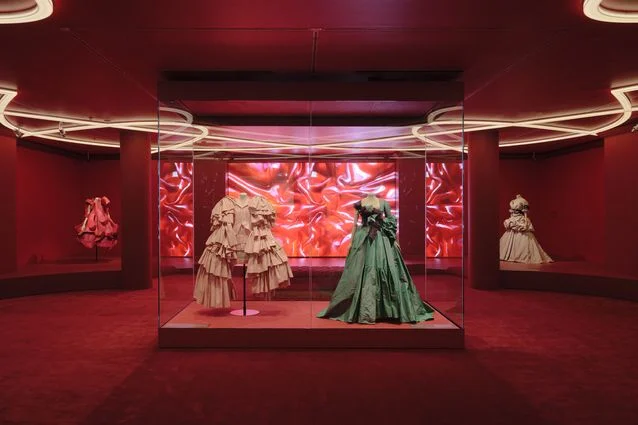
As the exhibition progresses, the spaces shift both spatially and sensorially. A smaller, intensely saturated red room referencing the heart features a kinetic lighting installation pulsing in sync with video. A following gallery, inspired by a pair of eyes, is visually distinct again, with crisp white curved partitions and circular windows. The design strategy continues through the ‘spine’ and concludes with a pair of hands, allowing the exhibition to unfold as a sequence of discrete experiences – breaking a large exhibition into a series of legible, paced moments.
View gallery
4. With so many garments to show as well as sound, film, photography and archival material, how do you make it visually legible and not overwhelming?
I rely on a combination of traditional and digital tools to test and refine ideas throughout the project. Sketching and planning are essential early on, particularly when working in plan to map the curatorial narrative. It’s a bit like a jigsaw puzzle – you have all the pieces and you know they shape they have to fit into, but they need to be continually turned and rearranged to make sense of the whole.
Increasingly, I work extensively in 3D, modelling the entire exhibition environment and placing each work as a virtual object within it. I approach this process much like a cinematographer, establishing key sightlines, framing moments of compression and release, and anticipating the visitor’s transitional views. From this model, I produce video fly-throughs that are shared with the project team to support collaborative refinement. One of the most satisfying aspects of this process is when NGV’s AV specialists add video and audio content into these renders – the exhibition begins to come alive long before it’s built.
View gallery
5. There are a few “showstopping moments” – there’s Rihanna’s Met Gala petal ensemble and Westwood’s wedding dress from the Sex and the City movie. How did the recognisability of these pieces influence your display/design decisions, and did you feel a responsibility to present them in new or unexpected ways?
I was strongly guided by the ethos of both Vivienne Westwood and Rei Kawakubo in approaching the exhibition design. Both are known as rule-breakers, but also as deeply thoughtful designers, and I wanted the exhibition to reflect that same level of care and intellectual rigour.
When working with highly recognisable garments, it’s important to acknowledge how their familiarity influences visitor behaviour. This means giving them sufficient physical and visual space, carefully considering how they are framed within the architecture, and being attentive to how their adjacency to other works can either elevate or dilute their impact. The aim was to situate these iconic pieces within a broader narrative, allowing them to resonate in new and unexpected ways through context and contrast.
View gallery
6. You’ve designed major fashion exhibitions before, such as The House of Dior at NGV. How did this one compare to others you’ve done?
Nearly a decade ago, I worked with the same core project team at NGV on The House of Dior, including curators Katie Somerville and Danielle Whitfield. It has been a real pleasure to collaborate with this team again. There is something personally satisfying about returning to the same building and galleries to begin again and create something that feels entirely new and unexpected.
Colleagues often remark when a new exhibition opens that it feels like walking into a completely different set of spaces, and hearing this validates a self-imposed challenge. For Westwood | Kawakubo, my goal was to conceive an exhibition design that was appropriate to these designers, responsive to the curatorial vision, and at the calibre of fashion exhibitions for which NGV is known. Now that the exhibition is open, I’m looking forward to seeing how visitors respond to it.
Westwood | Kawakubo is on at the National Gallery of Victoria until 19 April 2026.