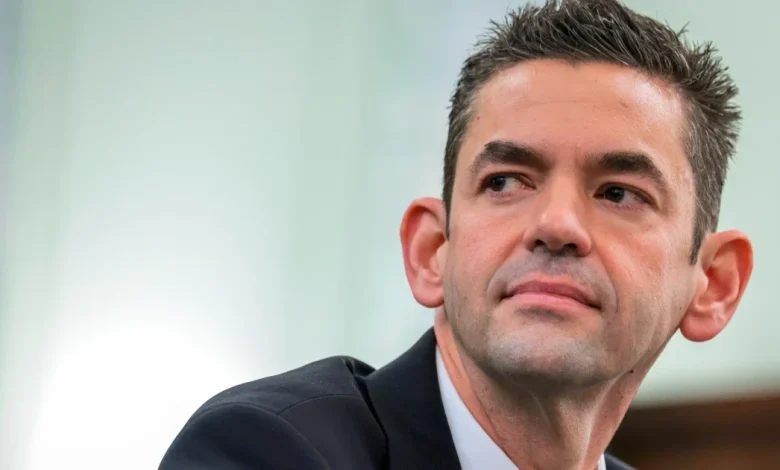
Billionaire entrepreneur Jared Isaacman was confirmed by the Senate on Wednesday to be the new head of NASA, marking the end of a dramatic saga that began more than a year ago.
Isaacman was first tapped to lead NASA in December 2024 by then-President elect Donald Trump, but Trump abruptly withdrew the nomination five months later after “a thorough review of prior associations.”
In an unusual turn of events, Trump renominated Isaacman in November, saying that his experience and passion for space “make him ideally suited to lead NASA into a bold new Era.”
The leadership change comes at a pivotal time for NASA, as questions persist over the space agency’s future budget and priorities. Like other government agencies, NASA is still reeling from major cuts to funding and personnel as part of the Trump administration’s efforts to shrink the size of the federal workforce.
The final confirmation vote was 67-30.
The Senate Commerce, Science, and Transportation Committee approved Isaacman’s nomination after a Dec. 3 hearing in which he spoke about the need to return NASA astronauts to the moon before China reaches the lunar surface.
Sen. Ted Cruz, a Texas Republican who chairs the committee, had said he wanted Isaacman confirmed by the end of the year.
Isaacman, 42, is founder and CEO of the payment processing company Shift4 but has never worked at NASA or in the federal government. He will take control of the space agency from Transportation Secretary Sean Duffy, who had served as NASA’s interim administrator since July.
During his hearing before the Senate committee, Isaacman said he is focused on returning to the moon and winning the new space race with China. Both countries want to establish a long-term human presence on the lunar surface, but NASA’s Artemis program has faced numerous delays and cost-overruns. China’s space program, meanwhile, has advanced at a furious pace in recent years.
NASA aims to send four astronauts on a flight around the moon next year in a crucial test of its next-generation rocket and spacecraft. If successful, the space agency said it will attempt to land a crew near the moon’s south pole in 2027. China has said it plans to land its own astronauts on the lunar surface by 2030.
Beyond NASA’s lunar ambitions, the space agency faces uncertainty over its funding and objectives. Earlier this year, Trump’s budget blueprint suggested cutting more than $6 billion, or roughly 24%, from NASA’s funding, but those proposals met strong opposition in the House and Senate.
In his confirmation hearing, Isaacman faced scrutiny over leaked documents known as Project Athena that outlined his vision for NASA. The 62-page plan, first obtained by Politico, suggested prioritizing Mars missions, focusing on nuclear electric propulsion, overhauling some NASA centers and majorly changing the space agency’s science operations, including a bigger emphasis on commercialization.
Isaacman said during the hearing that Project Athena was a “draft document” but stood by its content, adding that it was “all directionally correct.”
Questions also arose during the confirmation process about Isaacman’s ties to Elon Musk. Isaacman has twice flown to space on commercial SpaceX missions, funding the flights himself for an undisclosed sum. Musk, the founder and CEO of SpaceX, once a close Trump ally and backed Isaacman when he was first nominated.
The president’s decision to withdraw Isaacman’s nomination coincided with a public feud between Trump and Musk. In his confirmation hearing, Isaacman was grilled about his connection to Musk, including how his own business dealings are intertwined with SpaceX.
Isaacman downplayed the association, saying that his trips to space were with SpaceX because it is “the only organization that can send astronauts to and from space.”
“There are no pictures of us at dinner, at a bar, on an airplane or on a yacht because they don’t exist,” Isaacman added.