Manitoba’s largest school division only has one fixed rule for its staff and students when it comes to using artificial intelligence.
“Don’t put personal or confidential or sensitive information into one of these robots,” said Matt Henderson, superintendent of the Winnipeg School Division.
Given how rapidly this technology is evolving, Henderson said there’d be little value in creating other hard-and-fast rules.
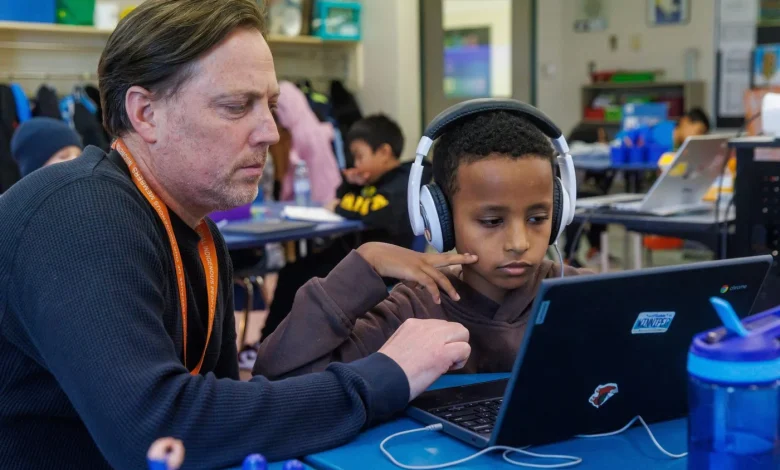
Yoas Degefu, wearing headphones, listens and reads to a graphic novel while his teacher Russell Miller supervises. – Mike Deal / Winnipeg Free Press
Instead of banning AI programs, the board office is promoting the responsible use of AI-powered chatbots and related tools.
Its new framework’s overarching principle — “AI-assisted, never AI-led” — was informed by feedback from staff and student families.
“You have to embrace it. You can’t fear it,” said Becca Koenig, a student teacher who is doing her inaugural University of Manitoba practicum in the division.
“(Our students) are going to use it, so we might as well teach them how to use it properly.”
Several months into her after-degree education program, Koenig has found U of M professors rarely outlaw AI chatbot-related support in its entirety.
Faculty members have made clear when, why or how it can be used, if at all, she said, noting that generative AI is typically allowed during the brainstorming stages of projects.
The 27-year-old said she is setting a similar tone with her middle years students at Earl Grey School, one of about 80 buildings in WSD.
The division’s AI framework states it aims to support teachers to design lessons that are more equitable and engaging.
Henderson noted that some parents have urged WSD to ban AI in recent months. At the same time, teachers have expressed concern that schools failed to think proactively about how phones and social media should, if at all, intersect with education, the superintendent said.
“The horse has left the barn on those. How do we make sure that we’re being really responsible and intelligent about artificial intelligence?” he said.
Senior administration has sought input from its 6,000 employees, including teachers, custodians and clerks, about how they‘ve been using AI since the start of the school year.
The board office invited families to a Sept. 17 open house at Technical Vocational High School to discuss the topic.
Russell Miller, a teacher and father in central Winnipeg, described AI as “a juggernaut” unlike anything else he’s used in his 22-year career.
The Grade 4 teacher at Greenway School has adopted Google Gemini as a virtual assistant and in-house translation service.
Miller is currently using it to create vocabulary charts featuring English and Arabic words, as well as phonetic pronunciations, for a newcomer student from Syria.
One of his proudest moments from last year was helping his students produce “Bill-Nye-style songs” about ligaments, nerves and other anatomy terms via Suno, an AI music creator.
“Once you do a bit of the hard work and learn how you can utilize it, yes, AI saves time — but it also just makes you a better teacher,” he said, noting that it helps him better tailor lessons to his students’ diverse interests and skillsets.
Miller has completed division-run professional development, Google training modules and a microcredential on generative AI (GenAI).
WSD recently renewed its partnership with Red River College Polytechnic to train a second group of teachers to leverage AI-powered chatbots and other tools that fall under the GenAI umbrella.
Koenig, the student teacher, keeps the ChatGPT app handy for when she’s in a creative rut.
She recently sought ideas for a fun, beginner and festive art project that was “flight-themed” when she was teaching a science unit on aviation.
The chatbot proposed drawing aurora borealis with Santa Claus’ sleigh in the forefront.
In response, Koenig tracked down oil pastels. She also found herself looking up videos of drones flying in the northern lights and researching this phenomenon’s historical significance to Indigenous people.
WSD’s new framework calls on teachers to “ground every AI use” and reflect on whether their usage “serves reconciliation and human flourishing.”
Koenig said she was proud of how her interdisciplinary unit on flight turned out, and how she was able to incorporate Indigenous perspectives into it.
“It hit all the points that I wanted to cover,” she said. “And I don’t think if I would’ve thought of it if it weren’t for ChatGPT.”