The decades‑old subsidy for new gas lines faces a decision that could reshape energy costs and building choices.
Watch Gov. Kathy Hochul speaking with USA TODAY Network’s Ed Forbes
New York Gov. Kathy Hochul spoke with Ed Forbes, senior director for opinion and engagement for the USA TODAY Network Northeast, on May 29, 2025.
In mid-November, the Hochul Administration agreed to pause a law that threatens to cut into fossil fuel industry profits by requiring new buildings seven stories or lower to have electric heat and appliances.
The law backed by Gov. Kathy Hochul in 2023 represented a victory for the state’s clean energy advocates, one that would reduce planet-warming carbon emissions in buildings — a leading source of greenhouse gases — keeping them from fouling the air for decades to come.
State Republicans waged a relentless campaign to undermine the idea, casting it as another costly, green energy mandate designed to separate New Yorkers from their gas stoves and furnaces.
So the administration’s November pivot — delaying the law’s January start while a legal challenge from the natural gas industry plays out — was viewed as a betrayal by some of Hochul’s fellow Democrats.
It was the word they repeated over and over during a conference call the day after the announcement. Brooklyn Assemblymember Marcela Mitaynes said the governor’s “two-steps-forward, one-step back” approach to climate initiatives wasn’t working. Hochul needed to go on the offensive against a president who entered the White House declaring it was time to “Drill Baby Drill,” others declared.
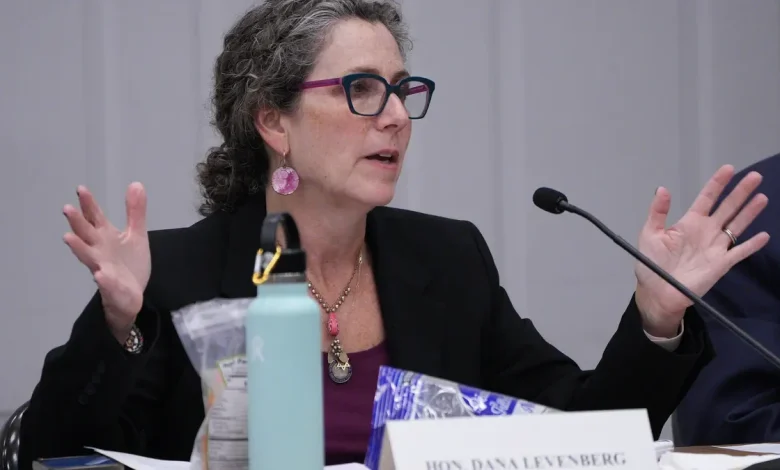
“Now is the time to stand up and fight for what we know is right, for what science tells us is right,” Assemblywoman Dana Levenberg, a Hudson Valley Democrat said.
“It just doesn’t make sense,” she added. “The all-electric buildings law is forward-looking legislation that makes environmental and economic sense particularly when you consider the higher cost of natural gas delivery versus electricity.”
Hochul’s decision to delay the law’s implementation has turned up the volume on criticism from climate advocates on the left who are questioning the governor’s commitment to the cause and threatening payback if things don’t start to go their way.
Climate advocates condemn the pause as a setback
Days before news of the all-electric buildings pivot broke, Food and Water Action, the political arm of the influential environmental watchdog, announced it was endorsing Lt. Gov. Antonio Delgado in his long shot bid to unseat Hochul in June’s Democratic primary, saying he was “willing to stand up to corporate polluters.”
The endorsement came after the Hochul Administration approved a controversial gas pipeline in New York Harbor favored by the Trump Administration.
“It’s very obvious that the kind of play nice, insider politics has gotten the climate movement nothing with this governor,” said Alex Beauchamp, the northeast region director of Food and Water Watch. “It doesn’t mean it can always get you nothing, but it certainly has with her. We’ve seen what happens when you sort of trust that they’ll do the right thing. That is not going to work. She is going to have to feel unrelenting pressure. And that’s what we’re trying to do over the next few months.”
The group has a history of making things uncomfortable for governors.
In its campaign to get Gov. Andrew Cuomo to ban hydraulic fracking more than a decade ago, Food and Water Watch had supporters pepper his office with phone calls in what became known as “Call Cuomo Mondays.” The governor agreed to the ban in December 2014, after a strong showing in the Democratic primary by anti-fracking candidate and Fordham Law professor Zephyr Teachout.
Through a spokesman, Hochul said the decision on the all-electric buildings law was meant to ensure it survives legal challenges.
“The Governor remains committed to the all-electric-buildings law and believes this action will help the State defend it, as well as reduce regulatory uncertainty for developers during this period of litigation,” spokesman Ken Lovett said. “Governor Hochul remains resolved to providing more affordable, reliable, and sustainable energy for New Yorkers.”
And the governor, in an interview with the USA TODAY Network in June, said she remains committed to the goals laid out in the Climate Law and Community Protection Act of 2018, which include adding renewables like solar and wind power to the grid and reducing carbon emissions.
But, she noted, surging gas prices, inflation, supply chain disruptions and a Trump Administration hostile to climate initiatives means the state could be facing headwinds over the next four years.
“So I need all the champions of this (climate) law,” Hochul said. “They need to understand that my heart and my vision is to take us to that place to protect our environment and our climate for the future, but I also can’t turn my back on what we need to do now.”
Climate challenges piling up
Hochul frequently invokes affordability to defend decisions unwelcomed by climate advocates. She delayed the start of congestion pricing, a plan to reduce the number of cars entering New York City at 60th Street and below, until the toll was reduced to $9.
It’s a stance that resonates at a time when more than 1 million state ratepayers are behind at least two months on gas and electric bills that are coming in two and three times larger than they’ve been in prior years. Grassroots movements in Rochester and the Hudson Valley are calling for the elimination of privately-run utilities.
But green energy advocates say now’s not the time to shy away from the challenges but to build on the progress already made. They say the transition to a greener economy will make the state less dependent on natural gas solutions and bring prices down. “We need to see a shift in direction from the governor in this coming year,” said Liz Moran, Earthjustice’s New York Policy Advocate.
In the meantime, the obstacles standing in the way of that transition continue to pile up.
The downstate electric grid is now nearly totally reliant on natural gas since the shutdown of the Indian Point nuclear power plant in 2021. A sluggish buildout of renewable energy upstate has the state rethinking climate goals of 70% reliance on renewable sources of power — wind, solar and hydro — by 2030. A state energy plan delivered this week says natural gas and nuclear power will need to stick around for at least the next 15 years to help the state achieve its energy needs.
And the New York Power Authority this month scaled back its outlook for adding more renewables to its portfolio, citing reductions in federal tax credits that have hurt developers.
What ending the 100‑foot gas rule could save ratepayers
The governor’s next test comes this week when she faces a Dec. 19 deadline to sign or veto a bill passed by the state Legislature this year repealing the so-called 100-foot rule. The rule requires utilities to provide gas service to customers who ask for it with the tab picked up by all ratepayers.
Advocate groups peg the annual cost to ratepayers at nearly $600 million.
“This is an outdated mandate that every New Yorker sees on their utility bills that requires them to pay for the expansion of gas pipeline and it comes at a heavy cost,” Moran said.
Republicans aren’t buying it
Republicans who’ve been railing against the all-electric bill were not about to heap praise on the governor for delaying what they’ve termed the “gas stove ban.” They viewed her move as a short-term maneuver to deflect conflict over the measure until after the November 2026 election.
“This is a cynical political ‘pause’ so she can screw New Yorkers with higher prices after the election,” said Rep. Elise Stefanik, a Republican who’s running for governor. “New York needs a full repeal and only a full repeal of the gas stove ban. Not this desperate pause to try to resuscitate her abysmal polling numbers.”
The idea is fairly unpopular with New Yorkers. In a Siena College poll taken in February 2023 when lawmakers were weighing the proposal, some 39% of surveyed voters supported the idea, while 53% opposed it.
The move was welcomed by upstate business leaders.
And in October, several upstate Democrats asked Hochul to hold off on enforcing the law. “A pause is not a rejection of decarbonization goals,” Assemblyman William Conrad, who represents a district in Western New York, wrote. “It is a prudent measure to ensure we do not jeopardize system reliability, impose runaway costs, or force unintended consequences on citizens and businesses.”
Beauchamp believes a backslide on the all-electric law could resonate not only with green energy supporters but voters watching to see if Hochul will stand up to President Trump.
And he said it may not be too late for her to reconsider. He recalls how Cuomo pivoted and embraced a ban on fracking, a process that unleashes natural gas from shale formations using a mix of chemicals water and sand.
“I don’t think Gov. Hochul’s views are all that concrete,” Beauchamp said. “Certainly, on climate issues we’ve kind of seen her waffle both directions. When she feels enough pressure, when she gets that this is a problem for her, she’s certainly been willing to change in the past. So you’d rather have someone who’s with you all the time but I do think that if we have a big enough showing perhaps we can win her back. But we’ll see.”
Thomas C. Zambito covers energy, transportation and economic growth for the USA TODAY Network’s New York State team. He’s won dozens of state and national writing awards from the Associated Press, Investigative Reporters and Editors, the Deadline Club and others during a decades-long career that’s included stops at the New York Daily News, The Star-Ledger of Newark and The Record of Hackensack. He can be reached at tzambito@lohud.com