It’s December, and we’re in our darkest month. It is also now meteorological winter — the name given to the coldest three months of the year (December, January and February). December comes with one of the year’s busiest meteor showers, and this time around, the final supermoon of 2025.
This is the month of the winter solstice, which marks the start of astronomical winter in the Northern Hemisphere. We’ve still got a few weeks to go before then, but already we’re almost scraping bottom in terms of sunlight. Tomorrow has only 10 minutes more daylight than the day of the solstice, which occurs at 10:03 a.m. on Sunday, Dec. 21.
Those of us who tend to notice sunsets more than sunrises will get a preview of sorts, as the sun goes down earlier on Sunday and Monday (Dec. 7 and 8) for our region than at any other time. On the up side, if you can get through these, the sun starts setting a few seconds later on subsequent days and the pace picks up as we approach and pass the solstice.
At the solstice, we will have added nearly four minutes of daylight to the end of our day. Two weeks after that, on Saturday, Jan. 3, 2026, when the latest sunrise happens, sunset comes almost 13 minutes later than today. So, take heart.
In Springfield, the shortest day (on the solstice) has nine hours and six minutes of daylight, but the surrounding couple of days also fall within a few seconds of that. You won’t notice the difference between them.
Just a few minutes north in Greenfield, the days around the solstice are six minutes shorter. Burlington, Vermont, gets 16 minutes less. The trend continues to the Arctic Circle, where the sun doesn’t come up at all for one day (but we needn’t concern ourselves with that). Just remember that around here, winter solstice days are more than six hours shorter than those at the summer solstice in June.
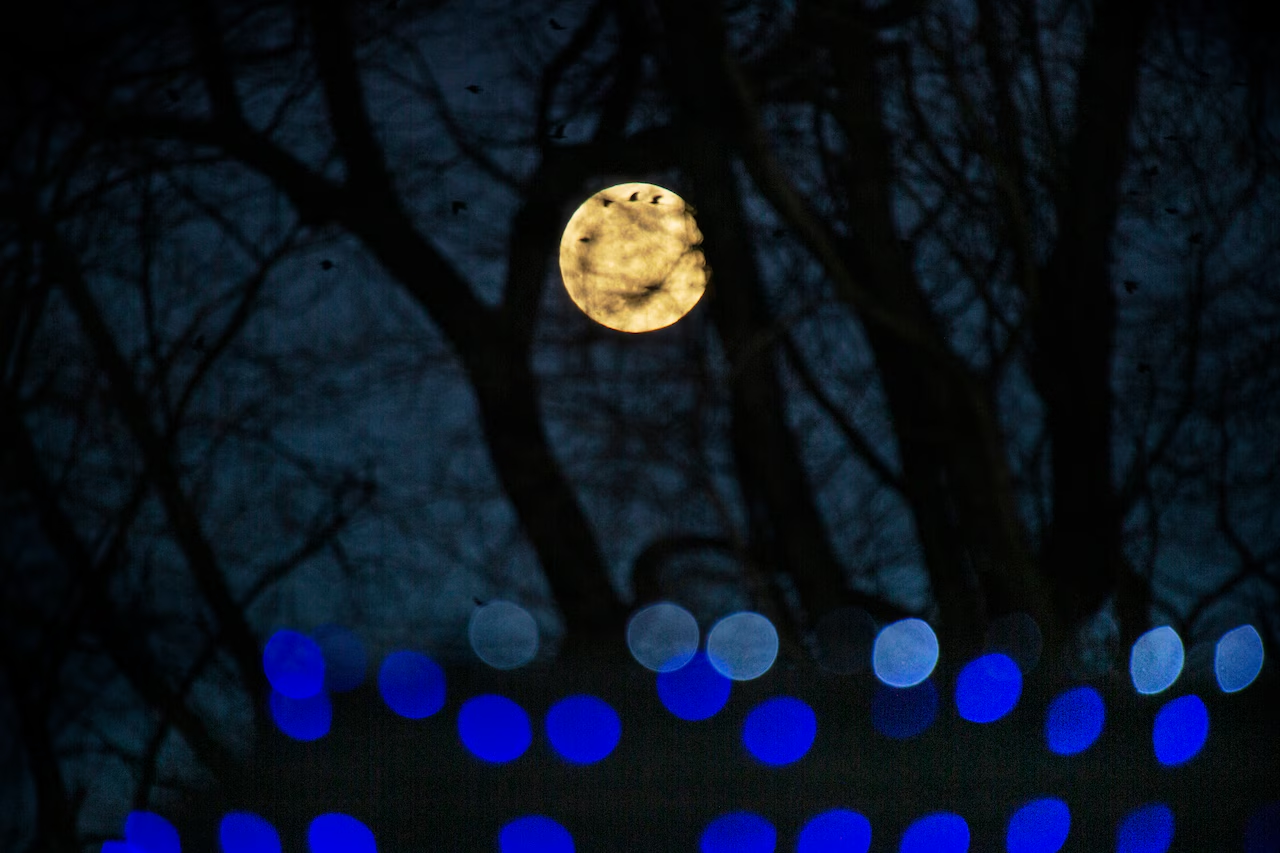
Tomorrow’s full December “Cold Moon” provides a brief antidote to the darkness. Full moons are opposite the sun in our sky; those that occur nearest to the winter solstice track higher across the sky than full moons at any other time of year, countering the sun’s lowest passes. Tomorrow’s will pass very high overhead in the middle of the night.
This year’s “Cold Moon” is noteworthy as a “supermoon” — a full moon that occurs near the time it is also closest to Earth, thus appearing slightly larger in the sky than usual. The moon reaches perigee, the closest point in its orbit of Earth, tomorrow at 6:07 a.m., when 221,806 miles away, then turns full just 12 hours later, at 6:14 p.m.
If skies are clear, bundle up and check it out — especially if there’s snow on the ground. If you can get out late when the moon is highest, its brightness might amaze you. The next supermoon will either be Jan. 3, 2026, or Dec. 24, 2026 — depending on who’s definition we use.
After tomorrow, the moon wanes and comes up later each night. That’s a good thing if you want to catch what could be the year’s busiest night of meteors. The Geminid Meteor Shower reaches peak activity on the night of Dec. 13-14, with more than 100 meteors per hour under the best possible viewing conditions.
By then, the moon will be a thin waning crescent, offering dark skies. The Geminids appear to radiate from the constellation Gemini, which rises in the mid-evening. The peak rate occurs from midnight to 3 a.m., but some should be visible throughout night.
Geminid meteors can be bright and sometimes colorful. They are not specially fast and do not usually leave trails. These meteors are also seen in the Southern Hemisphere, but only during the middle of the night and at a reduced rate.
Unfortunately, December is also one of our cloudiest months here in southern New England, so good luck with any celestial observations.
While we “endure” this deficit of sun and warmth every year by dressing it up with our own lights and festivities, most of us keep nature at bay with warm homes and full bellies. The less fortunate among us, however, and all creatures living outside, face the harsher reality of these longest, coldest and darkest nights, which hints of the universe at large.
In the beginning of January, Earth is actually 3 million miles closer to the sun than at the start of July, so our distance from the sun has little to do with our winter. What does is Earth’s tilt in relation to its orbit around the sun. At the winter solstice, the North Pole – and the whole Northern Hemisphere – is tilted at its maximum angle away from the sun.
For us, that means the sun traces its lowest and shortest arc across our sky by day. At night, it burrows most deep below the horizon. The stars we see now are more directly opposite to the sun than those in summer.
These winter stars include the brightest collection of any season. The constellations and stars are nature’s celestial clock as the sparkling stars we associate with winter appear earlier each night in our eastern evening skies.
Hardy souls can appreciate this view, secure in the fact that Earth will continue in its yearly orbit, and soon tip its North Pole back toward the sun. We know that spring will come, and our hemisphere will once again be warm and bright.
Have you ever wondered how we’d fare if it didn’t?
During winter, our part of Earth tries to equalize with surrounding space, which, like the rest of the universe, is cold and dark. It’s that way because, it is mostly empty. Go see for yourself.
Except along the plane of the Milky Way, the stars are spread thin. There really isn’t much stuff out there, and on a clear night we can see almost forever. The only thing stopping us is our small pupils and insensitive retinas, which limit views to this region of our galaxy, and barely to the next nearest major one, the Andromeda galaxy, 2.5 million light years away.
All existing matter – the stars, nebulae, planets, dust, and atoms – everything – accounts for 0.0000000000000000000042 percent of the universe. (That’s 20 zeroes after the decimal point, in case you don’t feel like counting.) The space between galaxies is so vast, that from most random locations in the Universe, no light would be visible to the human eye. This is where we live.
It’s a bitter pill to swallow, but astronomy humbles us. That allows us appreciate our own planet and strengthen our sense of kinship with all its creatures. It allows us to embrace and acknowledge our lot, and forces us to contend with our interdependence.
Find rise and set times for the sun and moon, and follow ever-changing celestial highlights in the Skywatch section of the Weather Almanac in The Republican and Sunday Republican.
Patrick Rowan has written Skywatch for The Republican since 1987 and has been a Weather Almanac contributor since the mid 1990s. A native of Long Island, Rowan graduated from Northampton High School, studied astronomy at the University of Massachusetts-Amherst in the 1970s and was a research assistant for the Five College Radio Astronomy Observatory. From 1981 to 1994, Rowan worked at the Springfield Science Museum’s Seymour Planetarium, most of that time as planetarium manager. Rowan lives in the Florence section of Northampton with his wife, Clara, and their cats, Eli and Milo.