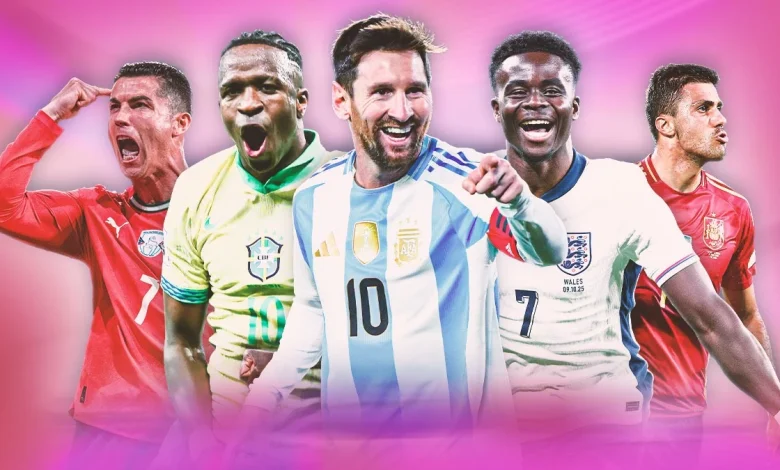
Ahead of the FIFA World
Cup 2026 draw on Friday 5 December, the Opta supercomputer has
produced its early predictions for this summer’s tournament in
North America. Here are the
results.
The
2026 FIFA World Cup draw takes place in Washington D.C. on 5
December, allowing fans of all nations to start plotting their
routes to a possible coronation at New Jersey’s MetLife
Stadium.
Sixteen venues across the United States, Canada and Mexico will
play host to the biggest-ever edition of the tournament, with the
number of teams increasing from 32 and 48 and the tally of games
upped from 64 to 104.
Six of the teams appearing at the tournament are still to be
decided, with four qualifying via the UEFA play-offs and another
two via the inter-confederation playoffs.
But most of the favourites are set, with Lionel Messi hoping to
help Argentina become the first team since Brazil in 1962 to
successfully defend their crown.
Argentina, though, will face fierce competition, not least from
2022 runners-up France and reigning European champions Spain.
England and Brazil, meanwhile, will hope the appointments of
Thomas Tuchel and Carlo Ancelotti prove inspired decisions.
Cristiano Ronaldo’s Portugal should not be discounted, while the
three host nations will be desperate to make their mark.
And what of a Norway team spearheaded by Manchester City goal
machine Erling Haaland?
Ahead of this week’s draw, we have taken a deep dive into the
Opta supercomputer’s first set of World Cup predictions to assess
who is most likely to lift the trophy.
The
Favourites
Spain:
17.0%
At Euro 2024, Luis de la Fuente’s Spain produced one of the most
eye-catching international tournament successes in recent
memory.
La Roja swept all before them, winning six of their seven
matches inside 90 minutes and only requiring extra-time to
eliminate hosts Germany in the quarter-final. They scored 15 goals
in the tournament – four more than anyone else.
And there has been no downturn from De la Fuente’s side since.
Spain are now unbeaten in their last 31 competitive games (W25 D6,
excluding penalty shootouts), beating the famous 30-match run they
enjoyed under Vicente del Bosque between 2010 and 2013 – a streak
that saw them win both the World Cup and the Euros.
By the time the next international break comes around in March,
it’ll be three years since Spain last lost a competitive match.
That defeat came away at Scotland on 28 March 2023 in a Euro 2024
qualifier (2-0).
It is little surprise, then, that
Spain are our predictive model’s early World Cup favourites,
going all the way in 17.0% of tournament predictions.
If Spain are to triumph, it is likely Lamine Yamal will play a
key role. Their Euro 2024 triumph came the day after Yamal’s 17th
birthday, as he replaced Pelé (1958, 17 years, 249 days) as the
youngest player to feature in a World Cup or European Championship
final.
Yamal created the most chances at the tournament, with 19, while
only teammate Nico Williams (2.1) had more expected assists (xA)
than his 2.0.
Spain will be closely monitoring the progress of Rodri, with the
midfielder playing just 294 minutes in the Premier League for Man
City since tearing his anterior cruciate ligament last year.
Barcelona duo Pedri and Gavi will also look to prove their fitness
after injury-disrupted starts to 2025-26.
But if their key players enter the tournament in good health,
Spain will be supremely confident of repeating their feat from
2008-12 of holding the Euros and World Cup trophies at the same
time.
France:
14.1%
The 2026 World Cup will mark the end of an era in French
football, with Didier Deschamps set to stand down from his role as
Les Bleus’ head coach after 14 years at the helm. He will hope to
go out with a bang and cement his legacy as France’s greatest
boss.
Deschamps’ reign has comprised 175 games, so if they reach the
first knockout round, he will have overseen 100 games more than
France’s next-longest serving boss (Raymond Domenech, 79).
After watching his team fall agonisingly short on penalties
against Argentina in Qatar, he has another chance to become only
the second coach to win multiple World Cups (after Vittorio Pozzo
in 1934 and 1938).
Deschamps also lifted the trophy as a player when he was captain
in 1998 and this will be Kylian Mbappé’s first World Cup as France
skipper.
The Real Madrid sensation will be targeting individual and team
records.
Mbappé is closing in on Olivier Giroud’s mark of 57 goals for
France, having netted 55 times in his 93 caps. There is a good
chance that record falls before the World Cup, but he is also
chasing down Miroslav
Klose’s all-time total of 16 goals at World Cups, having netted
12 times in just two editions of the tournament (four in 2018,
eight in 2022).
Messi (13) is one goal ahead of Mbappé, who will surely take
possession of the record eventually. But the prospect of two icons
duelling to end the tournament in the lead should be absorbing
viewing.
France also boast the player recently crowned the world’s best,
and it is not Mbappé. Ousmane Dembélé won the 2025 Ballon d’Or
after spearheading Paris Saint-Germain’s run to a first UEFA
Champions League crown, scoring 33 goals and recording 13 assists
in 2024-25 from a central attacking role.
Finding a way to get Mbappé and Dembélé to function in the same
attack will be one of the major conundrums facing Deschamps.
With a 14.1% chance, France are the supercomputer’s second
favourites, just behind Spain, who beat them 5-4 in the semi-finals
of the UEFA Nations League in June.
England:
11.8%
The only one other team assigned more than a one-in-10 chance of
becoming world champions is England, who are out to end 60 years of
hurt at major tournaments.
The Three Lions enter their first – and potentially only –
tournament under Tuchel as third favourites with a 11.8%
probability of lifting the trophy, having come up short in two
European Championship finals under Gareth Southgate.
Tuchel’s task is simple – get international football’s nearly
men over the line. He could become only the third manager to win
both the UEFA Champions League and the World Cup, after Marcello
Lippi (Juventus, Italy) and Del Bosque (Real Madrid, Spain).
His England reign took some time to get going, as England
laboured past Albania (3-0), Latvia (2-0), Andorra (1-0 and 2-0)
and were beaten 3-1 by Senegal in a June friendly.
But a rampant 5-0 victory in Serbia in September showcased the
Three Lions’ potential, and the emergence of Elliot Anderson seems
to have finally ended their search for a central midfield partner
for Declan Rice.
England ultimately finished Group K with eight wins – and eight
clean sheets – from as many matches, becoming only the second team
to win all their games in a UEFA World Cup qualifying campaign
without conceding after Yugoslavia in 1954.
Southgate’s England teams were also solid at the back but rarely
free-flowing. At Euro 2024, they recorded just 5.4 xG – Turkey,
Austria and Switzerland were among the teams to better that
tally.
So, Tuchel is also expected to provide better entertainment, and
he certainly has the tools to do so, with a stunning array of
options to choose from, particularly in the attacking midfield
positions.
There should be plenty of service for Harry Kane, who is
Europe’s most in-form striker, netting 24 goals in 20 matches for
Bayern Munich since the start of the season in August. But there is
a competitive race for the positions behind the England skipper
after Tuchel suggested Jude Bellingham and Phil Foden could not
both start, while Cole Palmer’s season has barely got going due to
injuries.
Given the way England often toiled at Euro 2024, Tuchel’s
refusal to crowbar in the big names could come as a breath of fresh
air, and the likes of Eberechi Eze and Morgan Rogers are staking
impressive claims.
Argentina: 8.7%
In the eyes of Argentina’s supporters, Messi struggled to emerge
from Diego Maradona’s shadow until the 2022 World Cup.
But the Barcelona legend produced one of the greatest individual
World Cup campaigns, scoring seven goals and assisting three, while
becoming the first player to ever net in the group stage, last 16,
quarter-finals, semi-finals and final of a single edition.
Messi also led all players in Qatar for shots (32), chances
created from open play (17) and fouls won (22), becoming the
second player to top all three metrics at a single World Cup. The
other? Maradona in 1986 (30 shots, 19 open-play chances created, 53
fouls won).
Now, he gets the opportunity to do something even Maradona could
not accomplish – win a second World Cup.
Messi has shown no signs of slowing down, helping Inter Miami
reach the Major League Soccer Cup final while contributing a
staggering 35 goals and providing 21 assists in MLS action this
year.
The attacker
already leads all players for appearances (26) and goal
involvements (21, since assists were first recorded in 1966) at
World Cups, while Messi’s battle to break Klose’s goal record
before Mbappé is an enthralling additional storyline.
Argentina dominated the CONMEBOL World Cup qualification group,
finishing nine points clear of second-placed Ecuador, and last year
they also retained the Copa América for the first time since
1993.
A lack of recent match practice against top-class European
opponents could count against the Albiceleste, who also saw Ángel
Di María retire from international football after the Copa
América.
But the likes of Enzo Fernández and Julián Alvarez have kicked
on in the last two years, and any team which has Messi has a chance
of going all the way – a creditable 8.7% chance, according to the
supercomputer.
Germany:
7.1%
Germany are the supercomputer’s fifth favourites with a 7.1%
chance of winning a record-equalling fifth World Cup.
But by the time next year’s tournament rolls around, it will
have been 12 years since Germany played a knockout game at a World
Cup. That was when they beat Argentina in the 2014 final.
Julian Nagelsmann’s side were beaten in the quarter-finals on
home soil at Euro 2024, marking the first time Germany have
appeared at four major tournaments (World Cup/Euros) in a row
without reaching a semi-final at any of them.
Their route to this World Cup was not completely smooth, either,
as they were left needing victory over Slovakia in their final
Group A game to avoid the play-offs. But they won that match by a
statement 6-0 scoreline, with Nick Woltemade, Serge Gnabry and
Leroy Sané among the goals.
Germany arguably played some of the best football at Euro 2024,
ranking second for average possession (62.5%) and goals scored
(11), but Nagelsmann has plenty of selection dilemmas to
consider.
Marc-André ter Stegen has lost his place as Barcelona’s
first-choice goalkeeper after undergoing back surgery, while
Nagelsmann has tested multiple midfield pairings since Toni Kroos’
retirement – Aleksandar Pavlović partnered Leon Goretzka in the
final two qualifiers.
Germany have at least scraped into Pot 1 for the group-stage
draw, taking the 12th and final spot among the top seeds, ahead of
Croatia, and despite question marks it would be rash not to
consider them as contenders at this stage.
Portugal: 6.6%
When Cristiano Ronaldo swapped Manchester United for Al-Nassr
after the 2022 World Cup, some may have expected it to be a case
of, ‘out of sight, out of mind’.
But the five-time Ballon d’Or winner simply cannot stop making
headlines, with FIFA recently announcing Ronaldo would not serve
the typical three-match ban following his red card in Portugal’s
defeat to the Republic of Ireland, freeing him up to play their
World Cup opener.
And after Messi finally ended his wait for a World Cup win in
Qatar, Portugal are assigned a 6.6% chance of giving Ronaldo his
own crowning moment.
Portugal boast, on paper, one of the most talented squads at the
tournament. Vitinha, João Neves and Nuno Mendes all enjoyed
spectacular 2024-25 campaigns with PSG, while EPL stars Rúben Dias,
Bernardo Silva and Bruno Fernandes make up a technically-gifted and
highly-experienced spine.
But when the tournament begins, the likelihood is that Ronaldo
will hog the headlines, just as he did in Qatar in 2022 and at Euro
2024. At the former tournament, Ronaldo was dropped for a last-16
tie against Switzerland after a series of ineffective displays, and
his replacement Gonçalo Ramos scored a hat-trick in a 6-1 win.
Then, in Germany, Ronaldo broke down in tears after seeing a
penalty saved in Portugal’s last-16 tie against Slovenia, which
they eventually won on spot-kicks.
Portugal went out to France at the next stage, as Ronaldo ended
the tournament without a goal from 23 shots and 3.6 xG – the
second-highest tally at the competition.
Like Messi,
Ronaldo will appear at a record-breaking sixth edition of the World
Cup, but of his eight goals in 22 games at the tournament,
three have been penalties and none have come in the knockout
stages.
However, this year’s Nations League triumph offers significant
hope that Roberto Martínez can get the balance right even while
accommodating the 40-year-old, who is still full of confidence
after scoring 84 goals in 86 Saudi Pro League games.
Fans have learned to never write Ronaldo off, and however
Portugal’s campaign goes, it is unlikely to be dull.
Brazil:
5.6%
Brazil are the only side to qualify for every edition of the
World Cup, though the Seleção cut things a little too fine this
time around, finishing fifth in CONMEBOL’s qualifiers.
Ancelotti was only in charge for the final five games of their
campaign, but less than eight months into his reign, he has already
overseen surprise defeats to Bolivia and Japan, as well as poor
draws with Ecuador and Tunisia.
Next year, it will have
been 24 years since Brazil last lifted the World Cup. They have
only endured one previous drought of that length since first
winning the tournament in 1958, between 1970 and 1994.
That previous dry spell ended, of course, in the United States,
and Brazil are assigned a 5.6% chance of another stateside
triumph.
If Brazil are to go all the way, Ancelotti must find a way to
get more out of Vinícius Júnior.
Vinícius has played under five different head coaches since
joining Real Madrid, and 149 of his 192 goal involvements for the
club came during Ancelotti’s second spell in charge of Los
Blancos.
Estêvão’s flying start to life with Chelsea gives Brazil another
electric option out wide, though it remains to be seen whether
Ancelotti will bow to pressure to recall Neymar – if he proves his
fitness – for his first appearance since 2023, amid the forward’s
persistent injury issues.
Brazil have consistently underwhelmed in recent years, failing
to get past the last eight at the two most recent World Cups and
the 2024 Copa América, but if any manager can get them to perform
on the big stage in a knockout tournament, it’s Ancelotti.
Netherlands: 5.2%
The Netherlands have reached the most World Cup finals without
ever lifting the trophy (three), and they are the eighth and final
team assigned more than a 5% chance of triumphing next year, at
5.2%.
The Oranje’s run to the semi-finals of Euro 2024 – losing late
on to England – was their best at any tournament since finishing
third at the 2014 World Cup.
Their current side has a distinctly English influence, with four
Premier League players scoring in their final World Cup qualifier
versus Lithuania (4-0, Tijjani Reijnders, Cody Gakpo, Xavi Simons
and Donyell Malen) – the first time that has occurred for the
Netherlands.
Ronald Koeman has restored the traditional Dutch 4-3-3 system
and has been rewarded with some positive performances against elite
opponents.
One recurring issue in recent years has been their lack of a
true centre-forward. But Memphis Depay remains a talisman for his
nation, becoming their all-time leading scorer when he netted his
51st international goal in September.
The Netherlands may lack the star power of the other main
favourites and are slipping under the radar with many, but the
supercomputer thinks they are worthy of consideration.
The Host
Nations
France became the sixth team to win the World Cup as hosts in
1998, but no side has accomplished the feat since then.
Even the most ardent supporters of the United States, Mexico or
Canada would struggle to make the case for a home triumph in 2026,
but with a little luck in the draw, you never know.
United
States: 0.9%
Eleven of the tournament’s venues are in the USA, and Mauricio
Pochettino’s side are assigned a 0.9% chance of going all the way.
They will be placed in Group D, with two of their first-round games
taking place in Los Angeles and the other in Seattle.
The USMNT appointed Pochettino after of a
humiliating group-stage exit as Copa América hosts last year,
and things did not immediately improve as the Argentine lost five
of his first 10 matches at the helm.
Pochettino’s side did reach the final of the 2025 CONCACAF Gold
Cup, despite star names including Christian Pulisic, Weston
McKennie, Folarin Balogun and Antonee Robinson missing the
tournament.
Pochettino has had no choice but to experiment – in November,
Giovani Reyna’s return to the squad saw him become the 51st player
to start a game for the USMNT in 2025.
Along with the Gold Cup run, a 5-1 win over Uruguay last time
out put Pochettino’s critics on notice, and the USA should feel
good about their chances of being competitive in the knockout
stages.
Mexico:
1.3%
Mexico, the team that defeated the USA in the Gold Cup final,
are the host nation viewed as most likely to shock the world and
lift the trophy, with a 1.3% probability.
It remains to be seen how the introduction of a round of 32 will
affect El Tri, who lost in the round of 16 at seven consecutive
World Cups before suffering a group-stage exit in Qatar.
Javier Aguirre’s team will play in the tournament’s opening
match, in Mexico City on 11 June, but they failed to win any of
their final six games in 2025 (D3 L3) – all of them friendlies –
with five of those coming against teams lower than them in the FIFA
World Rankings.
There will likely be an experienced feel to their squad, led by
Fulham striker Raúl Jiménez, who is only eight away from Javier
Hernández’s all-time Mexico goal record of 52.
But it remains to be seen whether
40-year-old goalkeeper Guillermo Ochoa will earn a historic
call-up. He is the third player – alongside Messi and Ronaldo –
able to appear at an unprecedented sixth edition of the World Cup
and was selected for the Gold Cup, so watch this space.
Canada
(0.4%)
Canada are deemed the least likely of the host nations to go all
the way, winning the tournament in just 0.4% of our simulations,
though they are only a year removed from a historic tournament
run.
Mere weeks into Jesse Marsch’s reign, Canada reached the
semi-finals on their Copa América debut, losing 2-0 to eventual
winners Argentina. Only a penalty shootout denied them a bronze
medal, as they lost to Marcelo Bielsa’s Uruguay in the third-place
play-off.
But a stunning defeat to Guatemala, in another shootout, ended
Canada’s Gold Cup campaign at the quarter-final stage and brought
them crashing down to earth.
If Canada are to spring a surprise on home soil (their Group B
fixtures will all be played in Toronto or Vancouver), they will
need Bayern Munich’s Alphonso Davies to be in peak condition,
having been sidelined with an anterior cruciate ligament injury
since March.
World
Cup Dark Horses
In addition to the top eight favourites, there are two other
teams given at least a 2% chance of winning the World Cup –
Norway (2.3%) and Colombia
(2.0%).
Norway will be the team nobody wishes to draw from Pot 3, having
steamrolled their way through the UEFA qualifiers with a perfect
eight wins and 37 goals – the most of any team.
Haaland struck 16 of those goals, matching Robert Lewandowski’s
2018 record for the most prolific UEFA World Cup qualification
campaign. Lewandowski scored his tally in 10 games, two more than
Haaland.
Colombia also deserve their lofty status in our
projections, as they come in the tournament off the back of a run
to the final of the 2024 Copa América, having outscored all other
teams at that tournament with 12 goals.
The resurgence of James Rodríguez made headlines at that
competition, as he led the way for chances created (20) and assists
(six) – that latter tally equalled the record for a single edition,
alongside Brazil’s Alex in 2003.
Those teams round out the top 10 favourites, with
Belgium next with a 1.9% probability. Many members
of the Red Devils’ ‘Golden Generation’ remain in the fold, even if
the years are starting to catch up with them.
Kevin De Bruyne and Romelu Lukaku, now teammates at Napoli, and
Thibaut Courtois will all feature at a fourth edition of the World
Cup – no player has ever represented Belgium at more (Enzo Scifo
also four).
This will be Rudi Garcia’s first tournament in charge since
replacing Domenico Tedesco in January, and even if Belgium are no
longer the force they once were – they drew three of their eight
qualifiers and only finished two points ahead of Wales – they
remain a threat.
Croatia are another team whose best days may be
behind them but can never be ruled out. Semi-finalists in both 2018
and 2022, they are assigned a 1.1% chance of glory – lower than
Mexico and Uruguay (1.7%), whose coach Bielsa
recently went on a rant in a press conference following speculation
over his position.
Inspirational Croatia captain Luka Modrić is hoping to appear at
his fifth World Cup at the age of 40, and no team will want to see
Croatia drawn into their group from Pot 2.
Morocco (1.1%) and Ecuador
(1.0%) are the other teams with a greater than 1% chance of glory,
with Japan (0.9%) and USA just behind.
Play-Off
Hopefuls
And of course, there are also six teams still to be decided in
March’s play-offs. There is currently a combined 3.7% chance of any
of those sides going all the way, with Italy
surely the most likely candidates if they can end their World Cup
exile.
When the tournament begins, it will have been 20 years since the
Azzurri played a knockout match at the World Cup – with their most
recent such game being the 2006 final.
They must get past Northern Ireland and
potentially Wales to make it, with both of those
sides hoping to join fellow home nations England and
Scotland.
Appearing at their first World Cup since 1998, the Tartan Army
are given a 0.2% chance of lifting the trophy, level with the likes
of South Africa, Australia,
Iran and Tunisia.
Sweden (in 1958) and Czechia
(in 1934 and 1962) have both been World Cup finalists previously
(the latter as Czechoslovakia) but could still miss the tournament,
as could former European champions Denmark.
If previous World Cups are anything to go by, shocks and
surprises should be a given, so all those teams will still be
dreaming of a deep run.
World
Cup Debutants and Outsiders
With 48 teams taking part, there also will be some new names
gracing the tournament.
Debutants Uzbekistan are seen as having a
slightly better chance of impressing than the other new nations, as
they have a 0.2% chance of going all the way. A more realistic aim
might be getting through the groups after impressing in AFC
qualification – beating out sides like Qatar and United Arab
Emirates.
Cape Verde (0.1%) have qualified and are the
second-smallest nation by population (after Iceland in 2018) to
achieve the feat. They fared slightly better with our model than
the other first-timers Curaçao and
Jordan (both 0.04%).
Saudi Arabia, Qatar, Panama and New
Zealand all could be in for a difficult summer as they
have the same rating as Cape Verde (all 0.1%).
As things stand, the least likely nation to prevail after coming
out bottom in our simulations is Haiti (0.03%), who have qualified
for the first time since 1974, but it already looks clear there are
going to be some brilliant stories from top to bottom in next
year’s tournament.
Enjoy this? Subscribe
to our football
newsletter to receive exclusive weekly content. You should
also follow our social accounts over on X, Instagram, TikTok and Facebook.