This article contains major character or plot details.
Season 1 of The Abandons opens with a land war brewing beneath the silver-rich ground of Jasper Hollow, on the edge of the booming frontier town of Angel’s Ridge, and ends with that escalating conflict exploding into an inferno that rewrites the fates of the Abandons — a found family of outcasts on the fringes of society — and the wealthy and powerful Van Ness dynasty.
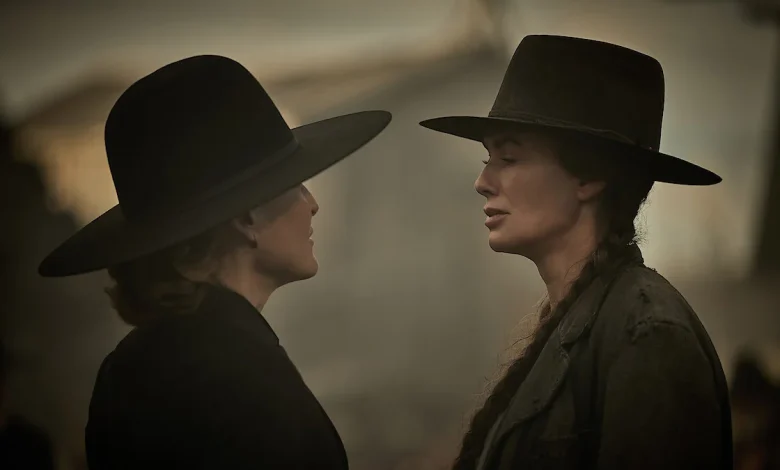
The series’ themes — what makes a family, how far you’d go to protect it, and how to behave morally in a brutal world — are, says executive producer Chris Keyser, the heart of the story, embodied by the feuding matriarchs, Fiona Nolan (Lena Headey) and Constance Van Ness (Gillian Anderson). “They both want to do the same thing,” he tells Tudum. “They want to protect their families, both economically and from a security point of view, [and] keep them safe and fed. Obviously, they have different resources and different positions in the world, but the way they approach the world is so clearly starkly contrasting in a fascinating way. They never intersect.”
After seven episodes of betrayals, secret alliances, shifting loyalties, and escalating violence, the finale brings Fiona and Constance together in a brutal hand-to-hand brawl amid the burning remains of the Van Ness estate. In the final shot of the season, only one woman’s silhouette emerges from the blaze.
Below, we break down the major threads of the Season 1 finale, what they mean for every clan in Angel’s Ridge, and which woman — and in turn, which definition of family — comes out on top.
Has the Van Ness empire collapsed?
Yes, but for how long is unknown. In Episodes 6 and 7, every hidden piece of Constance’s domain comes undone: Her secret militia is exposed and decimated, her alliances fracture, her children scatter, and the house itself — the physical symbol of her power — burns.
Keyser agrees the Van Ness operation is badly damaged. “There’s not much question about it,” he says. “Constance tells us that, right? All of this is very fragile.” But a defining feature of living on the frontier is always teetering on the edge. The mines’ silver is dwindling, which has diminished Constance’s ability to provide for the town and for her family. At the same time, says Keyser, “The things that she does to protect that, the actions she’s taken, put it all at risk in a completely different way.”
So is this the fall of the Van Ness empire, or just the end of one phase? The finale suggests both: The power structure is broken, but Constance may not be finished.
Is Fiona the hero of The Abandons?
As the leader of the have-nots, Fiona is the clear hero in the matchup against Constance — or, at least, she would be in a different show. “For me, what’s interesting about the series is taking a more generous view of Constance than you might think,” says Keyser.
By the finale, Fiona is severely compromised. She has lied, killed, covered up killings, undermined her alliance with the Cayuse, and launched an armed assault on the Van Ness estate. Yet she has also built a family out of abandoned children and repeatedly stood between them and annihilation.
Keyser doesn’t see The Abandons as a story with simple moral categories. “I don’t like stories that have completely obvious villains and completely obvious heroes,” he says. Quoting his favorite line from The Rules of the Game: “The awful thing about life is this: Everybody has their reasons.”
Still, he adds, “[Fiona is] certainly a hero in a sense.” He understands “both points of view, both Constance’s and Fiona’s,” describing the series as “a really interesting conversation that goes on between public responsibility and private rights.” Constance, he says, has “a pretty strong argument that the good of the whole of the community requires some compromise over the land that the Abandons sit on,” while Fiona “stands up for people for whom no one else would take a stand. … She’s created a family out of nothing and taken care of people who needed to be taken care of. She’s defending her right to something that she actually owns. And in that sense, in a very American way, she’s a hero.”
The finale pushes Fiona across multiple moral lines, but as Keyser says, “It would be a very sad, pessimistic world if there was no coming back from that. Particularly for somebody who, in a moment of extreme distress, did things that they might regret later … which is not to say she regrets them, because I’m not sure she does.”
What is The Abandons saying about blood family vs. chosen family?
At the heart of Fiona and Constance’s final confrontation is an argument about whose grief matters more. Constance insists her anguish over losing Willem is unique because he is her son by blood. Fiona counters that her adopted children are no less “real” than any biological ones.
Keyser calls this “the heart of the argument between these two women, apart from the argument about who should own the land.” Constance believes that some family units are more valid than others. Fiona’s answer, Keyser says, is simple: “Those whom I choose to love, I love every bit as deeply and as meaningfully as you do. Maybe more meaningfully.”
The series doesn’t crown a winner. “I don’t think anyone needs to win that argument, whether one is better than the other,” Keyser says. “To try to rank those kinds of families is a foolish, meaningless game. … Love is love.” Historically, though, he notes that in the 1850s, “there’s no question that the world would’ve considered Constance’s family a valid family and would’ve diminished the meaning of the family ties of Fiona’s.” In that sense, the series is both a cautionary tale and a reminder of how definitions of family have expanded in America over time. “It encourages a broader, more generous way of thinking about life,” says Keyser.
How has Dahlia been changed by what happened to her?
By the finale, Dahlia has endured abuse, assault, kidnapping, and brutal treatment at Constance’s hands. She emerges with a new, unnerving steadiness — she hardly flinches when Constance slashes her face.
The transformation has made her newly powerful. “It’s a really complicated process,” says Keyser. “We come to face the fact that the world can be a cruel place. It’s probably particularly cruel for women, it may be particularly cruel for women in a place where the law is only tenuously applied, and she comes to a place where she’s going to defend herself.” But becoming too hard could also be dangerous. “Whether that drives her beyond where we might want her to be, whether she becomes colder and more ruthless, more willing to take no prisoners, all of that — well, time will tell.”
For Keyser, Dahlia’s arc is mixed. “On the one hand, it’s the story of growing up and coming into one’s own and finding one’s power and the ability to protect oneself, and at the same time, [there’s a] coldness … that can only come from understanding truly what cards you might be dealt in life.” The finale leaves her standing at that crossroads.
What happens to Elias and Trisha’s star-crossed romance?
The siege on the Van Ness estate also marks the end of a love story — at least for now. After clandestine nights together and whispered plans for a different life, Trisha discovers that Elias killed Willem and helped hide the truth. Their confrontation in town seems to crush any hope for them as a couple, especially when Elias says, “I love you, but I’d do it again.”
Keyser always saw their relationship in a classical tradition. “It’s old and tried-and-true, right? From Romeo and Juliet,” he says. “You can set any rules you want about who’s on whose side of all of this, but the heart has reasons. And Trisha and Elias feel something that all the other rules of the world cannot deny, and, in the end, that can be very dangerous.” Crossing those invisible lines, he adds, puts them — and both families — at risk: “The world doesn’t treat well people who cross over lines that are dotted instead of solid. … I would say that both of them suffer very much in addition to gaining what[ever] they gain from the love that they find.”
What’s Constance’s motivation in The Abandons?
In the final episode, Constance watches her household turn into a fallen fortress, her staff and allies die for her, and her daughter flees in horror. She imprisons Dahlia, preserves Willem’s corpse, and faces off with Fiona inside a fiery attic.
For Keyser, Constance’s journey is an “extreme example” of the same process that shapes Dahlia. “You run the risk of crossing a line where your behavior no longer is acceptable, and Constance is flirting with that all the way through the series, and then by the end of the season, she clearly steps over that,” he says. “You could call it [madness]. … It is a kind of extreme behavior that might as well be called that, but it’s all the same, right? It’s all about the idea, ‘I will do anything to protect what I have and those that I love,’ and at some point, all guardrails are gone. ‘I will do anything.’ ”
Her obsession isn’t just about ambition or wealth — it’s rooted in loss, survival, and her belief that the prosperity of the town depends on her family’s control of Jasper Hollow. “For this woman to have traveled all the way across the country from whatever relatively protected, privileged life she had with her children, lose her husband, and remain in control enough to run a business, take care of a town, [and] protect her family is a remarkable thing,” Keyser says. “There’s a lot to be said for all of that.” The finale lets us see both the monstrous and the admirable at once.
He also hopes audiences won’t dismiss Constance as a one-note villain. “The argument that she makes, it says you can keep what you have and not make a deal, but without the mine, there is no town. And without the town, there’s no point in you being here. … You still have a responsibility to the community. You are not actually off on your own.”
So who walks out of the fire alive at the end?
The final image of the season — a lone, soot-covered silhouette emerging from the flames as the mansion collapses behind them — is intentionally ambiguous, inviting viewers to debate who survives and what it means for the future. The episode puts Fiona and Constance in a brutal, smoke-choked brawl inside Constance’s home as it starts to cave in around them. Only one figure walks away.
Asked if he knows who survives, Keyser says, “I’m not going to answer that question. … I have a feeling about how it ought to go, but I don’t want to, in any way, tip my hand.”
Yet he teases, “Clearly, one person survives, maybe two people survive, [but] which one that is, and whether it’s one or two — all of those things are up in the air. And that’s the fun.”
The fire at the end of The Abandons isn’t just a cliffhanger about who lives and dies — though it definitely is that. It’s also the moment when everyone’s motivations for their decisions collide — and the war for what kind of family, and what kind of world, blazes on.
The Abandons is now streaming, only on Netflix.