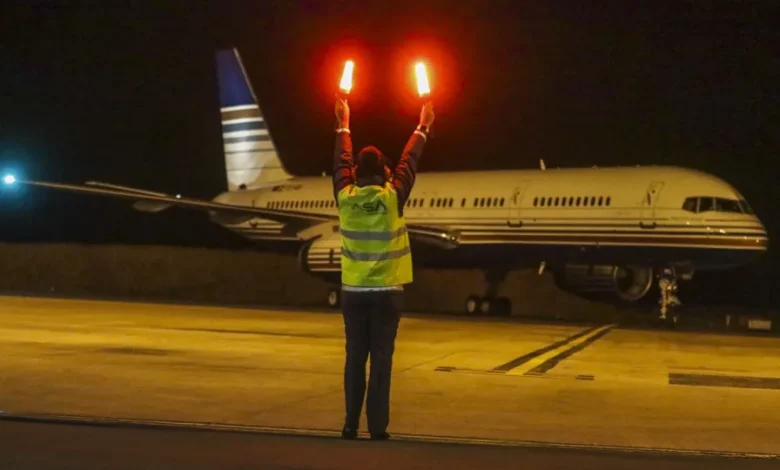
“We canceled because the civil requisition ultimately undermines the objectives of the strike and renders it ineffective, but we will submit a new notice today. We did not want to miss the opportunity to raise public awareness,” stated Maria de Brito, president of the Transport, Communications and Public Administration Union (Sintcap), in reference to a public protest held today at airports.
Although informed on Tuesday about the requisition published in the Official Bulletin, the leader emphasized that the strike could not be called off without holding an important gathering.
Elisângelo Vicente, president of the Cape Verdean Association of Air Traffic Controllers, quoted by Rádio de Cabo Verde (RCV), stated that scheduled staff reported for duty while others participated in the demonstration “to show the public their dissatisfaction.”
“The Government decided to proceed with this requisition, and out of duty, we have to comply,” he stated.
The gathering took place from 07:00 (08:00 in Lisbon) to 10:30 (11:30 in Lisbon) and saw the participation of 33 workers at the international airports of Sal, São Vicente, Boa Vista, and Praia.
The controllers had announced a strike from today until Saturday to demand better working conditions.
The walkout aimed to insist that the public company Airports and Air Security (ASA) pay overtime, meal allowances, and other benefits, as well as provide a professional reclassification.
Meanwhile, the Government justified the civil requisition by stating the strike “jeopardizes movements at national aerodromes and airports, risking national and international air connectivity, and operational safety of overflights in the Sal Flight Information Region (FIR).”
The resolution warned that the strike could cause cancellations, significant delays, and a reduction in air traffic management capacity, incurring financial impacts for operators, additional costs for airlines, and losses for the tourism sector, especially in high-demand periods.
The Government also argued that the inter-island air transport public service, essential for an archipelago country, would be compromised.
While acknowledging the right to strike as fundamental, the Government asserted that its exercise should not jeopardize essential needs, thus justifying the imposition of minimum services.