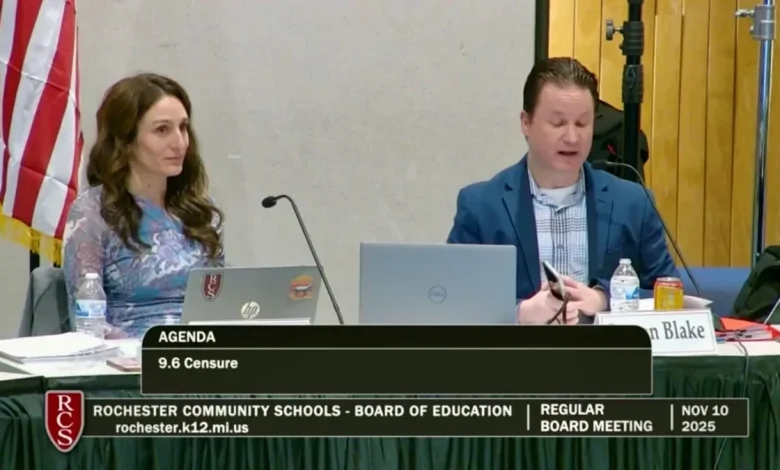
The Rochester Community Schools board will vote on a change to its bylaws on Monday to prohibit individual trustees from requesting documents or information directly from the administration.
Any trustee wanting to know anything not already provided or public, from a budget document to student trend data, will have to seek a consensus of a majority of the board to make the request.
The proposed change is an effort to limit the amount of information requests made of the superintendent, proponents on the board said at the November meeting, particularly aimed at limiting the “voluminous” requests made from one board member.
Trustee Jessica Gupta proposed the change, which the board debated in the first of two required readings at the Nov. 17 board meeting.
“Unfortunately, we have seen existing language which allows for individual trustees to request documents to be an abused privilege, which is wasting valuable staff time district resources and informing a work environment that does not maximize retention of valuable human resources,” Gupta said.
Requiring agreement from the majority of the board, she said, “would allow the board to make an informed collective decision, provide for ample public debate and consensus decisions.”
Other members of the seven-member board showed support, though some admitted it was reluctant.
“I’m not crazy about this change,” Trustee Jayson Blake said, noting he voted against a similar proposed action last year, but that he believed now it was necessary.
“It’s the volume and the detail and the incessant amount of requests that has caused a problem for our staff, for our administration,” he said.
The requests have been coming from Trustee Carol Beth Litkouhi, who has served on the board since 2022. For the superintendent’s recently completed evaluation, Litkouhi said she made 34 requests for documents or sets of data, from HR practices to three years’ worth of data on the number of students requiring academic intervention.
Litkouhi, who also previously sued the district over access to a class curriculum, fought back against the notion that her requests had gone overboard.
“I requested 34 items at that time because it’s a real evaluation, it requires real data,” she said. “The better question I would have is, why weren’t the rest of you guys doing this?”
Litkouhi said the move would prevent members of a minority faction on the board from “preventing independent oversight.”
All trustees would retain their ability to file a records request through the same process available to any member of the public.
Brad Banasik, legal counsel for the Michigan Association of School Boards, said individual board members don’t have a legal authority to request information outside of the public records process.
“An individual board member, they can’t give a directive to the superintendent, they don’t have the authority to do that,” he said.
Banasik said many boards and administrations will have working relationships in which reasonable requests made by one board member will be fulfilled.
“What we tell board members and superintendents is this is a lot about relationships as well,” he said. “If you have a relationship with your board and you’re comfortable knowing that a board member isn’t going to abuse the process of getting information or records from the administration or the superintendent, then there will likely be a back-and-forth process.”
When a board member “crosses the line,” he said, and it takes up a large part of an administrator’s day to fulfill the requests, “I think at some point the board has to say, the board has to be involved here and limit this individual’s requests.”
Boards are required to have bylaws, which dictate the normal processes of the board. Violation of the bylaws could result in a censure, Banasik said. Boards don’t have the power to remove one of their own members. Only the governor can do that.
The Rochester board has already recently censured Litkouhi over another matter, also removing her from her committee assignments. Litkouhi published an op-ed in the Detroit News in October about Oakland County school boards being asked to support putting an “enhancement millage” on a ballot next year, information that had not yet been made public. Litkouhi argued the public had the right to know.
In an interview, Litkouhi, who graduated from Rochester schools, said she recently moved her own children to a neighboring district because they weren’t being challenged enough in Rochester.
“There has been a decline and I think it’s because of some of the complacency that’s going on,” she said.
Litkouhi said ahead of the superintendent’s evaluation, the board president asked all members to submit a list of information or documents they would like to see to help them fill out the evaluation.
“By having the information, it allows you to ask better questions and learn what’s going on,” she said.
Litkouhi said she believed she was providing needed oversight.
“I ran on academic excellence and transparency and accountability,” she said. “And right now the board is not doing their job of providing accountability. They’re doing the exact opposite, actually. They’re tying the hands of the board member trying to provide transparency.”
One colleague sided with her at the November meeting. Trustee Shelley Lauzon said it was “absolutely insane” from a logistical standpoint to require a board vote for a board member to receive information. They only meet every two weeks, she noted, and over the summer, even less than that.
“I kind of feel like it delays the process, especially if it’s existing documents, things that already exist,” she said. “I just don’t understand why we’re giving the board president power over everyone to deem what is important and what is not important.”
Lauzon said the move appeared “very retaliatory against one trustee.”
“I feel like it’s an attempt to silence opposition and by limiting what questions and documents that we, that a trustee can ask,” she said. “Board governance, we should open, encourage transparent communication, and not try to restrict and control it even more than it already is.”
Board President Michelle Bueltel said that wasn’t what was happening, but rather, “these changes are intended to strengthen effective governance.”
“As a board, we set the vision, goal, and direction of the district collectively, not as seven individuals operating independently,” Bueltel said. “When individual trustees make frequent or wide-ranging document requests without board direction, it diverts administration away from their day-to-day responsibilities, creates a reactive Whack-a-Mole environment, and can significantly strain staff time.”
Bueltel, who called Litkouhi’s requests “voluminous,” said the change will make sure “information flow is coordinated, purposeful and tied to our shared priorities.”
“It reinforces that oversight is a board responsibility, not an individual one, and ensures that information flow remains purposeful, coordinated and aligned with our strategic work on behalf of our students,” she said.
The board will meet at 6 p.m. Monday at the Rochester Early Childhood Education Center, 3838 N. Rochester Road, Oakland Twp.
jpignolet@detroitnews.com