Bobby Hurley on motivating ASU’s defense against NAU
Bobby Hurley gave his team a max score mandate to his team and they met it, though it came down to the last possession.
- A former ASU associate athletic director is suing the university, claiming he was fired for reporting sexual harassment claims against a wealthy donor.
- The university argues the former employee was fired for performance issues and insubordination.
- ASU eventually investigated the donor, confirmed the harassment occurred, and banned him from university events.
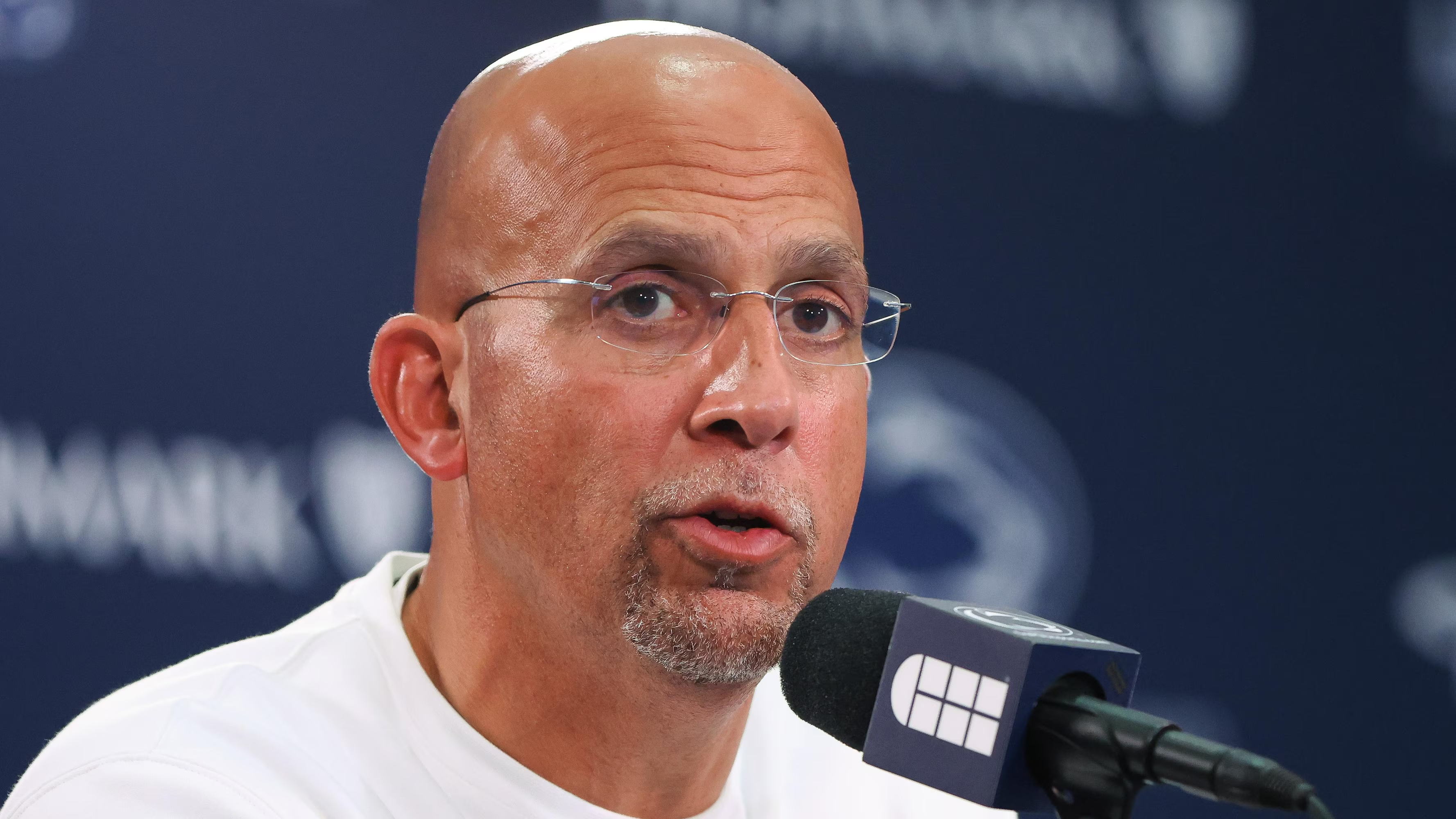
ASU men’s basketball coach Bobby Hurley said he was shocked that former Athletics Director Ray Anderson didn’t take immediate action after he was told a wealthy athletics donor had sexually harassed Hurley’s wife.
Hurley testified on the final day of a seven-day trial in a lawsuit brought by a former associate athletic director who contends he was fired in retaliation for reporting claims about harassment by the donor against several women. Hurley told jurors he thought Anderson downplayed the claims.
They were reported to Anderson by David Cohen, the former associate athletic director and ticketing manager who is suing over his termination. The university argues that Cohen was fired for performance issues and insubordination in a trial that has led to high-profile university leaders, including President Michael Crow, taking the witness stand.
At a basketball game in March 2019, Cohen was told by his then-wife, Kathy Cohen, that influential donor Bart Wear had touched her waist and her breasts. Other women, including Bobby Hurley’s wife, Leslie Hurley, told Cohen that they also had uncomfortable interactions with Wear.
Cohen said in earlier testimony that Hurley’s wife had told him that Ware was repeatedly inappropriate, but did not go into details of what happened.
Leslie Hurley had asked Cohen not to say anything about the incidents until after the basketball season ended, Hurley said in court.
“They didn’t want my mind clouded, and they knew that I would be very upset when I heard about it,” he said.
Cohen told Hurley about 10 days later, and also informed Anderson.
“It was a very difficult conversation,” Hurley said.
Hurley told the jury that he was frustrated when he learned in May 2019 no action had been taken.
ASU launched an investigation months later, in August 2019.
Hurley testified that he called Anderson after Wear showed up at a basketball game in December of that year. Anderson downplayed the sexual harassment on a phone, Hurley said, calling it a two or three on a scale of one to 10.
Anderson, who resigned as athletics director in 2023 and is now a professor at the university’s law school, took the stand and disputed Hurley’s version of the conversation.
“I said, ‘When there are offenses, people rate it on various levels. It could be a two, three, all the way up to a 10. Neither you know nor I know what the investigation found in terms of the level of allegation,’” Anderson said.
He said he told Hurley they would have to wait for the investigation to conclude before they could make any sexual harassment claims about Wear.
“He didn’t like that answer,” Anderson said.
Job changes, new manager lead to claims of retaliation
Cohen’s attorney, Jeffrey Feasby, claimed during closing arguments that Cohen did everything right and was ultimately fired for it.
Feasby argued Cohen followed the chain of command by reporting Wear’s actions to Anderson, his direct supervisor, and that university leaders, including President Michael Crow and Chief Human Resources Officer Kevin Salcido, agreed that reporting to Anderson was sufficient.
Anderson had said he would talk with Wear and handle the situation, according to Cohen’s testimony.
But after inaction from Anderson and the school, Cohen pushed the issue, and Anderson became upset, Feasby said.
“Mr. Anderson didn’t handle it. He never spoke with Bart Wear. Mr. Anderson himself testified that was a mistake. And he also testified that he never reported it to anyone, which was also a mistake,” Feasby said. “These mistakes ultimately cost Cohen his job.”
Months later, Cohen said, his duties changed. He lost oversight of the swimming and diving programs and was reassigned to a new manager.
Cohen asked Anderson at an August 2019 meeting if these changes were connected to reporting Wear. Anderson denied it and became infuriated, Cohen testified.
“Mr. Anderson had no intention of speaking with Mr. Wear, and he was only interested in Mr. Wear’s money,” Feasby told the jury.
Anderson testified that he fired Cohen days later. Cohen was actually placed on leave, however, and officially terminated in December 2019. After the August meeting with Anderson, Cohen told a university human resources official about the harassment claims, which launched the investigation.
Cohen later filed suit against Anderson and the Arizona Board of Regents, which governs public universities in the state. Cohen claimed that he was unable to find a job in the sports field since his termination, a problem he never had before ASU.
ASU’s investigation into the harassment allegations ultimately confirmed that sexual harassment incidents occurred but that the investigation “did not support a finding of retaliation in response to a report of that harassment.”
ASU said in a previous statement that the university “canceled the donor’s season tickets and informed him he is no longer welcome at university events, and he has otherwise dissociated himself from the university and related entities that support athletics.”
University’s attorney focuses on relationship with ticket vendor
Robert McKirgan, attorney for Anderson and the Arizona Board of Regents, presented the case in three simple questions during his closing comments. Was what Cohen did when he reported the harassment to Anderson a legally protected act? Did Cohen face retaliation? And did Cohen face retaliation because of a legally protected action?
McKirgan claimed that Cohen was required to report the harassment to the Dean of Students Office, the Office of Equity and Inclusion, or the Title IX coordinator, which protects all people involved with the university from sexual harassment or discrimination.
When Cohen failed to report to any of those offices, he violated the school’s policy and thus was not under Title IX protection, McKirgan argued.
McKirgan argued Cohen was not fired in retaliation but for other reasons, including what he described as Cohen’s unsavory relationship with ticket broker Vivid Seats, which buys discounted tickets from ASU and resells them.
Cohen had received a $690,000 check from the company a few years prior to the harassment report and initially deposited it into his personal account, he testified. He said it was sent to him by mistake and that he returned the full amount a few months later. Records were presented to the jury to confirm the funds were returned.
But McKirgan told jurors the timeline was inconsistent: Cohen deposited the check Feb. 15, 2017, transferred it into an account for his private company, and later moved it into an investment account.
“He then, a few months later, for whatever reason, perhaps because ASU was investigating his relationship with Vivid Seats, sent the money back,” he said.
Cohen went through these transactions without ever telling ASU, McKirgan said.
“Why didn’t he just rip up the check? Why didn’t he just put it in his wallet and take it into the office?” McKirgan asked the jury. “He has no answer for any of those questions.”
ASU didn’t know about the check until after Cohen was placed on leave, according to testimony.
Earlier testimony focused on a June 2019 performance review in which, Anderson said, Cohen became upset over a reduced bonus. Anderson said he increased the bonus after Cohen pleaded his case but removed swimming and diving duties so Cohen could focus on ticket sales.
They also moved him to another manager in August 2019, McKirgan said.
This move was not a demotion or a reprimand, McKirgan claimed. It couldn’t be, because the contract that Cohen was under specifically said that Anderson could assign Cohen to report to anyone he chose.
Cohen complained that the actions were done out of retaliation and that he expressed concern about working for a different manager, Anderson testified.
Anderson said Cohen was insubordinate because he complained about being moved to a new manager.
The issue for the jury is not whether Anderson fulfilled his duty to report; the issue is why Cohen was terminated, McKirgan said.
If Cohen was retaliated against for the reporting, he would have been fired much earlier, and Anderson certainly wouldn’t have given him an extra $25,000 during his bonus review months earlier, he said.
“Dave Cohen got fired because he was insubordinate on Aug. 12th,” he said. “Dave Cohen had been given first, second, third, fourth chances. Mr. Anderson had had enough.”
The case was sent to the jury to begin deliberations.