‘Avatar: Fire and Ash’ Review: For the First Time in His Spectacular Career, James Cameron Delivers a Movie That Feels Like Something You’ve Seen Before

Even after all this time, the simple fact of it still boggles my mind: Every single film James Cameron has made over the last 40 years represents some kind of evolutionary paradigm shift for blockbuster cinema.
“The Abyss” gave us the first “photorealistic” computer-generated character, while “Terminator 2” pioneered advanced morphing effects and the far more extensive use of CGI. “Titanic” seamlessly blended digital assets with large-scale practical sets in order to create what’s still the most transportive disaster movie ever made, while “Avatar” and 2022’s “The Way of Water” took performance-capture technology to such extraordinary new heights — and depths — that it feels like the rest of Hollywood is lagging several generations behind. Hell, even “True Lies” could be considered a game-changer for its innovative composite work and next-gen approach to cartoonishly virulent anti-Arab racism (9/11 was still almost a decade away, but Big Jim has always been ahead of the curve!).
Which is all to say how bizarre it is to watch a James Cameron new movie that feels like something you’ve already seen before. That notion seemed like a distinct possibility when it was first announced that he was going to be directing four “Avatar” sequels, but it didn’t prepare me for the reality of watching one of cinema’s greatest explorers walk in circles for three hours, even if Cameron — being Cameron — naturally finds a way to make that journey feel novel and invigorating at times.
But “Avatar: Fire and Ash” isn’t just more of the same, it’s also a significant amount less.
Not only does the third installment of the “Avatar” saga lack the unprecedented spectacle of its predecessors (the second of which was somehow even more jaw-dropping than the first), it also lacks the relative newness of their storytelling. Whereas the first movie effectively camouflaged its cliches amid the uncharted planet of Pandora, and the second extrapolated the franchise’s settler-adoption space fantasy into a hyper-emotive aquatic fable about the destructive nature of humanity’s survival instinct, “Fire and Ash” largely devotes itself to sifting through the ruins of a world that Cameron seems half-ready to leave behind and sitting with the fallout of the series’ previous battles. That wouldn’t be a weakness in and of itself, but his archetypical characters weren’t built to carry a “Lawrence of Arabia”-sized epic that hinges on the nuances of their love, grief, and neuroses. Spider doesn’t even have a shirt, let alone the layers required for us to care about his daddy issues.
At heart, “Fire and Ash” is a story about how people, in the broadest sense of the word, reconstitute themselves in the aftermath of war and its attendant losses. In other words, the first “Avatar” film that fails to meaningfully iterate on the premise of its franchise’s is ironically preoccupied with our power to change, a tension that Cameron struggles to resolve — and indeed makes a fair bit worse — by repeating so many of the same action beats from “The Way of Water.”
As might be expected of a movie that was initially conceived as the second half of the previous one (and could easily have been marketed as “The Way of Water Part II” had it been finished in time for Christmas 2023), “Fire and Ash” picks up where the first “Avatar” sequel left off. Jake Sully’s family — or what’s left of it — continue to mourn the cost of their latest and most devastating skirmish with the colonist forces of the Resources Development Administration, in which Jake’s son Neteyam was killed by the colonist “Sky People.”
Still embedded with the Metkayina Clan in the turquoise reefs of Pandora, the Sullys each embrace their own forms of grief. Jake (Sam Worthington), who was a Marine before his consciousness was transferred into the body of a giant blue alien, retreats into a mission-oriented state of mind, while his wife Neytiri (Zoe Saldaña) seethes at the dreadlocked white human child their family has raised as one of their own (Jack Champion), in no small part because Spider’s father is the evil “recombinant” who murdered Neteyam (Stephen Lang as Colonel Miles Quaritch, both men having the time of their lives as a towering extra-terrestrial horndog).
Now the eldest of the Sully kids, Lo’ak (Britain Dalton) sulks with survivor’s guilt, while teenage adoptee Kiri (Sigourney Weaver) questions her seemingly immaculate conception while deepening her connection to the all-knowing nature goddess Eywa. Jake and Neytiri’s biological daughter Tuktirey (Trinity Bliss) is also there, a fact that Cameron seems to be remembering in real-time whenever she finds her way into the frame. But it’s Spider who’s firmly at the center of the action here, as his inability to breathe the Pandoran air without a mask compels Jake and his family to escort him back to the safety of the High Camp, where all of our human scientist friends from the first “Avatar” are still going strong.
While that decision effectively amounts to the Sully clan losing another son (Kiri is extra upset about it, as she empathizes with Spider’s outsider status), Jake rationalizes it as a necessary sacrifice to heal the cracks in his family — a family that he’s always likened to a fortress. Alas, as anyone who’s ever played a JRPG might expect of a journey aboard a massive flying galleon, the Sullys’ convoy is attacked in the sky, and their family is scattered into a small handful of different factions that spend the rest of the movie trying to reunite. The ambush is delivered courtesy of the Mangkwan Clan, a cult of kamikaze hedonists who rejected Eywa after a volcano reduced their corner of Pandora to ash, but the RDA is happy to seize on the chaos and launch their final attack on the Metkayina’s oceanic stronghold.
The plot thickens from there, especially once the RDA finds evidence that humans might be able to breathe on Pandora after all (a discovery which could make the planet a viable new home for our species), but Cameron would much rather move the franchise inward than forward. That’s an admirable decision on its face, and while it’s hard not to be severely disappointed by the pat and self-evident answers we’re given to the franchise’s most intriguing mysteries, I can’t help but support Cameron’s willingness to yada yada yada over pieces of lore as soon as they’ve fulfilled their character-driven function (Eywa is a conveniently unknowable scapegoat, and returning co-writers Rick Jaffa and Amanda Silver are happy to take full advantage of that).
The problem is that these characters are seldom as intriguing as the mythology that Cameron has used to contextualize them, and — like Spider without a mask on — they begin to suffocate the moment they’re forced to survive on their own. Weird and wonderful as it will always be to watch Sigourney Weaver so believably inhabit the body of a teenage alien, “Fire and Ash” has nothing of substance to add to Kiri’s vision quest. The same could be said about the strained relationship between Lo’ak and Jake, or the franchise’s continued fixation on stress-testing the limitations of found family, to which it applies more pressure than ever when Quaritch issues a “give us Spider and we’ll stop trying to kill all the Na’vi” ultimatum.
‘Avatar: Fire and Ash’
And speaking of Spider, no other character so epitomizes how “Fire and Ash” spends most of its time belaboring the aspects from the previous movie that worked so well in small doses. As a glorified bargaining chip in “The Way of Water,” Jack Champion’s interstellar army brat was a goofy manifestation of Cameron’s most wooden instincts as a writer, his stunted manchild energy a harmless throwback to earlier kid heroes like Rebecca Jorden and John Connor.
As a — or maybe even the — central figure in this new installment, Spider is basically a surfer-coded Jar Jar Binks. Even if you, like me, find Cameron’s Reagan-era bro-speak to be more of a feature than a bug, and even if you, like me, are predisposed to laugh at the part in “Fire and Ash” where Spider guilelessly rocks up next to a 22nd century space whale and shouts, “You’re the man, Payakan!,” you might struggle to lock into the later and more harrowing scene where Jake Sully threatens to sacrifice his adopted son to the gods.
Also, it brings me no pleasure to report that Payakan is very much not the man anymore, as the exiled Tulkan, used with precision to unlock oceans of feeling in “The Way of Water,” is wasted here on an enervating “courtroom” subplot that entrusts far too much of this movie to the power of Papyrus subtitles. Like so much of “Fire and Ash,” Payakan’s urgent plea for his species to abandon their pacifist ways and fight back against the Sky People keys into Cameron’s all too relevant fascination with the various ways that communities reconfigure themselves in response to annihilation. Complicating his tendency to valorize Jake Sully’s willingness to realign his allegiances in the face of lived experience, and to vilify Quaritch for continuing to other the Na’vi even after essentially becoming one of them himself, Cameron defines the Mangkwan Clan by how radically they altered their principles in response to the catastrophe that destroyed their home. The “Ash People” don’t respect the balance that Eywa demands between ethos and elasticity, and so our heroes must fight them to the death.
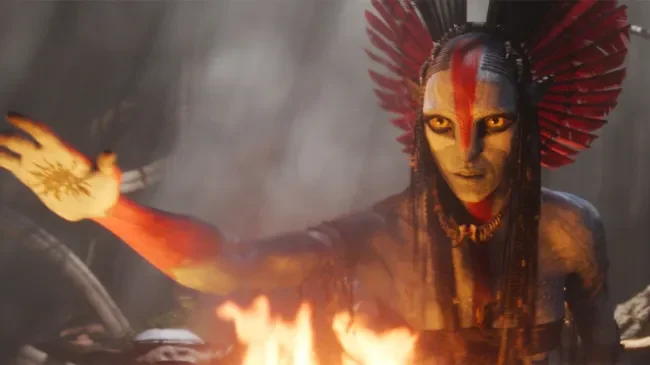
The Mangkwan Clan are one of the only new elements introduced in “Fire and Ash,” and are unsurprisingly responsible for all of the most exciting elements of the movie. Chief among those elements, and chief among the Mangkwan themselves, is a sky-scraping cosmic domme by the name of Varang (Oona Chaplin, going all out), who erupts into this movie with a head full of fire and a power kink that literally brings Quaritch to his knees. An embittered warrior shaman who dresses like an enraged Dilophosaurus and gets off on using her neural queue to force other Na’vi to serve her commands (the sexual imagery here will ripple across Tumblr for decades to come), Varang is both an interesting challenge to Jake’s Eywa-loving family and an incredible foil for Quaritch’s ongoing adventures in cross-species hybridization.
Cameron might ignore the fact that Quaritch is basically an immortal being who wouldn’t remember any of this stuff if he died again, but he sure has fun with the fact that Varang introduces the character to a degree of mutability that Quaritch never allowed before. There’s more than a little whiff of Colonel Steven J. Lockjaw to how fast a fascist like Quaritch admits to fetishizing the same population he exists to destroy, and Lang — like Sean Penn — takes giddy advantage of the opportunity this movie gives him to play around with that. The extent to which getting freaky with Varang does, and does not, change who Quaritch is at heart represents the most gripping and detailed character work that “Fire and Ash” has to offer, even if those nuances feel like a distant memory by the time Cameron devotes the story’s final act to a dull rerun of the big battle from “The Way of Water.”
Which unavoidably brings us to the ultimate sin of this movie, which is that “Fire and Ash,” as a blockbuster spectacle, fails to meet the unreasonably high standard that James Cameron has set for himself — the unreasonably high standard by which he demands to be judged.
The action is clean, massive, and staged at a level several cuts above Hollywood’s usual CGI slopfests, but only the “Mad Max”-like introduction of the Mangkwan raiders sparks the same visceral excitement that made the last acts of the previous two movies so indelible. There isn’t a single beat here that hits with the same fist-pumping force of the Na’vi shooting giant arrows at the RDA forces in mid-air, or Payakan ripping the arm off one of the bad guys who’s come to attack the reef. In fact, that same guy is back for seconds, and — in a failing that feels unprecedented in the history of Cameron’s filmography — his inevitable demise lands with a half-hearted whimper. So too does everything else in the grand finale, which smacks of obligation where even the least ambitious setpieces in his previous films were drunk with opportunity.
There are certainly things to see here (the Wind Traders’ air ship is a majestic vision of floating tentacles, and the sight of Edie Falco operating an “Aliens”-like mechanical exoskeleton is… something), and even the worst “Avatar” movie makes for an undeniable argument on behalf of the theatrical experience (though my patience for high frame rates is at an all-time low). But this one shrugs its way to the finish line with a sense that it doesn’t excite its creator in the same way that it used to — that Cameron needs the novelty this film is missing even more than we do.
I know that Cameron has committed himself to another two sequels, and now I know why he’s starting to hedge about whether or not he wants to direct them himself; even the most orgiastic moments in “Fire and Ash” left me feeling like he’s ready to come back down to Earth.
Grade: B-
20th Century Studios will release “Avatar: Fire and Ash” in theaters on Friday, December 19.
Want to stay up to date on IndieWire’s film reviews and critical thoughts? Subscribe here to our newly launched newsletter, In Review by David Ehrlich, in which our Chief Film Critic and Head Reviews Editor rounds up the best new reviews and streaming picks along with some exclusive musings — all only available to subscribers.